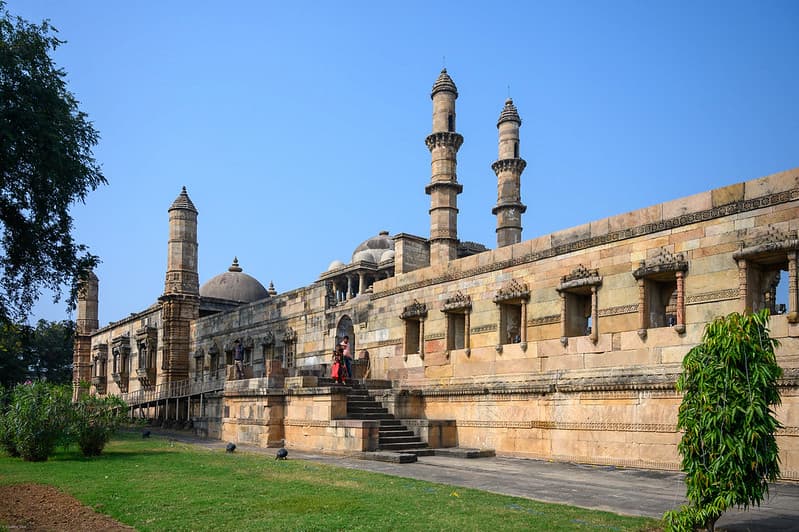
The Champaner-Pavagadh Archaeological Park in Gujarat, INDIA, is a sprawling historical landscape where time seems to have stood still. It is a rare “living” heritage site that blends ancient Hindu-Jain traditions with the refined aesthetics of a 16th-century Islamic capital.
The park is centered around the massive Pavagadh Hill, a volcanic formation rising 800m above the plains. The site is a vertical timeline of human history, stretching from the prehistoric Chalcolithic period to the medieval era.
- The Hill (Pavagadh): Crowned by ancient fortifications and the sacred Kalika Mata Temple, the hill was once a formidable Hindu fortress under the Solanki and Khichi Chauhan Rajputs.
- The City (Champaner): Located at the base of the hill, this was the short-lived capital of the Gujarat Sultanate under Sultan Mahmud Begada. It is the only complete, unexcavated pre-Mughal Islamic city remaining in India today.
- Architectural Features: The park contains over 100 identified monuments, including residential precincts, military fortifications, palaces, and sophisticated water-harvesting systems like stepwells (vavs) and tanks.
Attraction
What draws travelers from across the globe to this remote corner of Gujarat?
- Spiritual Magnetism: The Kalika Mata Temple is one of the “Shakti Peeths” (sacred seats of the Goddess) and attracts millions of pilgrims annually, especially during the Navratri festival.
- Architectural “Missing Link”: For history buffs, the site represents the transition between Hindu and Islamic architectural styles, a precursor to the grandeur of the Mughal Empire.
- Adventure and Nature: Visitors can choose between a strenuous 2,000-step trek to the summit or a scenic cable car ride that offers sweeping views of the surrounding teak forests and ruins.
- The “Lost City” Vibe: Because much of the city remains unexcavated and hidden beneath vegetation, exploring the outskirts feels like a genuine archaeological expedition.

World Heritage
UNESCO inscribed Champaner-Pavagadh in 2004 based on its unique historical and technical significance:
- Criterion (iii): It provides an exceptional testimony to a disappeared civilization—the regional Sultanate of Gujarat—which flourished briefly before its capital was abandoned.
- Criterion (iv): The Jama Masjid (Great Mosque) serves as a masterpiece of “Indo-Saracenic” architecture, blending Hindu craftsmanship with Islamic structural forms.
- Criterion (v) & (vi): It is an outstanding example of a human settlement perfectly integrated with its topography and remains a vital place of continuous pilgrimage.
Gateway
The primary gateway to the park is the city of Vadodara, located approximately 50km (31 miles) to the southwest.
- Commercial Airport: Vadodara Airport (BDQ) handles frequent daily flights from major Indian hubs like Delhi and Mumbai.
- Lodging: As a major industrial and cultural hub, Vadodara offers a vast range of accommodations, from luxury stays like the Welcomhotel by ITC to boutique heritage properties and reliable business hotels.
- Logistics: The drive from Vadodara to Champaner takes about 60 to 90 minutes via well-maintained roads.
When
- October to February (Best Time): The weather is pleasant and dry, with temperatures ranging from 12°C to 29°C. This is ideal for climbing the hill and exploring the sun-exposed ruins.
- Monsoon (July to September): The landscape turns a brilliant emerald green, and the hill is often shrouded in mist. However, the stone steps can become very slippery.
- Avoid Summer (March to June): Temperatures frequently soar above 40°C, making outdoor exploration physically punishing.
Consideration
- Physical Fitness: Exploring the hill requires significant walking. Even if you take the cable car, there is still a final climb to reach the Kalika Mata Temple.
- Hydration and Supplies: There are limited food and beverage stalls inside the main archaeological zones. Carry ample water and snacks.
- Dress Code: As the hilltop is a sacred pilgrimage site, modest clothing is required to enter the temples.
- Monkeys: The hill is home to many bold macaques. Keep your belongings secure and avoid carrying open food.
- Early Start: The park is vast. Arriving at the ticket counter by 8:30 AM ensures you can see the main mosques in the morning before the afternoon heat sets in.

Resources
- UNESCO World Heritage Centre – The official dossier on the site’s global significance and protected zones.
- Archaeological Survey of India (ASI) – Information on entry fees, ticketed monuments, and visiting hours.
- Gujarat Tourism – Local travel guides, itineraries, and transport details.
- Holidify: Champaner Travel Guide – A comprehensive breakdown of individual mosques and local tips.
- Booking.com – Use this platform to book your stay in Vadodara, ranging from budget guesthouses to 5-star hotels.


Comments:
Leave a Reply