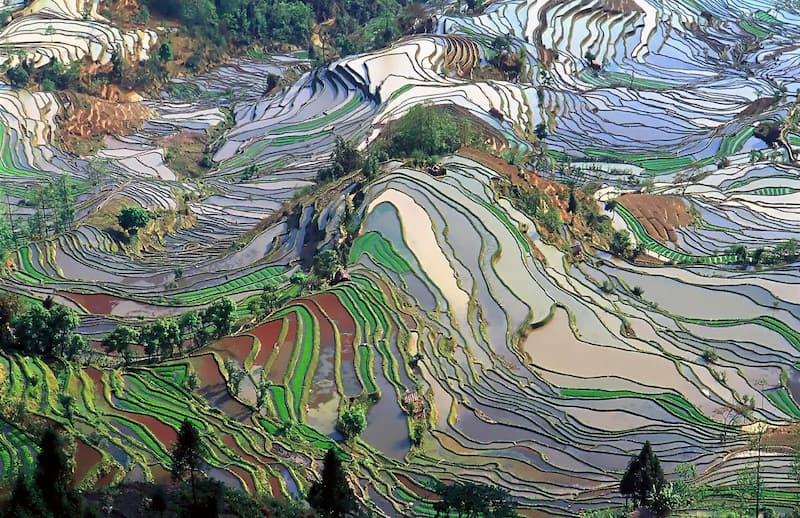
The Cultural Landscape of Honghe Hani Rice Terraces in southern Yunnan, CHINA, is a masterwork of “ecological engineering” that has sustained a civilization for over 1,300 years. Carved into the steep slopes of the Ailao Mountains, it is a living monument to the Hani people’s resilience and their profound understanding of mountain hydrology.
The site spans approximately 16,603 hectares and is defined by a unique “four-fold” integrated system that manages the mountain environment from peak to valley:
- Forests: The mountaintops are capped with dense forests that act as natural reservoirs, catching rainfall and recharging ground springs.
- Water System: A complex network of hand-dug canals and ditches channels water from the forests down through the villages and into the terraces.
- Villages: Positioned on the mid-slopes, the Hani villages feature iconic “mushroom houses”—structures with rammed-earth walls and thatched, cone-shaped roofs designed to shed heavy rain and blend into the misty landscape.
- Terraces: Thousands of narrow, flooded steps cascade down the slopes. Here, the Hani cultivate red rice alongside an integrated ecosystem of fish, ducks, and eels that fertilize the soil and control pests.
Attraction
The Hani Terraces are a pilgrimage site for landscape photographers and travelers seeking “slow” culture.
- The Mirror Effect: During the winter and spring (the irrigation season), the terraces are filled with water but have no crops. This transforms the mountainsides into thousands of shattered mirrors that reflect the sky, shifting from violet at dawn to fiery gold at sunset.
- Sea of Clouds: Due to the subtropical moisture and high altitude, the valleys often fill with a thick “sea of clouds” in the morning, leaving the village rooftops and terrace rims floating like islands in a white ocean.
- Living Heritage: Unlike many heritage sites that feel like museums, this is an active agricultural community where traditional festivals, ethnic costumes, and communal labor are still the daily reality.

World Heritage
UNESCO inscribed the site in 2013 because it represents an exceptional harmony between humans and nature.
- Resilient Land Management: It is a rare example of a traditional agricultural system that has remained stable and productive for over a millennium without damaging the local ecology.
- Social & Religious Continuity: The maintenance of the terraces is governed by a long-standing social structure and spiritual beliefs that prioritize the “sacredness of nature” and communal responsibility for water sharing.
- Gandhara Influence: The architectural and artistic blend represents a unique cultural exchange along the ancient southern Silk Road.
Gateway
The primary gateway to the Hani Rice Terraces is the city of Mengzi, the capital of Honghe Prefecture.
- Commercial Airport: Honghe Mengzi Airport (HMZ). This recently opened facility provides direct commercial flights from major hubs like Kunming and Chengdu, drastically reducing travel time compared to the traditional 7-hour bus ride from Kunming.
- Lodging: As a prefecture-level capital, Mengzi offers high-capacity, modern lodging. Notable options include the Jinhua Hotel and the ADS Grand Hotel, both of which provide international-standard amenities suitable for an overnight stay before heading into the rural terrace districts.
- Logistics: From Mengzi, the core terrace areas in Yuanyang are approximately a 1.5 to 2-hour drive away via well-maintained roads.
When
- The Photography Peak (December to March): This is the “flooded” season. The terraces are clear of rice plants and filled with water, creating the most dramatic reflections.
- The Green Season (May to July): The terraces are lush and vibrant as the young rice grows.
- The Golden Harvest (September to October): The hills turn brilliant gold just before the harvest, and the Hani New Year festivals often take place around this time.
Consideration
- Visibility Issues: The very fog that creates beautiful “sea of clouds” photos can also completely obscure the view for days. Patience is key; it is best to stay at least 3 days to ensure at least one clear window.
- Physical Demands: Exploring the viewpoints (like Bada or Duoyishu) involves navigating steep, often slippery stone steps. Sturdy, waterproof hiking boots are highly recommended.
- Cash is King: While mobile payments (Alipay/WeChat) are common in Mengzi, smaller guesthouses and local markets in the terrace villages often prefer cash.
- Temperature Swings: High-altitude mountain weather is unpredictable. Even in summer, nights can be chilly, and the damp mist makes the air feel colder than the thermometer suggests.
- Respect the Farmers: Avoid walking on the narrow terrace rims (the “bunds”) unless you are on a designated path, as these are fragile and critical to the water-holding capacity of the fields.

Resources
- UNESCO World Heritage Centre – The definitive source for the site’s historical and technical documentation.
- China Discovery – A highly detailed travel portal with current maps and transport logistics for the Yuanyang region.
- WildChina – A specialized travel agency focusing on high-end, sustainable cultural immersion in the Hani region.
- Yaso Trip – A practical guide covering local festivals, entry fees, and scenic area opening times.
- Trip.com – A commercial platform for user reviews of local guesthouses and tour bookings.
Featured Image
Honghe Hani rice terrace (Jialiang Gao, Wikimedia/CC BY-SA 3.0).
News Feed
Advertisement


Comments:
Leave a Reply