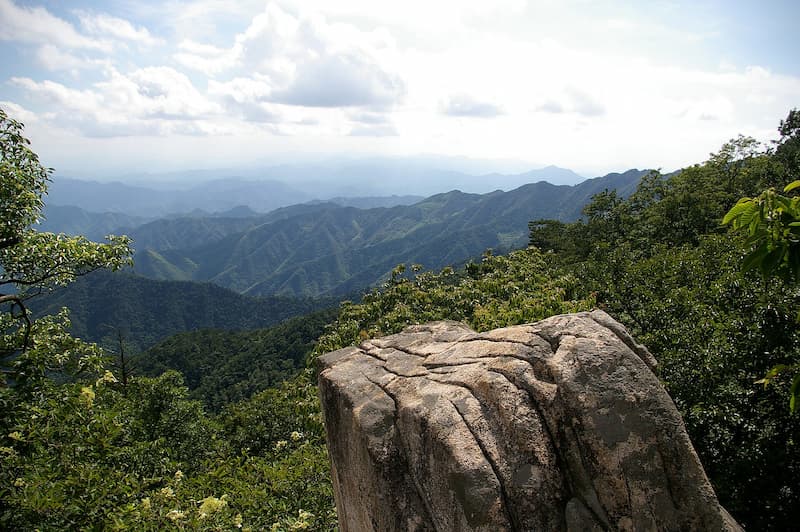
Tianmushan preserves Earth’s oldest wild ginkgo groves in Zhejiang
“Tianmushan” (Tianmushan Biosphere Reserve, also expanded and linked with Qingliangfeng as the Tianmushan–Qingliangfeng Biosphere Reserve) is a forested mountainous landscape spanning 54,730 hectares in Lin’an District, Hangzhou, in northwestern Zhejiang Province in eastern CHINA. Situated roughly 80 kilometers west of central Hangzhou and 230 kilometers southwest of Shanghai, its name—”Heavenly Eye Mountain”—comes from twin clear ponds crowning its eastern and western summits.
Known as the “Kingdom of Big Trees,” Tianmushan preserves a complete vertical vegetation spectrum from subtropical evergreen broad-leaved forests at lower elevations to deciduous and coniferous montane forests higher up. Its rugged granite and volcanic slopes protect ancient primeval groves—including the world’s oldest wild Ginkgo biloba communities, giant Japanese cedars (Cryptomeria fortunei), and rare wild Tianmu ironwood (Ostrya rehderiana)—alongside over 2,000 years of Taoist, Buddhist, and Confucian heritage.
Attraction
Tianmushan attracts botanists, hikers, wellness travelers, and cultural visitors globally who want cool forested mountain retreats, ancient monumental trees, and tranquil temple heritage within easy reach of the Yangtze River Delta.
Visitors hike shaded stone trails beneath centuries-old Japanese cedars and ginkgos, ascend toward Simian Peak and the Immortal Peak summit to view seas of clouds at sunrise, and visit historic Chanyuan Temple. Travelers also explore waterfalls, clear mountain streams, and bamboo groves, experience summer escapes from lowland heat, tour the Lin’an Ecological Research Institute’s interactive exhibitions, and stay in scenic mountain guesthouses in Lin’an.
Biosphere Reserve
Designated in 1996 under UNESCO’s Man and the Biosphere (MAB) Programme as Zhejiang Province’s first UNESCO Biosphere Reserve, Tianmushan is recognized for safeguarding extraordinary relict flora alongside centuries-old traditions of human-nature harmony:
- Global Botanical Gene Bank and Relict Forests: Located at a biogeographical crossroads between northern and southern Chinese floras, the reserve protects over 10,462 recorded species, numerous type specimens, the oldest wild ginkgo populations on Earth, and endangered endemic trees.
- Cultural Conservation and Sustainable Agroforestry: Protected historically through Buddhist, Taoist, and Confucian stewardship, the reserve integrates strict core forest conservation with sustainable bamboo, tea (Camellia sinensis), mulberry, and medicinal plant cultivation across surrounding communities.
Gateway
Travelers planning a visit to Tianmushan Biosphere Reserve can enter via three proximate eastern Chinese aviation hubs—each verified in IATA’s official directory and offering extensive overnight lodging, expressway or high-speed rail connections, and local tour guides:
- Hangzhou (Primary Local & International Gateway / Nearest Major Airport Hub):
- Airport: Hangzhou Xiaoshan International Airport (IATA Code: HGH; ICAO Code: ZSHC).
- Infrastructure and Distance: Located roughly 105 to 120 kilometers (about 1.5 to 2 hours by road via the Hang-Hui Expressway, or roughly 2 hours combining Hangzhou Metro Line 16 to Lin’an with local road transfers) east of Tianmushan. HGH is a major active public international airport indexed in IATA’s directory, while Hangzhou and Lin’an District provide abundant hotels, mountain homestays, car rentals, metro and bus networks, and licensed local guides.
- Huangshan / Tunxi (Primary Western Anhui Gateway):
- Airport: Huangshan Tunxi International Airport (IATA Code: TXN; ICAO Code: ZSTX).
- Infrastructure and Distance: Located in southern Anhui Province, roughly 135 to 155 kilometers (about 2 to 2.5 hours by road via the Hang-Rui Expressway) west of Tianmushan. TXN is an active public international airport listed in IATA’s directory, backed by city hotels, high-speed rail connections, car rentals, and regional nature tour operators.
- Yiwu (Primary Southern Zhejiang Commercial Gateway):
- Airport: Yiwu Airport (IATA Code: YIW; ICAO Code: ZSYW).
- Infrastructure and Distance: Located in central Zhejiang, roughly 155 to 175 kilometers (about 2 to 2.5 hours by road via expressway links through Hangzhou) south of Tianmushan. YIW is an active public airport indexed in IATA’s directory, supported by extensive hotels, high-speed rail links to Hangzhou, and private transfer options.
When
The ideal window to visit Tianmushan is from Late Spring to Autumn (April to November):
- Spring, Summer, and Autumn (April to November): Recommended for forest trekking, temple visits, and cloud-sea viewpoints, offering fresh spring blooms in April and May, cool forested summer temperatures around 20°C to 26°C (68°F to 79°F) from June to August, and golden ginkgo and maple foliage in October and November.
- Winter (December to March): Brings crisp mountain air, frost, and occasional snow along higher ridges—creating dramatic winter scenery while requiring extra caution on icy stone steps.
Consideration
- Plan Trail Ascents and Shuttle Bus Hours: The main scenic loop climbs steep stone stairways across roughly 6 to 8 kilometers; many visitors hike upward and take the scenic area shuttle bus down, noting that park admission typically closes around 2:00 PM and last downhill shuttles depart mid-afternoon.
- Prepare for Cooler Mountain Temperatures and Mist: High-elevation trails and viewing platforms are noticeably cooler and damper than lowland Hangzhou; bring layered clothing, a windproof/rain jacket, and non-slip hiking footwear.
- Digital Payments and Connectivity: Mobile payment apps (Alipay and WeChat Pay linked to international cards) are standard across China for park tickets, shuttle buses, and restaurants, though carrying some Chinese Yuan (CNY) cash notes is helpful in rural villages.
- Protect Ancient Trees and Fire Safety: Strictly observe smoking bans inside the forest reserve, stay on designated stone paths, and never touch or carve into ancient ginkgo or cedar trunks.

Resources
- UNESCO Man and the Biosphere Programme (Tianmushan Profile): Official UNESCO portal detailing boundaries, surface area, flora, and cultural conservation history.
- Chinese Academy of Sciences (Tianmushan Biosphere Reserve Report): Institutional science portal highlighting Tianmushan–Qingliangfeng biodiversity and conservation stories.
- Hangzhou Municipal Tourism & Culture Portal: Official city destination resource featuring Lin’an District attractions, seasonal travel guides, and transport details.
- Zhejiang Provincial Culture and Tourism Portal: Official provincial tourism website offering regional itineraries, heritage highlights, and visitor tips across Zhejiang.
- Trip.com: Online travel booking marketplace offering bookings for Tianmushan Nature Reserve admission tickets, shuttle packages, and Hangzhou transfers.


Comments:
Leave a Reply