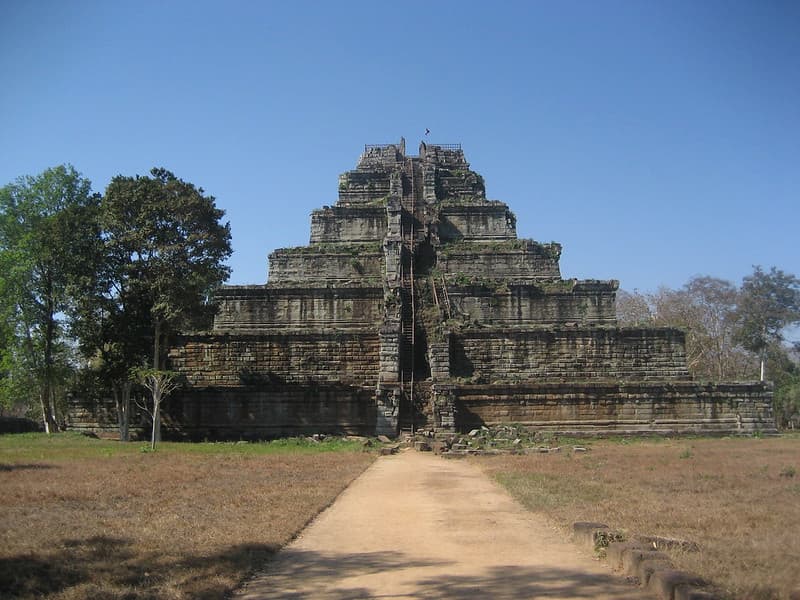
Prasat Thom anchors Cambodia’s most enigmatic pyramid complex
The UNESCO World Heritage site titled “Koh Ker: Archaeological Site of Ancient Lingapura or Chok Gargyar” is a monumental 10th-century urban complex situated in Kulen District, Preah Vihear Province, within the forested plains of northern CAMBODIA. Spanning roughly 1,189 hectares of protected cultural landscape, Koh Ker served as the temporary capital of the Khmer Empire under the reign of King Jayavarman IV and his son Harshavarman II between 928 and 944 CE.
The site encompasses 183 documented archaeological sanctuaries, royal enclosures, civil infrastructure, and stone quarries hidden amidst dense jungle. The focal point of the complex is Prasat Thom, a massive seven-tiered step-pyramid temple rising 36 meters high, constructed of sandstone blocks overlooking a sacred reservoir (Rahal baray). The urban plan exhibits sophisticated hydraulic engineering and unique stone construction methods, featuring royal palaces, unfortified settlement quarters, and monumental open-air sanctuaries that reflect ancient Indian cosmological concepts.
Attraction
Koh Ker draws history enthusiasts, photographers, and adventurers seeking an uncrowded, mystical alternative to the heavily visited temples of Angkor Wat.
Visitors travel to marvel at the soaring Prasat Thom pyramid temple, whose multi-layered step design stands as an architectural anomaly in traditional Khmer engineering, evoking comparisons to Mesoamerican pyramids. Tourists explore the overgrown ruins of Prasat Krahom (the Red Temple), admiring its oxidized brick towers, carved lintels, and moss-draped doorways framed by giant Banyan tree roots. The site is world-renowned among art historians for giving rise to the “Koh Ker Style”—a dynamic period of monumental stone sculpture featuring large-scale, expressive statues of Hindu deities in action. Additionally, walking along wooden forest paths to discover remote shrines scattered across the jungle offers travelers a rare sense of quiet exploration.

World Heritage
Inscribed on the UNESCO World Heritage List in 2023, Koh Ker is recognized under Cultural Criteria (ii) and (iv):
- Criterion (ii) – Human Value Exchange and Artistic Influence: The short-lived capital brought together innovative architectural concepts, monumental urban planning, and master craftsmanship. The site pioneered the “Koh Ker Style” of dynamic, free-standing sculpture and large-scale sandstone engineering, which profoundly influenced subsequent Khmer and Southeast Asian artistic developments.
- Criterion (iv) – Outstanding Architectural and Urban Ensemble: Koh Ker presents an exceptional layout of a 10th-century Khmer capital. Its combination of sacred temple pyramids, extensive water management reservoirs, stone quarries, and forest shrines illustrates a complete, planned royal landscape executed within a brief 23-year window.
Gateway
Travelers planning a visit to Koh Ker can access the remote archaeological site via practical Cambodian gateway locations featuring public IATA-listed airports searchable directly on IATA’s directory, lodging options, transit links, and tour operator services:
- Siem Reap (Primary Local Gateway / Nearest Airport Hub):
- Airport: Siem Reap–Angkor International Airport (IATA Code: SAI; ICAO Code: VDSA).
- Infrastructure and Distance: Located approximately 80 to 90 kilometers southwest of Koh Ker. SAI is an active public international aviation hub listed in IATA’s official directory. As Cambodia’s premier tourism base, Siem Reap offers extensive lodging options ranging from 5-star luxury resorts to boutique guesthouses. The city features private car rentals, taxis, intercity shuttle vans, and certified tour guides operating daily direct transfers to Koh Ker.
- Phnom Penh (Primary Regional Capital Gateway):
- Airport: Phnom Penh/Techo International Airport (IATA Code: KTI; ICAO Code: VDPP).
- Infrastructure and Distance: Located roughly 340 kilometers south of Koh Ker. KTI is the nation’s primary international airport searchable in IATA’s directory. As Cambodia’s capital, Phnom Penh features luxury hotels, domestic flight connections to SAI, rental car agencies, and travel operators running multi-day northern heritage circuits.
- Preah Vihear City / Choam Khsant (Suburban Base Gateway):
- Airport: Siem Reap–Angkor International Airport (IATA Code: SAI; ICAO Code: VDSA) — nearest operational public airport.
- Infrastructure and Distance: Situated approximately 60 to 70 kilometers northeast of Koh Ker. Utilizing SAI as its primary air connection, Preah Vihear City offers regional hotel lodging, local guesthouses, private driver rentals, and local guides providing easy road access to both Koh Ker and the nearby Preah Vihear Temple complex.
When
The ideal window to visit Koh Ker is during the Dry Season (November to March):
- Cool Dry Season (November to February): Highly recommended for comfortable sightseeing. Daytime temperatures are pleasant (22°C to 28°C / 72°F to 82°F) with low humidity and clear skies, making jungle trekking and pyramid climbing comfortable.
- Late Dry Season (March to April): Hot and dry, with afternoon temperatures routinely reaching 35°C to 38°C (95°F to 100°F). Visiting early in the morning is essential to avoid extreme midday heat.
- Wet Season (May to October): Heavy tropical rains turn dirt tracks muddy and increase humidity; however, the surrounding jungle becomes lush, and the ancient reservoirs fill with water.
Consideration
- De-Mining Safety and Marked Trails: Historical de-mining operations have cleared main visitor paths; however, unexploded ordnance (UXO) remains a risk in uncleared areas. Visitors must stay strictly on marked, cleared footpaths and wooden boardwalks at all times.
- Sun Protection and Hydration: Exploring the open pyramid structures and outer forest shrines requires substantial walking under tropical heat. Carrying bottled water, applying high-SPF sunscreen, and wearing a wide-brimmed hat are vital.
- Footwear for Terrain: Navigating uneven laterite pathways, wooden staircases, and dirt trails requires sturdy, comfortable walking or hiking shoes.
- Temple Dress Code: Modest attire is required across all sacred Cambodian monuments; shoulders and knees must be covered when visiting temple platforms.
- Currency and Cash: The Cambodian Riel (KHR) and US Dollars (USD) are standard. Remote ticket booths and local stalls do not accept credit cards; carrying physical USD or KHR cash is mandatory.

Resources
- UNESCO World Heritage Centre: Official inscription portal detailing site boundaries, criteria evaluations, and state of conservation reports.
- Ministry of Culture and Fine Arts of Cambodia: Official state administrative body providing archaeological research, site rules, and heritage preservation news.
- Cambodia Tourism Official Portal: Official national travel site providing transit logistics, regional itineraries, and lodging directories for Preah Vihear and Siem Reap.
- Preah Vihear National Authority: Official regional administrative authority managing conservation projects and visitor services across Koh Ker.
- Trip.com: Global online travel marketplace offering bookings for private driver transfers, guided day tours, and multi-temple excursions from Siem Reap to Koh Ker.


Comments:
Leave a Reply