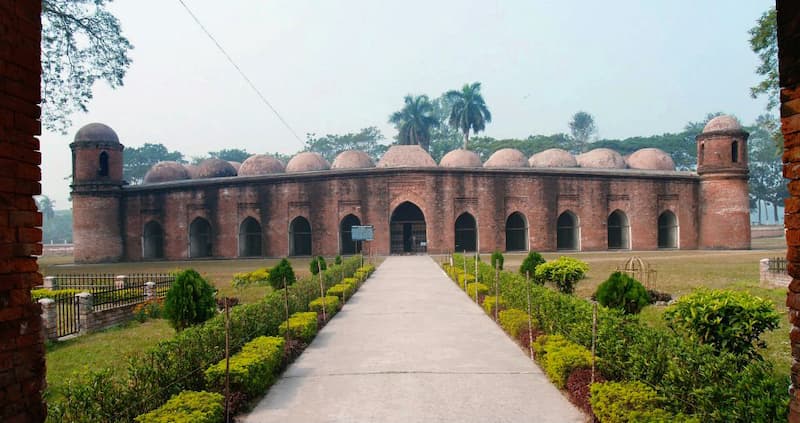
Bagerhat: A Journey Through Bangladesh’s Islamic Heritage
The UNESCO World Heritage site “Historic Mosque City of Bagerhat” is an ancient ruined city located in Bagerhat District of Khulna Division in southwestern BANGLADESH, near the Ganges and Brahmaputra river confluence. Founded in the 15th century (around 1459) by Turkish general and Islamic saint Ulugh Khan Jahan during the Bengal Sultanate, the city was originally named Khalifatabad. Spanning over 50 square kilometers, the site represents an extraordinary medieval urban settlement built at the jungle edge of the Sundarbans.
The property contains over 360 historic structures built primarily of fired red brick, including mosques, mausoleums, public buildings, bridges, roads, and large freshwater storage reservoirs (dighis). The architectural style is a distinctive regional adaptation known as the “Bengalization of Tughlaq architecture,” characterized by thick brick walls, curved cornices, multi-domed roofs, and delicate terracotta plaques. Key individual monuments within the complex include:
- Sixty Dome Mosque (Shat Gombuj Masjid): The grandest medieval mosque in Bangladesh, famous for its massive brick structure, 77 low domes (resting on 60 stone pillars), and corner towers.
- Mausoleum of Khan Jahan: A venerated single-domed shrine housing the founder’s tomb, located beside the large Thakur Dighi pond.
- Nine Dome Mosque: A symmetrical square mosque featuring nine domes resting on four interior pillars with rich terracotta floral motifs.
- Singar Mosque and Bibi Begni Mosque: Single-domed brick mosques exhibiting early Sultanate design with heavy corner towers and carved brickwork.
- Ronvijoypur Mosque: Features Bangladesh’s largest single dome, spanning over 11 meters in width.
Attraction
The Historic Mosque City of Bagerhat attracts international travelers because it presents a rare window into 15th-century Islamic civilization in Bengal. Unlike heavily restored urban sites, Bagerhat’s ancient mosques stand peacefully amidst palm groves, paddy fields, and village ponds, offering an authentic historical atmosphere.
Visitors are drawn by the engineering ingenuity of its brick architecture. Lacking natural stone, medieval builders fired local clay into durable red bricks, constructing massive monuments without mortar and decorating them with terracotta reliefs of lotus flowers and geometric patterns. Large water reservoirs like Thakur Dighi were excavated to supply clean drinking water across the deltaic settlement. Travelers also experience living spiritual heritage; the Shrine of Khan Jahan Ali remains an active pilgrimage site, especially during the annual Khanjali Mela fair. Additionally, proximity to the Sundarbans mangrove forest makes Bagerhat an ideal cultural addition to ecotourism trips across southern Bangladesh.

World Heritage
In 1985, UNESCO inscribed the Historic Mosque City of Bagerhat on the World Heritage List under cultural Criterion (iv).
- Criterion (iv) – Outstanding Architectural Ensemble: Bagerhat represents an outstanding architectural ensemble illustrating a significant stage in human history. It exhibits a unique Bengal Sultanate style where Northern Indian Tughlaq Islamic architecture fused with indigenous Bengali bamboo hut forms—such as curved cornices—and detailed terracotta art.
- Technical Genius and Deltaic Urbanization: The inscription highlights the technical mastery of Ulugh Khan Jahan and his builders. Overcoming harsh deltaic terrain, salinity, and jungle, they engineered a sophisticated urban infrastructure—including defensive embankments, paved roads, drainage networks, and freshwater reservoirs—enabling permanent human settlement in the Bengal delta.
Gateway
The primary gateway city serving the site is Jashore (historically Jessore), a regional hub in southwestern Bangladesh situated approximately 85 kilometers northwest of Bagerhat. Jashore serves as a key transit node for travelers exploring the Khulna Division.
Jashore is served by Jashore Airport (IATA Code: JSR; ICAO Code: VGJR), a domestic airport offering daily flights to Hazrat Shahjalal International Airport in Dhaka (IATA Code: DAC).
From Jashore, travelers reach Bagerhat by car, taxi, or bus via Khulna (30 kilometers west of Bagerhat). Khulna, the third-largest city in Bangladesh, serves as the central accommodation base with modern hotels. Jashore and Khulna provide sufficient lodging across categories, including mid-range hotels, business accommodations, government rest houses, and private guesthouses.
When
The ideal time to visit the Historic Mosque City of Bagerhat is during Winter (November to February).
- Winter (November to February): Delivers the most comfortable weather, featuring dry, sunny days and cool evenings. Temperatures range from 15°C to 26°C (59°F to 79°F) with low humidity, ideal for walking or cycling between scattered outdoor monuments.
- Hot Season (March to May): Temperatures frequently exceed 35°C (95°F) with high humidity, making sightseeing demanding.
- Monsoon Season (June to October): Heavy rains dominate the region. Downpours create muddy pathways around rural sites, though the landscape becomes vibrant green.
Considerations
- Appropriate Attire and Etiquette: Modest clothing covering shoulders and knees is essential. Women should carry a headscarf for active mosques or mausoleums. Shoes must be removed before entering prayer areas.
- Dispersed Site Layout: Monuments are spread across several kilometers. While Sixty Dome Mosque is easily accessible, reaching outlying monuments like Ronvijoypur or Nine Dome Mosque requires hiring an auto-rickshaw (CNG) or taxi.
- Prayer Times: During Friday prayers (Jumu’ah) and daily prayer slots, access to main prayer halls may be restricted for non-Muslims. Schedule visits between prayers for uninterrupted exploration.
- Health and Comfort: Due to humid tropical conditions near wetlands, carry insect repellent, sun protection, and bottled water.

Resources
- UNESCO World Heritage Centre: Official UNESCO web portal containing technical site summaries, criteria, and inscription records.
- Department of Archaeology Bangladesh: Official government portal overseeing Bangladesh’s national monuments and heritage protection.
- Beautiful Bangladesh: Official tourism board website providing travel information, heritage itineraries, and destination guides.
- Lonely Planet: Comprehensive travel resource offering practical guides, transportation advice, and regional coverage for Bangladesh.
- Trip.com: Major global travel platform featuring user reviews, hotel recommendations, community forums, and booking links.


Comments:
Leave a Reply