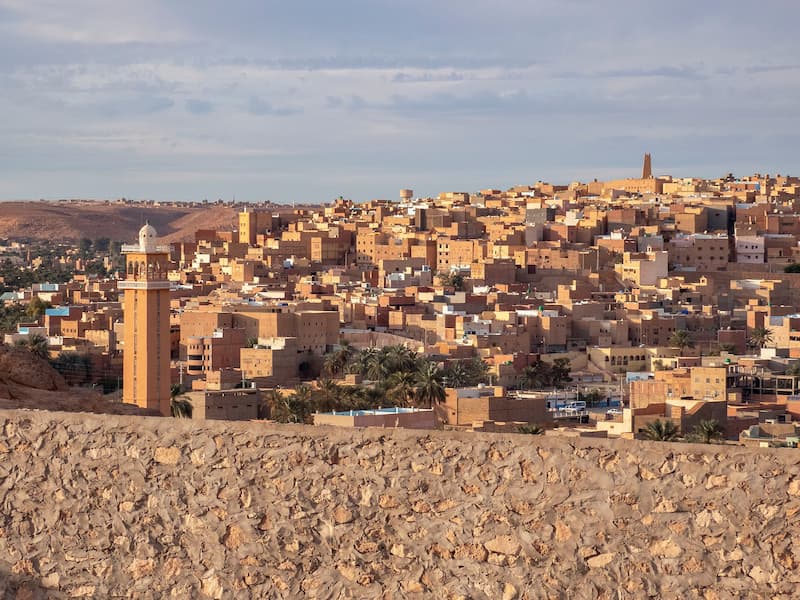
The M’Zab Valley is a deep, narrow oasis located in the northern Sahara Desert of ALGERIA. It is a striking “open-air museum” comprising five fortified towns, known collectively as the Pentapolis: Ghardaïa, Melika, Beni Isguen, Bounoura, and El Atteuf.
Founded in the 11th century by the Ibadi Mozabites (a Berber community), the valley is a masterpiece of traditional urban planning. Each of the five towns (ksour) is built on a rocky outcrop and follows a rigid, concentric layout. At the absolute summit of each hill sits the mosque, which historically served as both a spiritual sanctuary and a defensive fortress with a minaret acting as a watchtower.
From the mosque, simple, cubic houses painted in ochre, pastel blue, and white cascade down the hillside in tight circles. The architecture is famously minimalist, designed for functionality and climate control in an extremely arid environment. Beneath the towns, the Mozabites engineered an ingenious hydraulic system of dams and underground channels (foggaras) to sustain lush palm groves in an otherwise barren landscape.
Attraction
The M’Zab Valley draws travelers seeking a rare combination of architectural purity and cultural isolation:
- Architectural Influence: The valley is a pilgrimage site for architects. Le Corbusier visited in the 1930s and was profoundly influenced by the “honesty” and functionality of the buildings, which helped shape modern minimalist architecture.
- A “Time Capsule” Culture: The Mozabite community is remarkably traditional and private. Visitors witness a way of life that has remained largely unchanged for a millennium, from the unique white veils (haik) worn by local women to the strict social codes of the desert.
- The Carpet Capital: Ghardaïa is world-renowned for its hand-woven carpets. The vibrant marketplace (souq) is an attraction in itself, offering a sensory overload of spices, textiles, and traditional crafts.

World Heritage
UNESCO inscribed the M’Zab Valley in 1982 based on several cultural criteria:
- Criterion (ii): The site’s unique architecture provided a model for human settlements for nearly 1,000 years and heavily influenced 20th-century urban planning and architecture.
- Criterion (iii): It is an exceptional testimony to the Ibadi culture—an egalitarian society that maintained its social and religious identity through a meticulously organized urban and hydraulic structure.
- Criterion (v): It is an outstanding example of a traditional human settlement that is perfectly adapted to a hostile environment, demonstrating sustainable water management and agricultural practices in the desert.
Gateway
The city of Ghardaïa serves as the primary gateway to the valley.
- Commercial Airport: Noumerate Airport (GHA), also known as Moufdi Zakaria Airport, is located about 20 km from the city center. It receives frequent domestic flights from Algiers via Air Algérie.
- Lodging: Ghardaïa has a range of accommodations. For an authentic experience, many travelers stay in traditional guest houses within the palm groves (palmeries) or more modern hotels like the Hotel El-Djanoub.
When
The ideal window to visit is from October to April.
- Climate: During these months, daytime temperatures are comfortable (18°C to 25°C), which is essential for walking the steep, narrow alleys of the ksour.
- Summer Caution: From June to August, the heat is extreme, often exceeding 45°C, making outdoor exploration during the day nearly impossible.
Consideration
- Mandatory Guides: You are generally not allowed to enter the ancient ksour (especially Beni Isguen) without a certified local guide. This is to ensure respect for the community’s privacy.
- Photography Restrictions: This is a highly sensitive area for photography. Never take photos of local people (especially women) without explicit permission. Photography of government buildings and certain religious sites is strictly prohibited.
- Dress Code: Both men and women should dress conservatively. Shoulders and knees must be covered.
- Alcohol: The M’Zab Valley is a conservative religious area; alcohol is generally not available in public spaces or most hotels.

(Camille Gillet, Wikimedia/CC BY-SA 4.0).
Resources
- UNESCO World Heritage Centre – The official entry for maps and historical dossiers.
- Mosaic North Africa – A specialized travel operator providing in-depth cultural insights.
- GetYourGuide – A platform to book guided tours and excursions in the valley.
- Lonely Planet: Ghardaïa – Practical travel tips and independent reviews of the region.
- Fondation pour la Protection et la Promotion de la Vallée du M’Zab – The official Algerian agency website dedicated to the preservation of the site (often in French).


Comments:
Leave a Reply