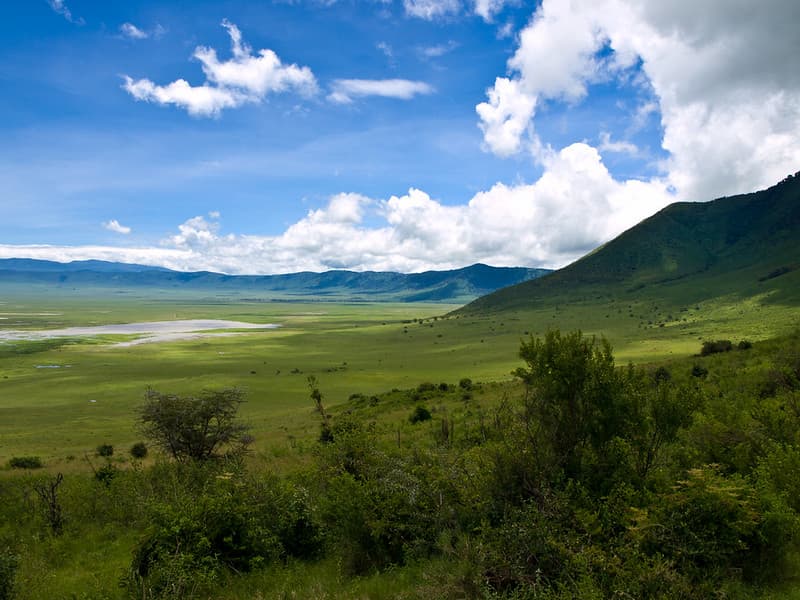
The Ngorongoro Conservation Area (NCA), located in the Arusha Region of northern TANZANIA, is one of the world’s most evocative and important prehistoric landscapes. Spanning approximately 8,000 square kilometers, it is a pioneering experiment in multi-purpose land use, where semi-nomadic Maasai pastoralists co-exist with a vast concentration of African wildlife.
The centerpiece of the conservation area is the Ngorongoro Crater, the world’s largest inactive, unbroken, and unfilled volcanic caldera. Formed when a massive volcano exploded and collapsed on itself two to three million years ago, the crater is now a natural amphitheater 600 meters deep and covering 260 square kilometers.
Beyond the crater, the site includes the Oldupai Gorge (often called Olduvai), a steep-sided ravine that is one of the most important paleoanthropological sites in the world. The landscape varies dramatically from lush highland forests on the crater rim to the sweeping short-grass plains of the Serengeti ecosystem in the west.
Attraction
Ngorongoro is often referred to as the “Eighth Wonder of the World” due to its incredible density of life and geological splendor:
- The “Big Five” in a Day: Because of the crater’s natural enclosure, it is one of the few places on Earth where visitors have a high probability of seeing the African Lion, Leopard, Elephant, Cape Buffalo, and the rare Black Rhino in a single game drive.
- The Great Migration: The plains of the NCA serve as the calving grounds for millions of wildebeest and zebras during the early months of the year, attracting predators and offering a raw look at the cycle of life.
- Maasai Culture: Unlike traditional National Parks, the NCA allows for cultural interaction. Visitors can visit traditional “Bomas” (villages) to learn about the Maasai way of life and their relationship with the land.
- Human Origins: At Oldupai Gorge, tourists can stand where the earliest ancestors of humanity once walked, viewing fossilized footprints and ancient stone tools.

(Remi Jouan, Wikimedia/CC BY-SA 3.0).
World Heritage
UNESCO inscribed the Ngorongoro Conservation Area as a World Heritage Site in 1979 (Natural) and 2010 (Cultural) based on several criteria:
- Criterion (iv): It provides an exceptional record of human evolution, with fossil remains dating back nearly four million years.
- Criterion (vii): The crater itself is a natural phenomenon of superlative beauty.
- Criterion (viii): It represents major stages of Earth’s history through its volcanic activity and geological formations.
- Criterion (ix) & (x): It is a globally significant site for biodiversity conservation, protecting endangered species and maintaining the integrity of the Serengeti-Mara ecosystem.
Gateway
The city of Arusha serves as the primary gateway to the Ngorongoro Conservation Area and the broader “Northern Circuit” of Tanzania.
- Commercial Airports: The city is served by Arusha Airport (ARK) for domestic hops and Kilimanjaro International Airport (JRO) for international arrivals.
- Lodging: Arusha offers an extensive range of accommodations, from high-end luxury at the Gran Melia Arusha to boutique lodges like Arusha Coffee Lodge and numerous budget-friendly hostels.
- Logistics: From Arusha, it is a roughly 180 km (3-hour) drive on well-paved roads to the Loduare Gate (the entrance to the NCA).
When
- The Dry Season (June to October): This is the best time for wildlife viewing. As water sources dry up, animals congregate around the permanent springs and marshes on the crater floor, making them easy to spot.
- The Calving Season (January to February): Ideal for those wanting to see the Great Migration on the southern plains. This is a time of high predator activity.
- The Green Season (March to May): The landscape is stunningly lush and green, and birdwatching is at its peak. While there is more rain, the dust is low and the crater is less crowded.
Consideration
- Entry Fees and Permits: Entry is strictly regulated. You must pay both a Conservation Area fee and a separate Crater Service fee (for the vehicle) to descend into the caldera.
- Temperature Variance: While the crater floor can be hot, the rim sits at an elevation of about 2,300 meters. It can be surprisingly cold and foggy in the mornings and evenings; warm layers are essential.
- Dust and Sun: During the dry season, the crater floor becomes very dusty. Bring a scarf (buff), sunglasses, and plenty of sunscreen.
- Time Limits: To prevent overcrowding, vehicles are generally limited to a maximum of six hours inside the crater per day.
- Malaria Precautions: Tanzania is a malaria-endemic region. Consult a healthcare professional about antimalarials before your trip and use insect repellent.

Resources
- UNESCO World Heritage Centre – Ngorongoro – The official technical documentation on the site’s environmental and cultural significance.
- Ngorongoro Conservation Area Authority (NCAA) – The official government portal for the most up-to-date fees, regulations, and permit information.
- Tanzania Tourist Board – A great resource for broader travel logistics across the country.
- Africa Safari Classics – A detailed guide on safari logistics and the different ecosystems within the conservation area.
- GetYourGuide – A commercial platform where you can read traveler reviews and book guided day-trips or multi-day safaris from Arusha.


Comments:
Leave a Reply