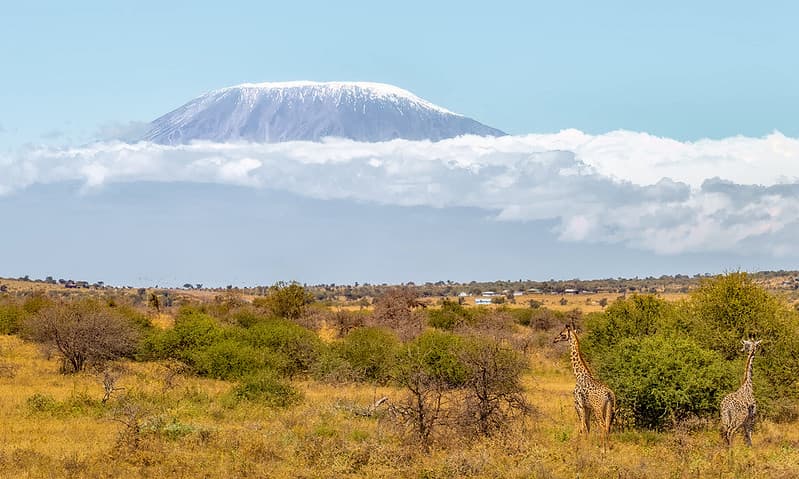
Mount Kilimanjaro towers as Africa’s highest free-standing stratovolcanic peak
The UNESCO World Heritage site titled “Kilimanjaro National Park” is a world-renowned natural reserve situated in the Kilimanjaro Region of northeastern TANZANIA, near the border with Kenya. Covering an area of 1,688 square kilometers, the park protects Africa’s highest mountain mass—Mount Kilimanjaro. Rising directly from the surrounding equatorial savannah plains to an altitude of 5,895 meters (19,341 feet) above sea level at Uhuru Peak on the Kibo crater rim, Kilimanjaro stands as the tallest free-standing mountain on Earth.
The park encompasses a massive stratovolcanic complex comprised of three main extinct or dormant volcanic cones: Shira, Mawenzi, and Kibo. As travelers ascend the mountain, they cross five distinct altitudinal ecological zones. The base features agricultural slopes and lush sub-tropical montane rainforests teeming with wildlife, transitioning sequentially into heath and moorland, high alpine desert, and finally an arctic summit zone defined by dramatic glaciers, snowfields, and ice walls.
Attraction
Kilimanjaro National Park is one of global eco-tourism’s ultimate bucket-list destinations, drawing thousands of adventurers, trekkers, and nature enthusiasts annually. Its primary worldwide appeal stems from being one of the famous “Seven Summits”—the highest peaks on each continent—yet it is widely considered the most accessible non-technical high-altitude climb in the world. Mountaineers can reach its summit without specialized climbing equipment like ropes, ice axes, or crampons.
Visitors travel to undertake multi-day guided trekking expeditions along established scenic routes such as Machame, Marangu, Lemosho, and Rongai. Along the trail, trekkers experience dramatic climate changes over a single week, passing unique endemic flora like giant groundsels (Dendrosenecio kilimanjari) and giant lobelias (Lobelia deckenii). Wildlife enthusiasts explore lower forest belts to spot blue monkeys, black-and-white colobus monkeys, bushbabies, forest elephants, and leopards, while enjoying panoramic sunrise views across East Africa from Uhuru Peak.

World Heritage
Inscribed on the UNESCO World Heritage List in 1987, Kilimanjaro National Park is recognized under Natural Criterion (vii) for its superlative natural phenomenon and exceptional aesthetic importance:
- Criterion (vii) – Superlative Natural Phenomenon and Aesthetic Beauty: Mount Kilimanjaro is an outstanding example of a giant volcanic massif standing in dramatic isolation above the surrounding African savanna. The visual contrast of its snow-capped peak, remnant equatorial glaciers, and surrounding green montane forest belt rising out of dry plains forms one of the world’s most iconic natural landscapes. The property preserves an intact vertical continuum of five vegetation zones housing exceptional biological richness and rare endemic plant species.
Gateway
Travelers planning a trekking expedition to Kilimanjaro National Park can access the sanctuary via practical Tanzanian gateway locations featuring public IATA-listed airports searchable directly on IATA’s directory, complete lodging options, transit links, and tour operator services:
- Moshi (Primary Local Base Gateway / Nearest Airport Hub):
- Airport: Kilimanjaro International Airport (IATA Code: JRO; ICAO Code: HTKJ).
- Infrastructure and Distance: Located approximately 40 to 45 kilometers west of Moshi and about 45 kilometers from the southern park entry gates. JRO is an active international aviation hub indexed in IATA’s directory. As the immediate operational base for mountain climbs, Moshi provides extensive accommodations ranging from luxury safari lodges to budget eco-hostels, climbing gear rental shops, local transport, and certified mountain trekking agencies.
- Arusha (Primary Regional Safari Capital Gateway):
- Airport: Arusha Airport (IATA Code: ARK; ICAO Code: HTAR) and Kilimanjaro International Airport (IATA Code: JRO).
- Infrastructure and Distance: Situated roughly 80 to 90 kilometers west of the park gates. ARK is a public domestic airport searchable in IATA’s directory serving northern Tanzania’s safari circuit. Serving as Tanzania’s safari capital, Arusha provides complete luxury hotel infrastructure, car rentals, intercity coach buses, and major tour operators running combined mountain and wildlife safari itineraries.
When
The ideal windows to climb Mount Kilimanjaro are during Tanzania’s two distinct Dry Seasons (January to March and June to October):
- Warm Dry Season (January to March): Highly recommended for climbing. Offers relatively warm temperatures, clear morning skies, low rainfall on lower slopes, and lower tourist crowds compared to mid-summer.
- Cool Dry Season (June to October): Delivers stable, dry weather, low rainfall, and clear visibility from the summit. While July and August represent peak high season with busier trails, late June and September offer ideal climbing conditions with fewer crowds.
- Wet Seasons (April to May and November): Heavy rains hit lower forest trails, creating muddy conditions, dense fog, and ice or heavy snow at high altitudes.
Consideration
- Altitude Sickness and Acclimatization: Altitude is the primary reason climbers fail to summit. Selecting a longer trekking route (6 to 8 days rather than 5 days) allows gradual acclimatization to prevent Acute Mountain Sickness (AMS).
- Compulsory Guide and Crew Regulations: Under Tanzania National Parks Authority (TANAPA) rules, solo unguided trekking is strictly illegal. Climbers must hire licensed guides, porters, and cooks through registered operators.
- Physical Fitness and Preparation: While non-technical, daily long hikes carrying gear over steep, rocky terrain require strong cardiovascular stamina and leg endurance.
- Cold-Weather Mountain Gear: Temperatures at summit camps drop well below freezing (-10°C to -15°C / 14°F to 5°F) with high winds. Thermal base layers, down jackets, waterproof outer shells, and high-altitude sleeping bags are essential.
- Currency and Tipping Culture: Tanzanian Shilling (TZS) is the official currency, but US Dollars (USD) are widely used for park fees and tour payments. Tipping guides and porters at the end of the climb is a mandatory social custom; carrying physical cash is required.

Resources
- UNESCO World Heritage Centre: Official inscription portal detailing boundaries, criteria evaluations, and state of conservation reports.
- Tanzania National Parks Authority (TANAPA): Official government administration portal regulating park tariffs, climbing permits, and conservation policies.
- Tanzania Tourist Board: Official national travel portal offering transit logistics, regional itineraries, and accommodation directories across Moshi and Arusha.
- Mount Kilimanjaro National Park Guide: Comprehensive destination resource providing route profiles, elevation maps, and gear checklists.
- Trip.com: Global online travel marketplace offering bookings for private guided climbing packages, day-hikes, airport transfers, and northern circuit safaris.


Comments:
Leave a Reply