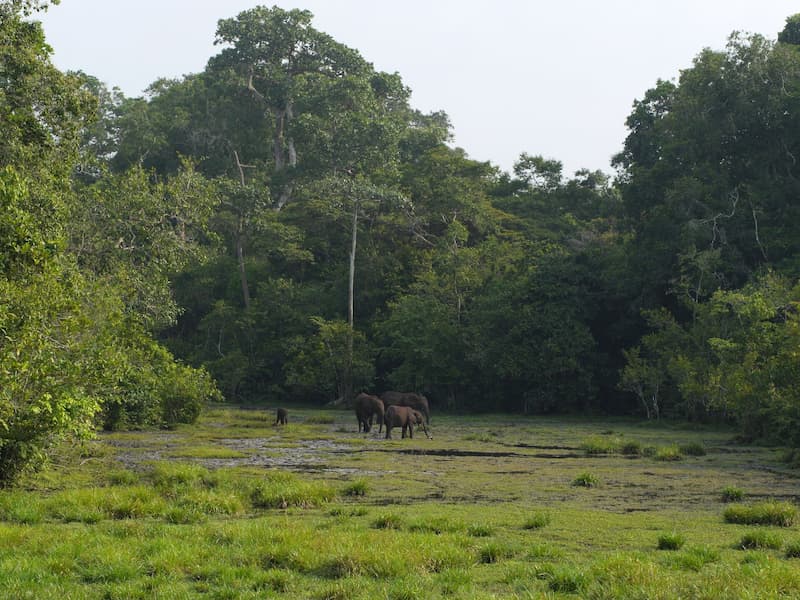
The Forest Massif of Odzala-Kokoua is a vast and ecologically critical national park located in the REPUBLIC OF THE CONGO. Covering over 1.3 million hectares in the heart of the Congo Basin—the world’s second-largest tropical rainforest—it is a pristine mosaic of dense equatorial forest, sprawling savannahs, and complex river systems.
The park is defined by its “baïs,” nutrient-rich forest clearings where wildlife congregates to feed and socialize. It serves as a vital sanctuary for endangered species and a massive carbon sink. The landscape is characterized by a “tangled” jungle environment, with major river sources like the Mambili and Lekoli feeding into the mighty Congo River.
Attraction
- Iconic Wildlife: It is one of the premier locations on Earth to track the Critically Endangered western lowland gorilla in its natural habitat.
- Unique Encounters: Beyond gorillas, visitors encounter forest elephants, forest buffalo, bongos, and chimpanzees. It is notably the only place in the region where spotted hyenas can still be found.
- Untamed Exploration: Tourists are drawn by the “raw” adventure of the park; activities include walking safaris through primary rainforest, kayaking through labyrinthine river channels, and observing wildlife from platforms overlooking the baïs.

World Heritage
Inscribed in 2023, the site was recognized for its outstanding ecological value:
- Biological Hotspot: It represents a vital refuge for threatened species and showcases complex evolutionary processes.
- Intact Ecosystem: It is one of the most significant remaining intact forest systems in Africa, serving as a crucial link in maintaining regional biodiversity.
- Research & Conservation: The site is a global priority for scientific study and long-term conservation, managed through a successful partnership between the Congolese government and African Parks.
Gateway
Brazzaville is the essential gateway for international travelers.
- Airport: You must fly into Maya-Maya Airport (BZV) in Brazzaville.
- Logistics: The park is extremely remote. Travel typically involves a scheduled charter flight from Brazzaville to the private airstrip at Mboko, within the national park. Guest services usually coordinate these onward transfers upon your arrival in the capital.
- Lodging: In Brazzaville, major hotels such as the Radisson Blu or the Hilton are recommended. Once in the park, visitors stay at specialized eco-lodges (Ngaga, Lango, or Mboko), which are integrated into the safari experience.
When
- Prime Season: January–February and June–September are the best times. These months offer drier conditions, which make forest trails more navigable and gorilla tracking more comfortable.
- Wet Season: Mid-March to May and October to mid-December bring heavy rains. While these months lead to lush landscapes and vibrant birdlife, they make navigation significantly more difficult.
Consideration
- Logistics & Cost: This is a high-end, expedition-style destination. Access is expensive, and planning requires working with specialized safari operators.
- Physical Demands: Gorilla tracking and forest walks are physically demanding, involving trekking through humid, muddy, and dense environments.
- Health: Ensure you have up-to-date vaccinations and malaria prophylaxis. Consult your travel clinic well in advance of your trip.
- Pack Light: If you are taking internal charter flights to the lodges, there are usually strict weight limits for luggage.

Resources
- African Parks – Odzala-Kokoua – The most authoritative source for park management and conservation data.
- Visit Odzala – The official tourism portal with information on the lodges and park activities.
- Kamba African Rainforest Experiences – The primary operator for lodge stays and flight logistics.
- UNESCO World Heritage Centre – Official documentation on the park’s world heritage status.
- Yellow Zebra Safaris – A resource for booking bespoke, all-inclusive safari itineraries.


Comments:
Leave a Reply