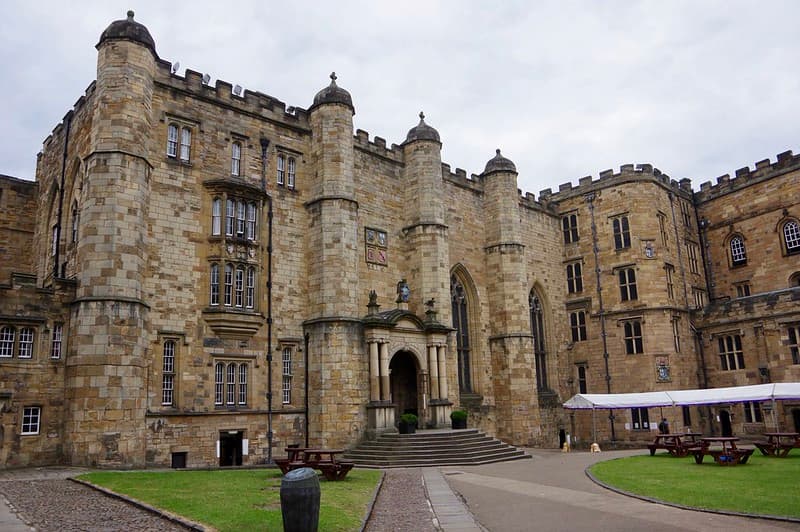
The Durham Castle and Cathedral site, located in Northeast England, UNITED KINGDOM,is a powerful architectural ensemble that symbolizes the arrival of Norman power in England. Perched dramatically on a rocky promontory enclosed by a loop in the River Wear, it is often cited as one of the most beautiful urban landscapes in Europe.
The site consists of two massive structures facing each other across the manicured lawns of Palace Green:
- Durham Cathedral: Built between 1093 and 1133, it is the premier example of Norman (Romanesque) architecture. It was designed to house the shrine of Saint Cuthbert, the patron saint of Northern England, and the remains of the Venerable Bede. Its interior is famous for its massive, incised stone pillars and the earliest large-scale use of rib vaulting in the world.
- Durham Castle: Originally built by William the Conqueror in 1072, the castle served as the seat of the Prince-Bishops of Durham. These unique figures held both religious and secular authority, acting as a defensive buffer between England and Scotland. Since 1837, the castle has been home to University College, Durham, making it one of the few ancient castles in the world still used as a functioning residence for students.
Attraction
Durham draws a global audience for its blend of spiritual history, cinematic fame, and academic prestige:
- Architectural Purity: For students of history and architecture, the cathedral is a “textbook” example of the transition from Romanesque to Gothic styles.
- Harry Potter & Cinema: The Cathedral’s cloisters and Chapter House were used as filming locations for Hogwarts in the first two Harry Potter films. It also appeared as a location in Avengers: Endgame.
- Spiritual Pilgrimage: As the resting place of St. Cuthbert and the Venerable Bede, it remains a major destination for religious pilgrims.
- The “University City” Vibe: The integration of the Castle into Durham University (one of the UK’s top-ranked institutions) gives the site a vibrant, scholarly atmosphere that appeals to visiting academics and prospective students.

(Misha Popovikj, Flickr/CC BY-SA 2.0).
Heritage
Durham was among the first group of sites in the UK to be inscribed on the UNESCO World Heritage List in 1986. It meets several criteria:
- Innovation in Engineering (Criterion ii): The Cathedral is the largest and most perfect monument of “Norman” style architecture. Its innovative use of rib vaulting over the nave was a revolutionary technical achievement that paved the way for the Gothic era.
- Symbol of Power (Criterion iv): The ensemble of the Castle and Cathedral illustrates the unique status of the Prince-Bishops, representing the fusion of ecclesiastical and military power in medieval Europe.
- Historical Continuity (Criterion vi): The site has been a place of continuous worship and learning for nearly a millennium, preserving the traditions of the Benedictine monastic community.
Gateway
While Durham is a city in its own right, it does not have its own commercial airport. The primary gateway is Newcastle upon Tyne.
- Commercial Airport: Newcastle International Airport (NCL). It handles domestic flights from across the UK and international flights from Europe, the Middle East, and North America.
- Lodging: Newcastle offers a high volume of lodging, from the luxury Vermont Hotel near the historic Quayside to reliable chains like Premier Inn and Hotel Du Vin.
- Logistics: Durham is exceptionally easy to reach from Newcastle. Frequent trains run from Newcastle Central Station to Durham Station, taking only 12 to 15 minutes.
When
- Late Spring (May to June): The gardens on the riverbanks are in bloom, and the weather is generally mild for walking the “river loops.”
- Autumn (September to October): The fall colors along the River Wear provide a stunning frame for the Cathedral’s sandstone walls.
- Lumiere Festival (Biennial, November): If your visit coincides with this event, the entire peninsula is transformed by world-class light installations.
- Note for Academics: Avoid the weeks of Congregation (Graduation) in late June/early July if you want to stay in or near the Castle, as lodging is usually booked out by families of the graduates.

(Oliver Bonjoch, Wikimedia/CC BY-SA 3.0).
Consideration
- Castle Access: Because Durham Castle is a functioning university college, you cannot just walk in. Access is primarily via guided tours which must be booked in advance through the University website.
- The Climb: The walk from the railway station to the Cathedral involves a steep incline. Wear comfortable, supportive shoes.
- Religious Services: The Cathedral is a working church. Access to certain areas (like the high altar) may be restricted during services. Check the “Services & Music” schedule if you wish to hear the world-class choir.
- The Cathedral Tower: For the best view in Northern England, you can climb the 325 steps of the Central Tower, but it requires a separate ticket and a good level of physical fitness.

(Chris Heaton, Wikimedia/CC BY-SA 2.0).
Resources
- Durham Cathedral Official Site – The best source for service times, tower climb bookings, and current exhibitions.
- UNESCO World Heritage Centre – Durham – For technical dossiers and maps regarding the site’s protected boundaries.
- Durham World Heritage Site Visitor Centre – Information on the history of both the Castle and Cathedral, located on Owengate.
- Visit County Durham – The official tourism board providing travel logistics, event calendars, and regional guides.
- GetYourGuide – Durham Tours – A commercial platform for booking walking tours and finding vetted local lodging.


Comments:
3 responses to “Durham Castle and Cathedral”
-
I once walked the footpath along the edge
of the River Wear where it goes almost around the Cathedral up on the hill there. What a beautiful site. Felt peacefully old, the river, trees and cathedral. Especially considering it’s in a modern city. Thanks for the memory. -
Love Durham. Beautiful place, and the best showcase of Norman architecture surviving anywhere; a fascinating departure from the (admittedly glorious) Gothic cathedrals all over the rest of the country and the rest of western Europe.
-
The night view is spectacular. The Durham railway station sits on heights across the Wear from the town. At least one map quite rightly places the “scenic view” symbol at the spot. The view of Durham impressed me a lot. I think it has to do with the cathedral’s commanding position, and also the beautiful proportions of the three towers. Inside, nothing compares to the enormous columns with their incised patterns.

Leave a Reply to BowmanCancel reply