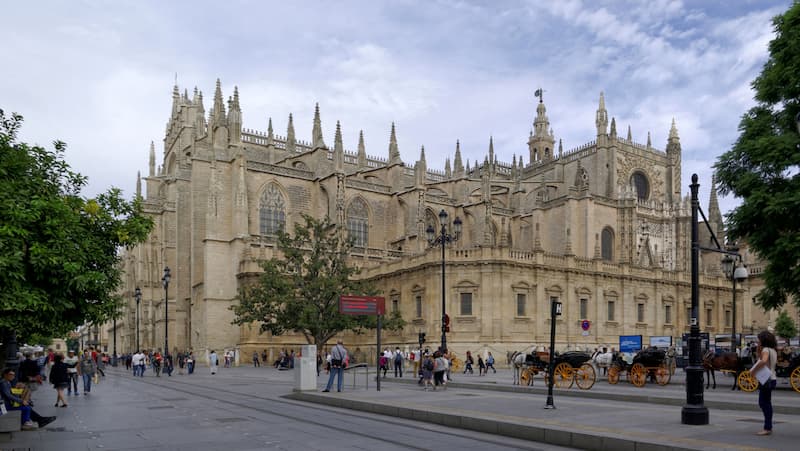
The Cathedral, Alcázar and Archivo de Indias in Seville represent the very soul of the Spanish “Golden Age.” This ensemble of three buildings, located in the heart of Andalusia, tells the story of Seville’s transformation from a powerful Almohad capital to the primary gateway between Europe and the New World.
The site consists of three distinct yet geographically connected monuments:
- The Cathedral of Seville: Built to “make people think the builders were mad” for its sheer scale, it is the largest Gothic cathedral in the world. It incorporates the Giralda, a stunning bell tower that was originally the minaret of the 12th-century Great Mosque. Inside, the architecture shifts from soaring Gothic arches to the intricate Renaissance design of the Royal Chapel.
- The Real Alcázar: A sprawling royal palace complex that is still used by the Spanish Royal Family. It is famous for its Mudéjar architecture—a style created by Muslim craftsmen for Christian rulers—featuring delicate plasterwork, “azulejo” tiles, and lush, sprawling gardens with water features.
- The Archivo de Indias: A monumental Renaissance building designed by Juan de Herrera. Originally a merchant’s exchange, it now houses the world’s most important collection of documents related to the discovery and administration of the Americas, including letters from Christopher Columbus and the Treaty of Tordesillas.
Attraction
Seville attracts millions of visitors not just for its beauty, but for its layers of cultural significance:
- The Tomb of Columbus: The Cathedral houses the monumental tomb of Christopher Columbus, held aloft by four figures representing the kingdoms of Spain.
- A Cinematic Backdrop: Fans of Game of Thrones will recognize the Alcázar as the “Water Gardens of Dorne,” while its gardens have appeared in numerous other films like Kingdom of Heaven.
- The Flamenco Heartbeat: The surrounding Santa Cruz neighborhood is the spiritual home of Flamenco, with the bells of the Giralda providing a constant, melodic backdrop to the city’s rhythms.

Heritage
UNESCO inscribed this site in 1987 based on several criteria of “Outstanding Universal Value”:
- Criterion (i): The Cathedral and the Giralda represent a masterpiece of human creative genius, blending Islamic and Christian architectural traditions.
- Criterion (ii): The site reflects an exceptional exchange of human values over centuries, particularly the influence of the Almohad period and the subsequent emergence of the “Spanish-American” cultural link.
- Criterion (iii): It is a unique testimony to the vanished Almohad civilization and the subsequent power of the Spanish Empire.
- Criterion (vi): The buildings are directly associated with events of universal significance: the discovery of the New World and the expansion of Western influence across the globe.
Gateway
The city of Seville serves as its own perfect gateway.
- Commercial Airport: Seville Airport (SVQ) handles numerous international and domestic flights daily.
- Lodging: From the historic opulence of the Hotel Alfonso XIII to thousands of boutique apartments in the old town, Seville has an exhaustive range of overnight options.
- Accessibility: Once you land, the “EA” airport bus or a short taxi ride puts you in the city center within 20 minutes.
When
To see the city at its most magical, timing is everything:
- The “Golden Window”: March to May. The scent of orange blossoms (azahar) fills the air, and the temperatures are pleasant (usually around 20°C–25°C).
- Festival: * Semana Santa (Holy Week): This is a solemn, visually spectacular week of religious processions.
- Feria de Abril (April Fair): This is the city’s 185th-anniversary celebration of the fair—expect non-stop dancing, horses, and flamenco dresses.
- Avoid July and August: Temperatures often exceed 40°C, making midday sightseeing nearly impossible.

Consideration
- Book the Alcázar in Advance: Tickets for the Alcázar sell out weeks ahead. Do not expect to walk up and buy a ticket on the day.
- Climbing the Giralda: There are no stairs; instead, there are 34 steep ramps. This was designed so the Muezzin could ride his horse to the top to call for prayer!
- The “Siesta” Schedule: Many shops and smaller sites close between 2:00 PM and 5:00 PM. Use this time for a long lunch or a rest to avoid the afternoon sun.
- Dress Code: While the Alcázar is flexible, the Cathedral is a place of worship. Ensure your shoulders are covered and shorts/skirts are a respectful length.
- Monday Closures: Most major museums in the city are closed on Mondays, though the Cathedral and Alcázar typically remain open (check their official calendars for specific liturgy times).

Resources
- UNESCO World Heritage Centre – Official historical data and criteria.
- Catedral de Sevilla (Official) – For booking tickets and checking mass schedules.
- Real Alcázar de Sevilla (Official) – The only place to buy official, non-markup tickets for the palace.
- Visit Seville – The official tourism portal for planning your broader stay in the city.
- GetYourGuide – Excellent for booking combined “Skip the Line” guided tours if the official slots are sold out.
Featured Image
Seville Cathedral (Berthold Werner, Wikipedia/CC BY-SA 3.0).
In The News
Advertisement


Comments:
3 responses to “Cathedral, Alcázar and Archivo de Indias in Seville”
-
The Alcazar is a place to stop and stare, listen to the fountains and breathe in the scent of sour oranges – a place that really just needs to be enjoyed.
-
The Alcazar needs a few hours of your time to really experience it to the full. And then there are the gardens which are truly exotic in style, with many tropical flowers on display. These large and extensive gardens have both Moorish and Renaissance influences.
-
I really loved Seville and look forward to returning someday soon. It really is one of the most beautiful cities we have been to.


Leave a Reply to BillCancel reply