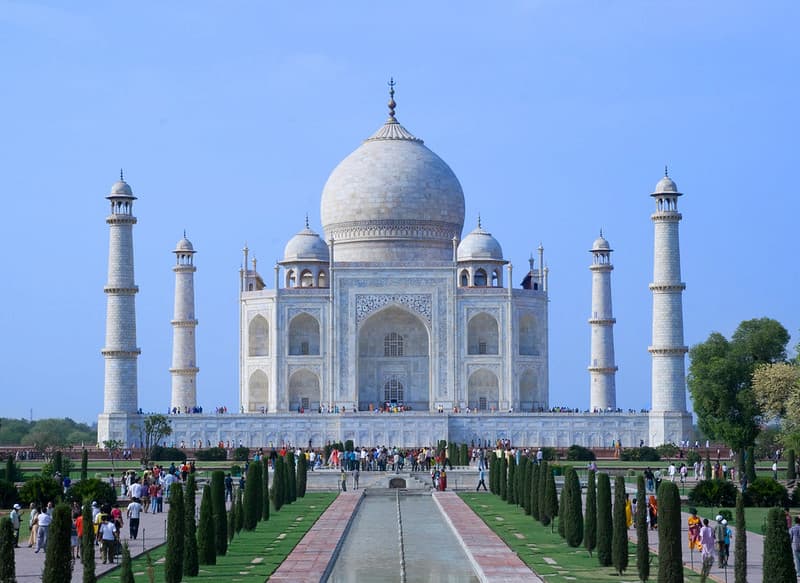
The Taj Mahal, located in Agra, India, is widely considered the most beautiful building ever constructed. It is not just a monument; it is a profound architectural statement of grief and devotion, standing as the ultimate symbol of the Mughal Empire’s artistic peak.
Commissioned in 1632 by the Mughal Emperor Shah Jahan, the Taj Mahal was built as a mausoleum for his favorite wife, Mumtaz Mahal, who died during childbirth. The project took roughly 20 years and more than 20,000 artisans to complete.
The site is a sprawling 42-acre complex that includes:
- The Main Mausoleum: A colossal, octagonal structure made of translucent white marble brought from Makrana. It is topped by a massive “onion” dome and flanked by four 40-meter-tall minarets.
- Pietra Dura Inlay: The marble surfaces are decorated with pietra dura, an intricate technique where thousands of semi-precious stones (like lapis lazuli, jade, and turquoise) are inlaid into the marble to form floral and geometric patterns.
- The Charbagh (Garden): A traditional Persian-style garden divided into four quadrants by reflecting pools and walkways, representing the Islamic concept of the four rivers of Paradise.
- Symmetry: Every element of the complex, except for the cenotaph of Shah Jahan himself (which was added later), is perfectly symmetrical. This includes the red sandstone mosque to the west and its identical twin “guest house” (jawab) to the east.
Attraction
The Taj Mahal attracts millions of visitors annually, not only for its scale but for its “ethereal” quality:
- The Changing Colors: Because of the high quality of the white marble, the monument appears to change colors throughout the day. It glows pinkish in the soft morning light, brilliant white under the midday sun, and golden under the moonlight.
- The Romantic Narrative: The story of an emperor building a “dream in marble” for his lost love resonates across cultures, making it one of the most romanticized sites on Earth.
- Architectural Perfection: It is the quintessential example of Mughal architecture, seamlessly blending Persian, Islamic, and Indian styles into a harmonious whole.

(Zorka Sojka, Wikimedia/CC BY-SA 4.0).
Heritage
UNESCO inscribed the Taj Mahal in 1983 as a masterpiece of human creative genius. It qualifies under several criteria:
- Criterion (i): It represents a “masterpiece of human creative genius,” standing as the highest achievement in the whole range of Indo-Islamic architecture.
- Architectural Influence: It demonstrates an important interchange of human values on developments in architecture and technology within the Mughal Empire.
- Cultural Testimony: It provides exceptional testimony to the cultural traditions of the Mughal dynasty, illustrating a significant stage in human history (the 17th-century zenith of the empire).
Gateway
The city of Agra in the state of Uttar Pradesh is the direct gateway to the site.
- Commercial Airport: Agra Airport (AGR), also known as Pandit Deen Dayal Upadhyay Airport, is a domestic commercial airport with regular flights from major Indian hubs like Delhi, Mumbai, and Jaipur.
- Lodging: Agra is a major tourism hub with thousands of lodging options, ranging from ultra-luxury five-star resorts with views of the Taj (like the Oberoi Amarvilas) to budget-friendly guesthouses.
- Proximity: The monument is located within the city limits, making it easily accessible via local transport, electric rickshaws, or hotel shuttles.
When
- The “Golden Months” (October to March): This is the best time to visit. The weather is cool and pleasant, avoiding the blistering heat of the North Indian summer. November and February are particularly ideal for clear skies and comfortable walking.
- Sunrise: Most travelers aim for sunrise to witness the pink glow of the marble and to beat the massive midday crowds.
- Full Moon Nights: The Taj Mahal is opened for night viewing for five nights every month (the night of the full moon and two nights before and after). This is a highly sought-after, ticketed experience.

(Biswarup Ganguly, Wikimedia/CC BY 3.0).
Consideration
- Friday Closure: The Taj Mahal is closed to all tourists every Friday. It is only open to those attending prayers at the mosque.
- Security Restrictions: Security is extremely tight. You are generally only allowed to carry a small bag with a phone, wallet, and a water bottle (only clear plastic). Prohibited items include tripods, selfie sticks, food, tobacco, and drones.
- Dress Code: While there is no strict religious dress code for the grounds, it is respectful to dress modestly (covering shoulders and knees). You must remove your shoes or wear provided shoe covers to step onto the main marble plinth.
- Ticketing: Tickets are almost exclusively sold online via the Archaeological Survey of India (ASI) portal. Foreign tourists pay a significantly higher “High Value” ticket price (1,100 INR approx.) which includes faster entry and shoe covers.

(Abhiman Singh, Flickr/PDM 1.0).
Resources
- Official Website of the Taj Mahal – Managed by the Government of Uttar Pradesh; the best source for current entry fees, timings, and official history.
- UNESCO World Heritage Centre – Detailed technical documentation on why the site is protected and its conservation status.
- Archaeological Survey of India (ASI) – The official custodian of the site, providing historical and archaeological insights.
- World Heritage Travel – An independent travel resource that provides practical visitor tips and includes links for booking regional tours and hotels.
- Incredible India – The official national tourism portal of India, offering broader context on visiting the Agra region.


Comments:
6 responses to “Taj Mahal”
-
I spent a night in the grounds of the Taj – it was one of the more relaxing nights of my life.
If YOU ever have the opportunity – GO. And take a small pocket penlight with you so you can illuminate the sunflowers on the display coffins (the real ones are on a lower floor). Fascinating imagery from the flowers.
-
Nothing can ever really prepare you for your first view of the Taj Mahal. I have been lucky enough to see it twice, and each time I was mesmerised. I didn’t really like Agra much the first time I went (my friend was very sick and we stayed in a horrible guest house), but when I went last year I liked it better. There is just so much to see and do in India.
-
I must say the Taj looks completely different during day and in night. I would recommend visiting at both times as its charm is varied and ecstatic.
-
Having been to the Taj a few times, I’ve learnt the importance of wearing shoes that are easy to remove. You need to take your shoes off when you go inside and the easier they are to slip on and off the better.
-
Great post
-
I had to stop just after entering the gate to reflect on and admire the beauty of India’s most famous monument. The 115 ft. onion dome dominates the skyline, not only because of its size, but also the design elements. Surrounding the tomb are four slender minaret towers that lean slightly outward, so as not to damage the tomb in case of an earthquake. Perhaps the best and most iconic viewpoint is standing at the end of the reflecting pool, with a walkway on either side. Up close, the exterior decorative features are exquisite. The marble is intricately carved in bas-relief, some areas with a delicate inlay of yellow marble, jasper and jade, and carvings of passages from the Qur’an.


Leave a Reply to RyanCancel reply