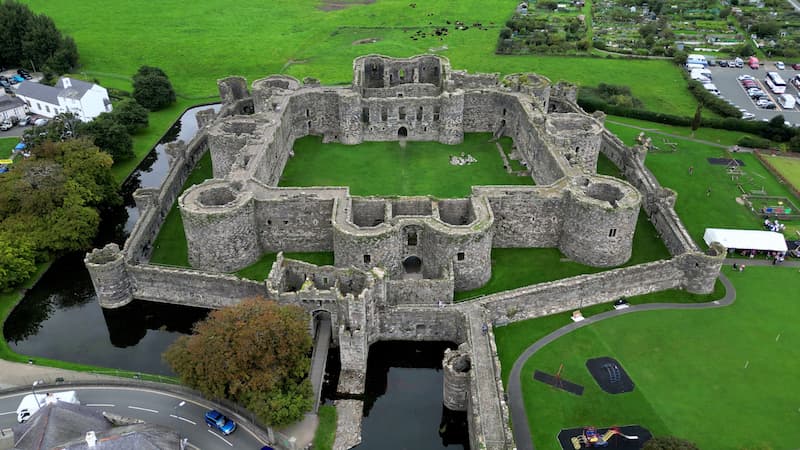
The Castles and Town Walls of King Edward in Gwynedd represent the most ambitious and concentrated building project of the Middle Ages in Europe. Located in North Wales, this World Heritage site comprises four massive fortresses—Beaumaris, Conwy, Caernarfon, and Harlech—along with the remarkably preserved town walls of Conwy and Caernarfon.
Constructed between 1283 and 1330 under the direction of King Edward I and his master architect, James of St George, these fortifications were designed to colonize and subdue the North Wales heartland.
- The “Ring of Iron”: These castles formed a defensive circle around the mountains of Snowdonia (Eryri).
- Architectural Diversity: The site includes Beaumaris, the “perfect” symmetrical concentric castle; Caernarfon, an imperial palace-fortress with polygonal towers; Conwy, a grit-stone masterpiece built at breakneck speed; and Harlech, a dramatic stronghold perched on a near-vertical cliff.
- Town Walls: The town walls of Conwy and Caernarfon are among the most complete medieval circuits in the world, once serving as “security blankets” for English settlers.
Attraction
The site is a magnet for travelers due to its combination of military power and raw beauty.
- Royal Connection: Caernarfon Castle is world-famous as the site of the Investiture of the Prince of Wales, a tradition maintained for centuries.
- Military Ingenuity: Enthusiasts visit to see “high-tech” 13th-century defenses, including complex barbicans, murder holes, and “walls within walls” designs.
- Cinematic Landscapes: Set against the backdrop of the Irish Sea and the peaks of Snowdonia, these castles offer some of the most photogenic vistas in the United Kingdom.
1.jpg)
Heritage
Inscribed in 1986, the site meets UNESCO Criteria (i), (iii), and (iv):
- Masterpiece of Genius: They are the finest examples of late 13th-century military architecture in Europe, showcasing the technical mastery of James of St George.
- Historical Documentation: Uniquely for the Middle Ages, the construction of these castles is extensively documented, providing a rare economic and social record of how such massive projects were financed and built.
- Pristine State: Despite centuries of conflict, the castles remain largely in their original medieval forms, offering a “veritable repertory” of medieval architectural shapes.
Gateway
While North Wales is the destination, the primary gateways within the United Kingdom are Liverpool or Manchester.
- Airports: Manchester Airport (MAN) is the largest global hub in the north, while Liverpool John Lennon Airport (LPL) offers extensive budget connections.
- Lodging: Both cities offer thousands of beds ranging from five-star hotels to hostels. From either city, the A55 “Expressway” provides a direct 1.5 to 2-hour drive to the heart of Gwynedd.
- Local Alternative: For those wishing to stay in Wales, the city of Bangor is centrally located between the castles and offers sufficient lodging, though its airport (Anglesey VLY) has very limited commercial service.
When
- Late Spring (May–June): The weather is typically at its driest, and the Welsh countryside is a vibrant green with blooming wildflowers.
- Summer (July–August): Ideal for outdoor historical reenactments and “The Siege of Harlech” events, though sites will be crowded.
- Autumn (September–October): Fewer crowds and dramatic, misty skies that enhance the atmospheric, “fairytale” look of Conwy and Harlech.

Consideration
- Cadw Membership: The castles are managed by Cadw (the Welsh heritage agency). If you plan to visit all four, a “3-day or 7-day Explorer Pass” is highly cost-effective.
- Physical Exertion: Climbing the spiral staircases of the towers is physically demanding and not for those with vertigo. Sturdy, non-slip footwear is essential.
- Weather Readiness: North Wales is famously rainy. Even on a sunny day, the wind on top of the battlements can be biting. Pack a waterproof windbreaker.
- Timed Entry: Some castles—particularly Caernarfon and Conwy—recommend booking your entry slot online during peak weekends to avoid disappointment.

Resources
- Cadw Official Site: The primary resource for current ticket prices, opening times, and 2026 event schedules for all four castles.
- UNESCO – Castles of King Edward: The official technical file detailing the historical integrity and boundary maps of the sites.
- Visit Wales – UNESCO Trail: A curated travel itinerary for exploring the “Ring of Iron” and surrounding attractions.
- Everything Everywhere – Gwynedd Guide: A comprehensive independent traveler’s review with photography tips for the region.
- Expedia – North Wales Lodging: A reliable platform for booking hotels and guesthouses in the towns of Conwy, Caernarfon, and Beaumaris.
Featured Image
Beaumaris Castle (Llywelyn2000, Wikimedia/CC BY-SA 4.0).
In The News
Advertisement



Comment:
2 responses to “Castles and Town Walls of King Edward in Gwynedd”
-
When you visit Conwy Castle, you can climb the battlements to enjoy the view over the town and the ocean. You can also explore the great hall and wind your way through the inner corridors, bedrooms, and kitchen. The interior will give you a good sense of how a castle must’ve operated back in medieval times, even if it doesn’t beat the views from atop its stone towers.
LikeLike
-
Restored after a period of decline, today’s visitors can easily imagine the Caernarfon Castle’s grandeur in the past. You can climb up onto the higher walls before going even higher up inside the angular towers to emerge at the top of spiral staircases at gorgeous vantage points. Explore hidden passageways and peer into dark nooks and crannies. Do watch out for low ceilings and uneven surfaces!
LikeLike

 All About World Heritage Sites (...and more)
Leave a reply to Aren Cancel reply