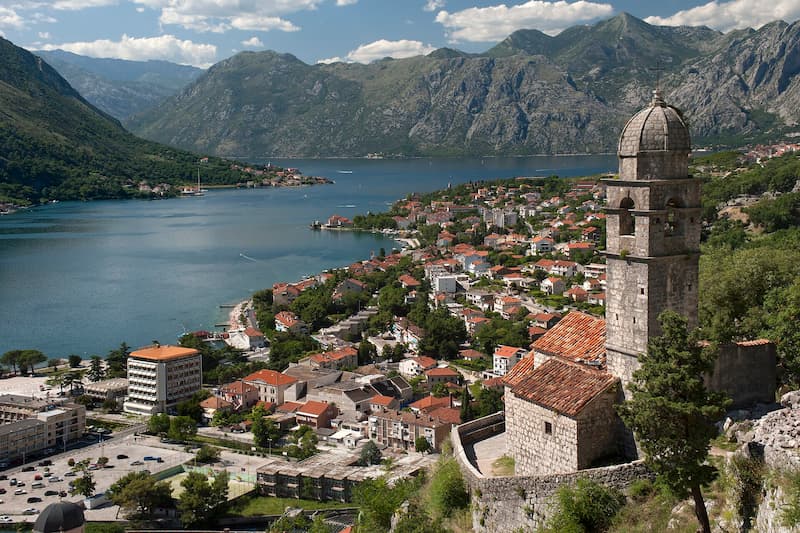
The Natural and Culturo-Historical Region of Kotor is one of the most visually stunning and historically rich destinations in the Mediterranean. Located in Montenegro, this site represents a perfect marriage between a dramatic “fjord-like” landscape and a meticulously preserved medieval urban fabric.
The site encompasses the inner part of the Bay of Kotor (Boka Kotorska), a submerged river canyon surrounded by the towering limestone cliffs of the Orjen and Lovćen mountains. It includes the fortified city of Kotor, the maritime town of Perast, and several smaller settlements like Risan and Dobrota.
Key architectural highlights include:
- Kotor Old Town: A triangular medieval city characterized by its labyrinthine streets and the 12th-century Cathedral of St. Tryphon.
- The City Walls: A massive fortification system that stretches 4.5 km and climbs almost vertically up the mountain to the Fortress of San Giovanni (St. John).
- The Islands of Perast: Two iconic islets—Our Lady of the Rocks (an artificial island built by sailors) and St. George—stand as symbols of the region’s deep connection to the sea.
Attraction
Kotor is a magnet for travelers due to its unique “East meets West” atmosphere and its sheer physical drama:
- The “Southernmost Fjord”: While geologically a ria (a submerged river valley), its resemblance to a Norwegian fjord set in the warm Mediterranean is a major draw.
- Hiking the Ladder of Kotor: The 1,350 steps to the fortress offer panoramic views that are frequently cited as some of the best in Europe.
- Maritime History: Perast, with its 16 Baroque palaces, tells the story of a golden age when local captains commanded the largest fleets on the Adriatic.
- Cat Culture: Kotor is famously a “City of Cats,” with a dedicated cat museum and friendly strays that have become an unofficial mascot for the town.

Heritage
The region was inscribed on the UNESCO World Heritage List in 1979.
- Criteria (i), (ii), (iii), and (iv): It is recognized for its exceptional harmony with the landscape and its role as a bridgehead of Venetian culture in the southern Adriatic. Its schools of masonry and iconography had a profound influence on the arts across the region.
- Dual Inscription: In 2017, the Kotor Fortress was also included as part of a second UNESCO listing: the Venetian Works of Defence between the 16th and 17th Centuries.
- Intangible Heritage: The Boka Navy, a traditional maritime organization founded in 809, was inscribed on the UNESCO Representative List of Intangible Cultural Heritage in 2021.
Gateway
- Tivat (TIV): The closest airport (4.6 km from Kotor). It is the most convenient gateway, though flights can be seasonal.
- Dubrovnik (DBV), Croatia: Located roughly 45 km away. Many international travelers fly here due to the higher frequency of global flights and then take a bus or private transfer across the border.
- Lodging: Kotor Old Town offers numerous boutique hotels and apartments within historic stone buildings. For a more resort-style stay, Tivat (specifically Porto Montenegro) offers high-end luxury hotels and modern amenities.
When
- Shoulder Season (May to June & September to October): These months offer warm, swimmable water and sunny skies without the oppressive heat or the massive crowds from cruise ships.
- Late July to August: The busiest time. Temperatures can exceed 35°C, and the narrow streets of the Old Town can become congested with day-trippers.
- Winter: Very quiet and atmospheric, though many restaurants close, and the region receives significant rainfall.

Consideration
- Cruise Ship Schedules: Check the port calendar. On days when 2-3 large ships are in port, the Old Town can become overwhelmed; try to plan your fortress hike or major sightseeing for days with fewer arrivals.
- Not in the EU/Schengen: Montenegro uses the Euro (€), but it is not part of the European Union or the Schengen Area. You will likely go through a border check if arriving from Croatia or Albania.
- Physical Demands: Exploring the site requires significant walking on uneven cobblestones. To reach the best viewpoints at the fortress, you must be prepared for a steep, hour-long climb.
- Tourist Tax: Visitors must register with the local tourist office and pay a small daily tax (approx. 1-2 Euros), usually handled by your accommodation provider.

Resources
- UNESCO World Heritage Centre – Kotor: The definitive source for historical data and conservation reports.
- Visit Montenegro – Kotor: The national tourism portal for events and general travel logistics.
- Kotor.me (Official Tourism Site): Local information on city sights, museums, and maritime tradition.
- Everything Everywhere – Kotor UNESCO Guide: A deep dive into the site’s significance from a heritage travel specialist.
- GetYourGuide – Kotor Tours: A platform for booking popular boat tours to the Blue Cave and guided walking tours of the Old Town.
Featured Image
Bay of Kotor (Ggia, Wikimedia/CC BY-SA 3.0).
In The News
Advertisement

Comment:
7 responses to “Natural and Culturo-Historical Region of Kotor”
-
The main entrance to the town was constructed in 1555 when the town was under Venetian rule (1420–1797). Visitors should look out for the winged lion of St Mark, Venice’s symbol, which is displayed prominently on the walls here and in several other spots around the town. Also worth taking is the steep path up to the Fortress of San Giovanni, which rewards with spectacular views of the UNESCO World Heritage Old Town below and Europe’s southernmost fjord.
LikeLike
-
Be warned, it’s easy to get lost wandering around this medieval city, purposefully built like a maze to bewilder invading forces and protect it from attack. Top tip: look out for the city’s main landmarks, like St. Tryphon’s Cathedral and St. Nicolas Church.
LikeLike
-
Kotor’s Stari Grad (Old Town) is nestled inside fortifications built during the Venetian period and features well preserved churches, charming squares, and informative museums that will take about two hours to explore on foot. The old town is so beautiful and surreal that you wouldn’t be the only one to think you had just stepped into a fairy tale, or on to the set of Game of Thrones.
The fortifications snake up the steep mountainside above the Old Town to the Castle of San Giovanni (Fortress of St John), also known to the locals as Tvrđave Kotora. Here, at 280 meters above sea level, is the most breathtaking panorama of the electrifying blue fjord and a spectacular bird’s-eye-view of the Old Town’s orange topped buildings below. A walk to the top of the fortress is certainly a must-do on any visit to Montenegro!
LikeLike
-
I love Kotor i stayed there summer last year for couple of days and i enjoyed wandering around the cobblestone alleyways and hiking up the fortress for the sunset view.
LikeLike
-
A labyrinth of rambling cobbled streets, hidden plazas and crumbling staircases that lead to nowhere, the old town of Kotor is the perfect place to spend an afternoon or three following your feet rather than a map and getting completely and delightfully lost. If you’re not a fan of hiking, then taking a leisurely stroll around town is probably one of the best things to do while you’re in Montenegro. Though some streets can seems a little dressed-up for tourists, take a few wrong turns and you’ll quickly find rows of pastel shutters listing in their frames, little old ladies hanging their washing overhead and the cute mewing cats for which this medieval town is famed.
LikeLike
-
Despite seeing many images of this place before my visit, nothing really prepared me for just how stunningly beautiful this bay is. The waterside setting (obviously) with its mountainous backdrop was for me a cross between the Norwegian fjords and those lovely Alpine lakes.
LikeLike
-
The symbol of strength of this town is, I would say, the Clock Tower, which lies in the middle of the town square. It is at an approximate 30-degree slant. Originally upright, a couple of massive earthquakes struck the region over the centuries and caused the structure to incline. Just a few hundred metres from the town square were the protective city walls. There were two routes to reach the top—the steep streets through the interior of the town, and the two-hundred-odd steps straight to the vantage point. I was quite lazy and didn’t want to walk, so I took the shortcut. When I reached up there, all I could see were dreamy blues, pantile roof houses and hundreds of yachts.
LikeLike

 All About World Heritage Sites (...and more)


Leave a comment