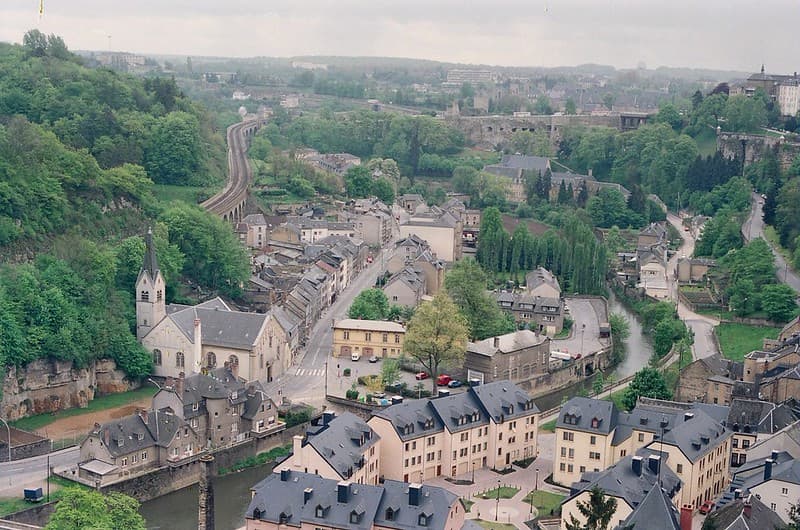
The City of Luxembourg: its Old Quarters and Fortifications is a breathtaking site where military history meets modern European governance. Often referred to as the “Gibraltar of the North,” the city is defined by its dramatic topography, featuring deep river gorges and towering sandstone cliffs that once formed one of the most formidable fortresses in Europe.
The world heritage site encompasses the historic core of Luxembourg City. It is split into two distinct levels: the Ville Haute (High City), perched on the massive Bock cliff, and the Ville Basse (Low City), situated in the Alzette River valley.
The site is dominated by its defensive structures, which were reinforced over four centuries by various European powers—including the Burgundians, Spanish, French, Austrians, and Prussians. While much of the fortress was dismantled following the Treaty of London in 1867 to ensure the country’s neutrality, significant portions remain. This includes the Bock Casemates, a 17km network of subterranean tunnels carved into the rock, and the towering ramparts that offer a “tiered” view of the city’s medieval houses and winding streets.
Attraction
- The “Chemin de la Corniche”: Often hailed as “Europe’s most beautiful balcony,” this pedestrian promenade follows the 17th-century ramparts and provides iconic views of the Grund district below.
- Underground Exploration: The Casemates offer a unique look at military engineering, where visitors can explore the tunnels used to shelter thousands of soldiers and horses during sieges.
- The Contrast of Old and New: As one of the three institutional seats of the European Union, the city offers a fascinating juxtaposition between 1,000-year-old stone walls and the glass-and-steel skyscrapers of the nearby Kirchberg plateau (the financial and EU district).
- Quaint Urban Charm: The Grund and Pfaffenthal districts feel like rural villages frozen in time, with stone bridges, traditional pubs, and narrow alleys nestled directly under the massive fortress walls.

Heritage
UNESCO inscribed the site in 1994 based on its historical and architectural significance:
- Criterion (iv): Luxembourg played a vital role in European history for centuries. Its fortifications are an outstanding example of military architecture that evolved over 400 years, reflecting the strategic importance of the city as a gateway between the major European powers.
- Exceptional Preservation: Despite the “dismantling” in the 19th century, the city has maintained its historical character and topographical integrity. The relationship between the urban fabric and the defensive walls is still clearly visible and exceptionally well-preserved.
Gateway
The site itself is located within the capital city, making Luxembourg City the primary gateway.
- Commercial Airport: Luxembourg Airport (LUX), also known as Findel Airport, is the only international airport in the country. It is located just 6km from the city center.
- Lodging: The city offers a vast selection of high-end hotels, particularly in the Upper City (such as Hotel Le Place d’Armes) and the Kirchberg area, as well as charming boutique stays in the historic quarters.
- Unique Feature: Luxembourg is the first country in the world to offer free public transport (trains, trams, and buses) nationwide, making travel from the airport to the Old Quarters effortless and cost-free for all visitors.
When
- Late Spring to Early Autumn (May to September): This is the best time for walking the fortifications and enjoying the many outdoor cafes in the Place d’Armes.
- Summer (June 23rd): National Day is a spectacular time to visit, featuring military parades, street parties, and a massive fireworks display over the Adolphe Bridge.
- December: The city hosts beautiful Christmas markets in the historic squares, creating a fairytale atmosphere against the backdrop of the illuminated fortifications.

Consideration
- Hilly Terrain: The city is built on multiple levels. While there are public elevators (like the panoramic Pfaffenthal Lift) to help move between the High and Low cities, be prepared for a significant amount of uphill walking.
- Multilingualism: You will hear a mix of Luxembourgish, French, and German. English is very widely spoken, especially in tourist areas and the financial district.
- Cost of Living: Luxembourg is one of the wealthiest countries in the world. While public transport is free, dining and lodging can be significantly more expensive than in neighboring countries.
- Opening Hours: The Casemates are usually closed during the winter months (November to February) for maintenance and safety, so check the schedule if this is a priority for your visit.
- Photography: The best light for photographing the Grund from the Corniche is in the late afternoon when the sun illuminates the valley walls.

Resources
- UNESCO World Heritage Centre – Detailed maps and the official evaluation of the site’s historical value.
- Luxembourg City Tourist Office (LCTO) – The official portal for booking tours of the Casemates and finding local events.
- Visit Luxembourg (National Portal) – Excellent for planning trips beyond the city to see the country’s other castles and nature trails.
- Luxembourg Times – An English-language news site that is great for getting a pulse on local culture and current travel advisories.
- Booking.com: Luxembourg City – A reliable platform for comparing lodging options within walking distance of the Old Quarters.
Featured Image
Ville Basse, Luxembourg (EuroAsia Vizion, Flickr/CC BY 2.0).
In The News
Advertisement


Comment:
3 responses to “City of Luxembourg: its Old Quarters and Fortifications”
-
Even for a diminutive destination, a day tour wasn’t nearly enough time to explore.
LikeLike
-
Our tour took us through the old quarters including this commanding view of the city. It was easy to see why the fortress stood for centuries on that promontary. We loved this view of the Petrusse Valley from the Grund. The Grund neighborhood was located in the lower part of the fortification along the Petrusse River. It still has a village like atmosphere with cobblestoned streets. It is now a district filled with pubs and restaurants and great for nightlife. As we made our way outside of the old city, it was easy to see why Luxembourg city was also called a “City of Contrasts”. The remnants of the old city, its historic sites and the modern buildings all seemed to stand side by side seamlessly. Much like its architecture coexisting, the city is a melting pot of many cultures and people – 170 various nationalities and counting.
LikeLike
-
The ‘most beautiful balcony in Europe’ is in Luxembourg City. It’s called Corniche and if you haven’t been yet, it’s not a balcony quite like the one you have at home though the idea is fairly similar. The balcony have a brilliant view of the old part of the city and is a must-see when you’re in the city.
LikeLike

 All About World Heritage Sites (...and more)
Leave a comment