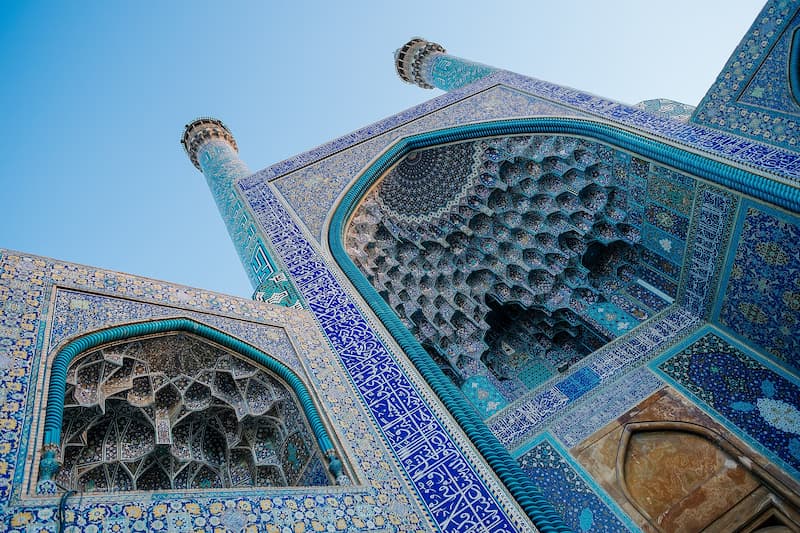
The Meidan Emam (also known as Naqsh-e Jahan Square) in Esfahan, Iran, is one of the most majestic urban spaces ever conceived. Built at the dawn of the 17th century, it was the “Image of the World” (the literal meaning of Naqsh-e Jahan) and served as the grand centerpiece of the Safavid Empire’s new capital.
The square is a massive rectangular expanse, measuring approximately 560m in length and 160m in width. It is entirely enclosed by a continuous, two-story arcade of shops and punctuated by four monumental structures that represent the pillars of Safavid society:
- Masjed-e Shah (The Shah Mosque): Located on the south side, this is the pinnacle of Persian-Islamic architecture, famous for its iconic blue-tiled dome and its ingenious 45-degree angle shift to face Mecca.
- Mosque of Sheikh Lotfollah: Situated on the east, this was the private mosque of the royal court. It lacks minarets and a courtyard but features a dome that changes color from cream to pink depending on the sun’s position.
- Ali Qapu Palace: On the west, this six-story palace served as the royal residence and the grandstand from which the Shah watched polo matches and celebrations in the square below.
- The Qeysarie Gate: On the north, this monumental portal leads into the sprawling Grand Bazaar, one of the oldest and largest in the Middle East.
Attraction
Meidan Emam is often the “love at first sight” moment for travelers in Iran.
- Scale and Symmetry: It is the second-largest historical square in the world (after Beijing’s Tiananmen), yet its architectural harmony makes it feel intimate and inviting.
- The “Half the World” Experience: Locals call Esfahan Nesf-e-Jahan (Half the World), and the square is the epicenter of this claim. The vibrant mix of religious devotion, royal history, and commercial hustle creates a unique atmosphere.
- Exquisite Tilework: The “Haft Rangi” (Seven-Colored) tiles and intricate calligraphy on the mosques are considered some of the finest artistic achievements in the world.
- Evening Culture: As the sun sets, the square transforms. Families picnic on the lawns, horse-drawn carriages clatter across the stone, and the illuminated domes reflect in the central pools.

Heritage
UNESCO inscribed Meidan Emam in 1979 (among the first three sites in Iran) based on its exceptional universal value:
- Criterion (i): It is a masterpiece of human creative genius. The square constitutes a homogenous urban ensemble built over a short period according to a unique and harmonious plan.
- Criterion (v): It is an outstanding example of a traditional human settlement. The integration of the palace, mosques, and bazaar into a single public space represents a pinnacle of Safavid urban planning.
- Criterion (vi): The site is directly associated with the peak of the Safavid dynasty, a period of immense cultural, religious, and political influence that shaped modern Persian identity.
Gateway
The city of Esfahan itself is the gateway. You don’t just “visit” the site; you live within its historic radius.
- Commercial Airport: Isfahan International Airport (IFN), also known as Shahid Beheshti Airport, serves several international routes (Dubai, Istanbul, Doha) and frequent domestic flights from Tehran.
- Lodging: The city offers world-class lodging. The most famous is the Abbasi Hotel, a 300-year-old former caravanserai that is a destination in its own right. There are also numerous boutique traditional houses (khaneh) like the Kianpour Historical House.
- Accessibility: The square is centrally located and easily reached by taxi, bus, or the city’s growing metro system.
When
- Spring (March to May): This is the prime season. The weather is mild (15°C to 25°C), and the city’s famous gardens are in full bloom. Nowruz (Persian New Year) in late March is festive, though very crowded.
- Autumn (September to November): The temperatures are perfect for walking, and the crisp air makes for stunning sunset photography.
- Time of Day: Visit in the late afternoon. Explore the bazaar while it’s bustling, then watch the square transition from a marketplace into a glowing, moonlit social hub.

Consideration
- Dress Code: Iran has specific modesty laws. Women must wear a headscarf (hijab) and a tunic or coat that covers the hips. Men should wear long trousers (no shorts).
- Currency & Cards: International credit cards (Visa/Mastercard) do not work in Iran due to sanctions. You must bring cash (USD or EUR) and exchange it for Rials or use a local prepaid travel card.
- The Bazaar Maze: It is very easy to get lost in the Grand Bazaar. It’s part of the fun, but keep a landmark (like the mosque domes) in mind to find your way back to the square.
- Hospitality: Iranians are famously hospitable. Don’t be surprised if locals approach you to practice their English or invite you for tea; it’s usually a genuine gesture of welcome.

Resources
- UNESCO World Heritage Centre – The official source for the historical dossier and conservation data.
- Visit Iran (Official Tourism) – The national portal for practical traveler info and cultural highlights.
- Islamic Architectural Heritage (IRCICA) – A deep dive into the technical and architectural specifics of the square’s monuments.
- Archnet – An excellent academic and visual repository for the study of the square’s Safavid design.
- GetYourGuide – A reliable platform to book guided walking tours of Esfahan that include Meidan Emam and the historic bridges.
Featured Image
The Shah Mosque (Skot, Wikimedia/CC BY-SA 4.0).
In The News
Advertisement



Comment:
3 responses to “Meidan Emam, Esfahan”
-
What should I bring home? Isfahani carpets. They’re the best in Iran and the colours and knotwork are particularly fine. Nowadays, they’re coloured with artificial dyes, whereas the older pre-1970 carpets were naturally dyed. They’re better, but they’ll cost you.
LikeLike
-
Isfahan is a city of beautiful bazaars, age-old monuments, nice warm people who have a reputation for being stingy (something I never experienced) and a great many restaurants. And then there is the famous Shah Abbas Hotel, a former religious seminary dating back to the Safavid period, and without a doubt one of the most beautiful hotels in the world, with a courtyard that is truly breathtaking. In the grand bazaar of Isfahan, you can find almost everything, from herbs, to hand-made tablecloth, a famous trademark of the city, to Khatam kari. In a small little shop, three young women were hand-painting the famous mina kari of Isfahan which is another special artwork of Isfahan.
LikeLike
-
After the splendors of the neighboring Shah Mosque, one might expect a visit to the Sheikh Lotfollah Mosque to be anti-climactic… The design provides for an amazing reveal as the visitor turns at the end of the passageway to confront the mosque’s hidden magnificence.
LikeLike

 All About World Heritage Sites (...and more)

_2013_06.jpg)
Leave a reply to Kirk Cancel reply