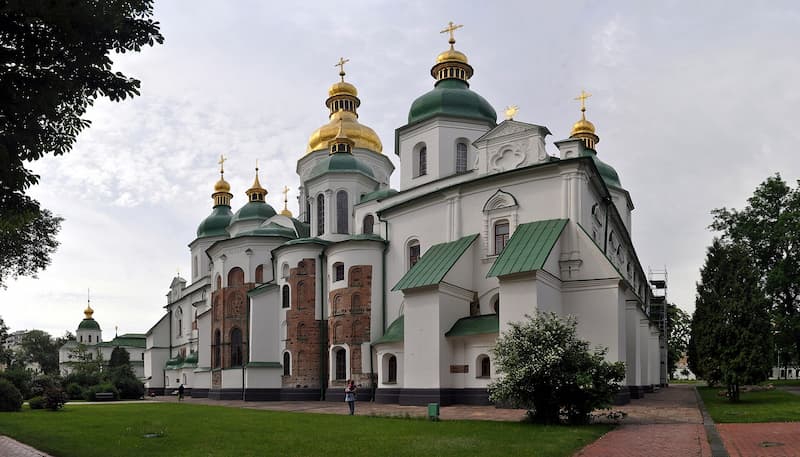
Rising from the hilly right bank of the Dnipro River, the Saint-Sophia Cathedral and the Kyiv-Pechersk Lavra are the spiritual and architectural twin pillars of Ukraine. Together, they represent the transition of Kyivan Rus’ from a pagan stronghold to the epicenter of Eastern Christian culture.
This World Heritage site consists of two distinct but historically linked complexes:
- Saint-Sophia Cathedral: An 11th-century Byzantine masterpiece built to rival the Hagia Sophia in Constantinople. It features five naves and 13 cupolas. While its exterior was remodeled in the 17th-century Ukrainian Baroque style (white walls and green-and-gold domes), its interior remains a time capsule of the Middle Ages, housing the world’s largest collection of authentic 11th-century mosaics and frescoes.
- Kyiv-Pechersk Lavra (Monastery of the Caves): Founded in 1051, this is a sprawling ensemble of churches, bell towers, and subterranean labyrinths. It is divided into the “Upper Lavra” (museums and major churches) and the “Lower Lavra” (the active monastery and caves). The caves are a network of narrow tunnels where the naturally mummified remains of saints have been resting for centuries.
Attraction
Travelers are drawn to these sites for their blend of high art and haunting mysticism:
- The “Virgin Orans” Mosaic: Inside Saint-Sophia, the 6-meter tall “Indestructible Wall” mosaic of the Virgin Mary has survived a millennium of wars and Mongol invasions, leading to the local legend that as long as the mosaic stands, Kyiv will stand.
- The Caves of the Lavra: Visitors descend into the cool, dark tunnels by candlelight to see the mummified monks. It is an experience that is both eerie and deeply moving, regardless of one’s faith.
- The Great Lavra Bell Tower: At 96.5 m tall, it was once the highest structure in the Russian Empire. It offers a breathtaking 360-degree panorama of the city and the winding Dnipro.

Heritage
Inscribed in 1990 (and placed on the List of World Heritage in Danger in 2023 due to the ongoing invasion), the site is recognized for:
- Criterion (i): The 11th-century mosaics and frescoes are a unique peak of Byzantine art.
- Criterion (ii) & (iii): These buildings served as the primary model for Orthodox architecture across Eastern Europe for centuries, influencing church design from Belarus to Russia.
- Criterion (iv): They represent the “Golden Age” of Kyivan Rus’, the precursor state to modern Ukraine, Russia, and Belarus.
Gateway
All commercial airports within Ukraine remain closed to civil aviation due to the ongoing martial law and aviation emergency.
- Gateway: Warsaw, Poland (Warsaw Chopin Airport – WAW).
- Logistics: From Warsaw, the best way to reach Kyiv is via the “Kyiv Express” direct night train (approx. 15–17 hours) or a long-distance bus.
- Lodging: Warsaw has an abundance of world-class lodging (e.g., Hotel Bristol or the InterContinental) where travelers can stay before catching their cross-border transport.
- Secondary Option: Chełm or Przemyśl in Poland serve as the final rail hubs before crossing the border.
When
- Late Spring (May): Kyiv is known as the “City of Chestnuts.” In May, the city’s thousands of chestnut trees are in full white-and-pink bloom, and the weather is typically mild.
- Early Autumn (September): The “Golden Autumn” turns the city’s many parks into a backdrop of yellow and orange, which perfectly complements the golden domes of the cathedrals.

Consideration
- Security Context: Ukraine is an active conflict zone. You must monitor air raid alerts via local apps (like “Air Alert”) and follow the instructions for seeking shelter in the Metro system.
- Dress Code (Lavra): The Lavra is an active religious site. Women must cover their heads with a scarf and wear a skirt that falls below the knee. Men must wear long trousers (no shorts) and shirts with sleeves.
- Photography: Taking photos is strictly prohibited inside the caves and is often restricted near the 11th-century frescoes to prevent light damage.
- Martial Law: Be aware of nightly curfews (typically starting at midnight) and carry your passport at all times for potential military checkpoints.

Resources
- UNESCO – Kyiv: Saint-Sophia & Lavra: The official record of the site’s historical significance and “In Danger” status.
- Visit Ukraine: A comprehensive portal for current travel requirements, insurance (military risk coverage), and safety updates.
- Sophia Kyivska National Reserve: The official museum site for the Cathedral, providing details on frescoes and tour availability.
- Ukrainian Railways (UZ): The essential site for booking the highly sought-after train tickets from Poland to Kyiv.
- Trip.com – Kyiv Travel Guide: A reliable site for booking hotels in Kyiv and finding recent traveler reviews of the site’s accessibility.
Featured Image
Saint-Sophia Cathedral (Pawel “pbm” Szubert, Wikimedia/CC BY-SA 3.0).
In The News
Advertisement



Comment:
 All About World Heritage Sites (...and more)

Leave a comment