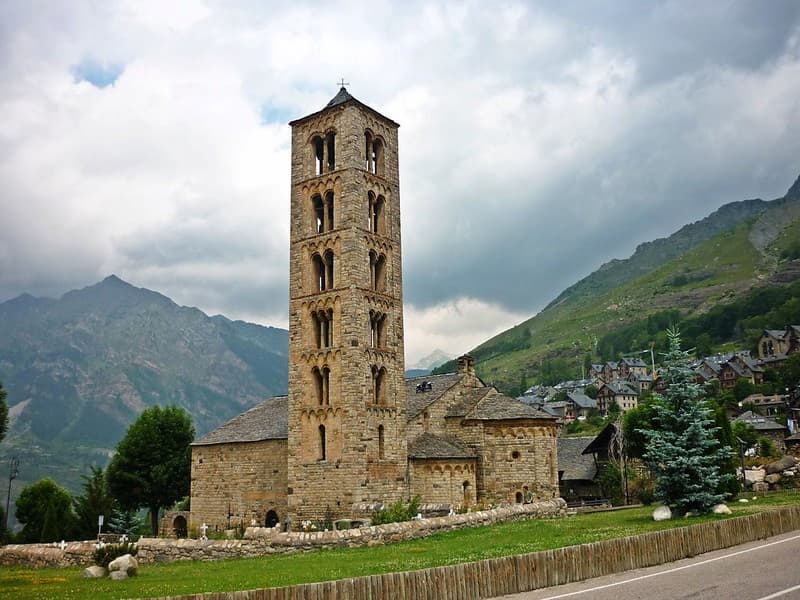
The Catalan Romanesque Churches of the Vall de Boí represent one of the most significant and cohesive collections of Romanesque architecture in Europe. Located in the high Pyrenees of Alta Ribagorça in Catalonia, Spain, this site consists of nine early medieval churches that have remained remarkably preserved for nearly a millennium.
The site is a cultural landscape where architecture and nature converge. The nine churches—Sant Climent and Santa Maria (Taüll), Sant Joan (Boí), Santa Eulàlia (Erill la Vall), Sant Feliu (Barruera), la Nativitat (Durro), Sant Quirc (Durro), Santa Maria (Cardet), and l’Assumpció (Coll)—were built during the 11th and 12th centuries.
Characterized by the Lombard Romanesque style, these structures feature:
- Stone Masonry: Meticulous work with local stone.
- Bell Towers: Slim, multi-story square towers with elegant arched windows.
- External Decoration: Blind arches and saw-tooth friezes that decorate the apses.
- Frescoes: While many originals were moved to protect them, the churches originally housed world-famous wall paintings.
Attraction
Tourists from across the globe are drawn to the valley for its unique combination of artistic heritage and alpine beauty. Key attractions include:
- The “Mapping” of Sant Climent: A high-tech video projection (video mapping) that reconstructs the famous 12th-century Pantocrator fresco over the original apse, providing a breathtaking look at how the church appeared in its prime.
- Historical Preservation: Walking through villages like Taüll or Erill la Vall feels like stepping back into the Middle Ages, as the urban layout and the churches have faced minimal modern alteration.
- Outdoor Integration: The site sits at the doorstep of the Aigüestortes i Estany de Sant Maurici National Park, allowing travelers to pair high-culture visits with world-class hiking and mountain scenery.

Heritage
UNESCO inscribed the site in 2000 based on its outstanding universal value. It met two primary criteria:
- Criterion (ii): The churches represent an especially pure and consistent example of Romanesque art in a virtually untouched rural setting. They reflect a significant cultural exchange across medieval Europe, specifically the spread of Lombard architectural influences from Italy to the Pyrenees.
- Criterion (iv): They are an exceptional example of a type of building ensemble that illustrates a significant stage in human history—the period when Christianity expanded and solidified its presence in the mountainous regions of the Iberian Peninsula.
Gateway
The primary gateway to the Vall de Boí is Barcelona.
- Commercial Airport: Josep Tarradellas Barcelona–El Prat Airport (BCN) is the largest international hub in the region, offering direct flights from most major global cities.
- Lodging: As a world-tier tourist destination, Barcelona offers thousands of lodging options, from luxury hotels to boutique hostels.
- Connection: From Barcelona, it is approximately a 3.5 to 4-hour drive to the valley. While Lleida (ILD) is closer (1.5 hours) and has a smaller airport (Lleida-Alguaire), its commercial flight schedule is significantly more limited than Barcelona’s, making Barcelona the more reliable gateway for international travelers.
When
The ideal time to visit is from late May to early October.
- Late Spring/Early Autumn (June & September): These are the “sweet spots” with mild weather, blooming landscapes, and fewer crowds than the peak summer months.
- Summer (July-August): Excellent for mountain hiking, though the small villages can get crowded and the popular video mapping shows at Sant Climent often require advance booking.
- Winter: Beautiful if you enjoy snow and skiing (Boí Taüll is a major ski resort), but be aware that mountain passes can be tricky to navigate.

Consideration
- Transportation: A rental car is highly recommended. While local taxis and limited bus services exist, the nine churches are spread across different villages; having your own vehicle allows you to explore at your own pace.
- Joint Tickets: Don’t buy individual entries at every stop. Visit the Centre del Romànic in Erill la Vall first to purchase a pass that covers multiple churches.
- The Originals are in Barcelona: Many of the original 12th-century frescoes were removed in the early 1900s to prevent them from being sold abroad. They are now housed in the Museu Nacional d’Art de Catalunya (MNAC) in Barcelona. It is highly recommended to visit the MNAC to see the original “Christ in Majesty” before or after your trip to the valley.
- Mountain Gear: Even in summer, temperatures can drop rapidly in the evenings. Pack layers and sturdy walking shoes.

Resources
- UNESCO World Heritage Centre: The official source for the site’s historical and cultural significance.
- Centre del Romànic de la Vall de Boí: The local authority site providing opening hours, ticket prices, and guided tour information.
- Visit Pirineus: The official tourism portal for the Pyrenees, great for planning broader itineraries.
- Museu Nacional d’Art de Catalunya (MNAC): Essential for viewing the original frescoes and understanding the art history of the region.
- TripAdvisor: Useful for reading recent traveler reviews, checking photos of the video mapping, and booking nearby accommodation.
Featured Image
Sant Climent Church (Albert Torello, Flickr/CC BY-SA 2.0).
In The News
Advertisement


Comment:
 All About World Heritage Sites (...and more)
Leave a comment