The Wieliczka and Bochnia Royal Salt Mines in southern Poland represent one of the world’s most extraordinary industrial and cultural complexes. These two mines, worked in parallel for seven centuries, comprise a vast subterranean world of labyrinths, chapels, and lakes carved entirely from rock salt.
The site consists of the Wieliczka Salt Mine, the Bochnia Salt Mine, and the Saltworks Castle in Wieliczka.
- Wieliczka: Reaching depths of 327 meters, it features over 287 kilometers of galleries. The “Tourist Route” leads visitors through majestic chambers and past underground saline lakes.
- Bochnia: The older of the two (founded in 1248), it offers a more raw, industrial perspective, including a unique underground boat crossing and a 140-meter slide connecting mine levels.
- Saltworks Castle: The medieval administrative heart that managed the “Kraków Saltworks” enterprise for the Polish kings.
Attraction
The primary draw is the breathtaking underground artistry.
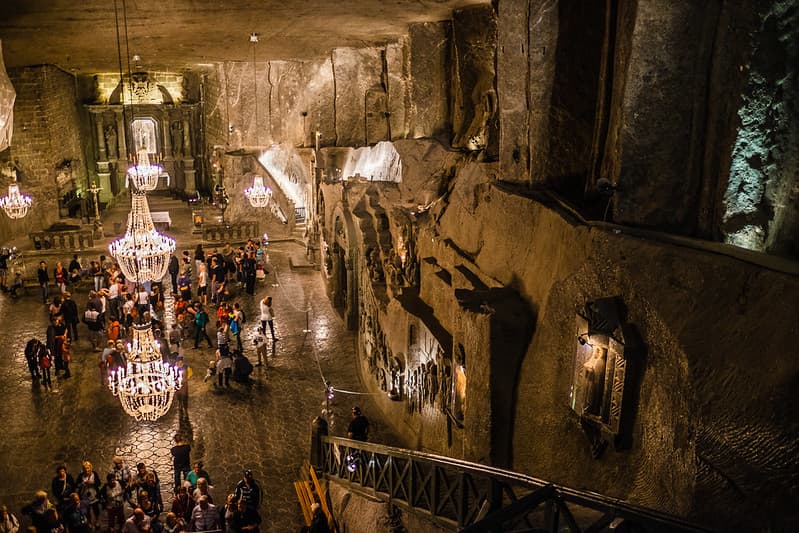
- Chapel of St. Kinga: Often called the “Underground Salt Cathedral,” this massive chamber features altars, reliefs, and even intricate chandeliers carved entirely from salt.
- Legends and Lore: The mines are steeped in the legend of Princess Kinga, whose “magic ring” supposedly led to the discovery of the salt deposits.
- Health and Adventure: Beyond sightseeing, the mines host a health resort (the microclimate is excellent for respiratory issues) and offer “Miners’ Routes” where visitors wear jumpsuits and carry headlamps to perform actual mining tasks.

(Kj, Wikimedia/CC BY-SA 4.0).
Heritage
The site was one of the first 12 entries on the original UNESCO World Heritage List in 1978 (Bochnia was added in 2013).
- Technological Evolution: It provides exceptional testimony to the development of mining techniques in Europe from the 13th to the 20th centuries.
- Artistic Masterpiece: The subterranean chapels and sculptures represent a unique “miners’ culture,” where workers expressed their faith and social traditions in a harsh underground environment.
- Integrity: It is a complete serial property that preserves the mine, the machinery, and the administrative castle.
Gateway
- The Gateway: The historic city of Kraków serves as the perfect base. It is only about 15 kilometers (20–30 minutes) from Wieliczka.
- Airport: John Paul II International Airport Kraków-Balice (KRK) is a major commercial hub with direct flights across Europe and the Middle East.
- Lodging: Kraków offers thousands of options, from 5-star luxury hotels in the Old Town to modern apartments and budget hostels.
When
The mines have a constant temperature of about 17°C to 18°C (63°F to 64°F) year-round, making them an “all-weather” attraction.
- Off-Peak (November to March): Ideal for avoiding the heavy summer crowds. Visiting during the Christmas season is particularly magical due to the underground decorations.
- Early Morning: Regardless of the month, booking the first tour of the day (usually around 8:00 AM) is the best way to experience the silence of the chambers before the large groups arrive.

Consideration
- Physical Activity: Be prepared to walk about 3.5 kilometers and descend over 800 stairs (including 380 at the very start). While you return to the surface via a high-speed elevator, the descent is on foot.
- Clothing: Even if it is a heatwave outside, the mine is cool. Bring a light jacket or sweater.
- Photography: You generally need a small supplemental fee/permit to take photos inside, though this is often included in modern tour packages.
- Claustrophobia: While most chambers are massive (some as high as 50 meters), the access tunnels can feel enclosed.

Resources
- Wieliczka Salt Mine Official Site: The definitive source for booking tickets (essential to book in advance for English tours).
- Bochnia Salt Mine Official Site: Information on the multimedia route and the underground boat crossing.
- UNESCO World Heritage Centre: Detailed historical background and the “Statement of Outstanding Universal Value.”
- Kraków Travel Guide: The official city portal with logistics for getting from Kraków to the mines via train or bus.
- GetYourGuide – Wieliczka Tours: Useful for booking all-in-one day trips from Kraków that may include hotel pickup and skip-the-line entry.
Featured Image
Wieliczka Royal Salt Mines (David Staedtler, Flickr/CC BY 2.0).
In The News
Advertisement

Comment:
2 responses to “Wieliczka and Bochnia Royal Salt Mines”
-
The only warning about visiting the mines is that there are hundreds of steps to descend when entering the mine. The guide was very knowledgeable and the tour was taken at a good pace enabling those who wanted to take photographs time to do so. The chambers themselves were amazing and made the trip a must see. The work carried out by the miners is a sight to see. The highlight is the chamber containing the chapel which is still functioning to this day. The trip ends with a return to the surface on the minors elevator, this is cramped by only lasts for a short time.
LikeLike
-
I’ve seen some impressive sites before, but never heard raving reviews about a salt mine so I wasn’t sure what to expect. The size of the mine was inconceivable until I had actually descended the 378 steps to get to the first of nine levels, 64 metres deep. Our 3-kilometre tour took us deep into the mine, although there was so much more that we didn’t see. Highlights included licking many walls and seeing the salty Pope John Paul II statue in the mines cathedral. It wasn’t just a normal workplace. Horses lived down there transporting salt without ever seeing daylight, workers prayed in the many churches and artists worked to carve impressive sculptures and paintings. The mine goes down to 327m below ground level which is deeper than the height of the Eiffel Tower. Luckily there is an elevator up to ground level after eventually reaching 135m below ground level, otherwise I may have had to book into the Salt Mine hotel for the night.
LikeLike

 All About World Heritage Sites (...and more)

.jpg)

Leave a comment