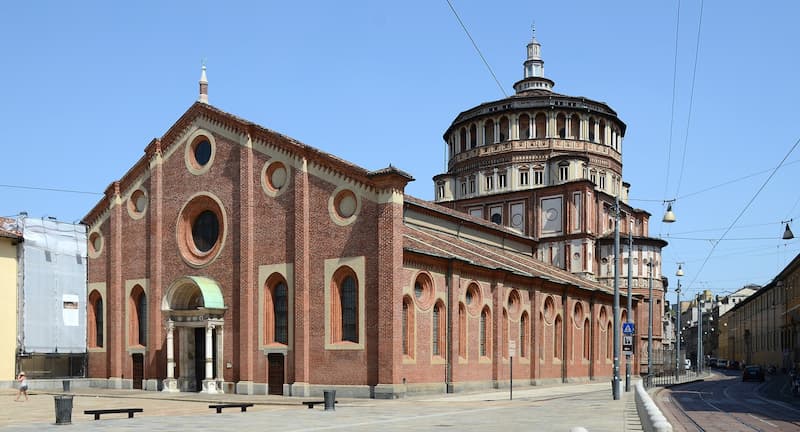
In the heart of Milan, Italy, the Church and Dominican Convent of Santa Maria delle Grazie stands as a supreme monument of the Renaissance. While the church itself is an architectural masterpiece, it is globally renowned for housing one of the most famous and influential works of art in human history: Leonardo da Vinci’s “The Last Supper” (Il Cenacolo).
The complex is a stunning synthesis of Gothic and Renaissance styles. Construction began in 1463 by architect Guiniforte Solari, but it was later transformed under the patronage of Duke Ludovico il Moro. The Duke commissioned the legendary Donato Bramante to enlarge the church, resulting in a magnificent dome and a luminous tribune that represent the pinnacle of Lombard Renaissance design.
The true treasure, however, lies in the Refectory (the monastery’s former dining hall). On its north wall, Leonardo da Vinci painted “The Last Supper” between 1495 and 1497. Measuring approximately 4.6m x 8.8m, the mural depicts the explosive psychological moment after Jesus announces that one of his disciples will betray him. Unlike traditional frescoes, Leonardo used an experimental technique of tempera and oil on dry plaster to achieve a richness of detail and light, though this ultimately led to the painting’s rapid deterioration and necessitated centuries of restoration.
Attraction
“The Last Supper” is more than a painting; it is a cultural icon that draws millions of visitors for several reasons:
- The Master of Perspective: Leonardo’s use of one-point perspective—where all lines converge at Jesus’s right temple—creates an illusion of three-dimensional space that seems to extend the actual room of the refectory.
- Psychological Realism: Before Leonardo, the apostles were often depicted as static figures. Here, they are a whirlwind of human emotion: shock, anger, grief, and confusion.
- Cultural Proliferation: From Dan Brown’s The Da Vinci Code to endless parodies in pop culture, the image is etched into the global consciousness, making a first-hand viewing a “bucket-list” experience.
- Bramante’s Architecture: Beyond the painting, the church’s “Cloister of the Frogs” and the elegant dome provide a serene and architecturally significant environment that captures the spirit of 15th-century Milan.

Heritage
UNESCO inscribed the site in 1980 based on its “Outstanding Universal Value”:
- Criterion (i): “The Last Supper” is a unique artistic achievement, representing a “new era in the history of art” through its revolutionary composition and emotional depth.
- Criterion (ii): The work had an immeasurable influence on the development of Western painting. It set the standard for iconographic themes and the use of space and perspective that would be followed by artists for centuries.
- Architectural Integrity: The site is recognized for the harmonious relationship between the church, the convent, and the mural, preserved despite significant damage during WWII.
Gateway
The gateway to the site is the city of Milan itself.
- Commercial Airports: * Milan Malpensa (MXP): The primary international hub, about 50 minutes from the city center via the Malpensa Express train.
- Milan Linate (LIN): Closer to the city center, primarily serving domestic and European flights.
- Lodging: Milan is a global fashion and business capital with thousands of options. For proximity to the site, the Magenta and Centro Storico districts offer luxury boutique hotels like The Antica Locanda Leonardo (located just steps away) or well-known chains for every budget.
When
- Spring (April–May) and Autumn (September–October): These months offer the most pleasant weather for walking the city.
- Time of Day: Morning slots (8:15 AM – 10:00 AM) often have the best natural light filtering through the windows, though evening visits can feel more intimate.
- Avoid Mondays: The museum of the Last Supper is closed every Monday, although the church itself remains open for worship.

Consideration
- The “Two-Month” Rule: Tickets are notoriously difficult to get. They are released in blocks approximately two months in advance and often sell out within minutes. You must book your time slot through the official website.
- The 15-Minute Limit: To protect the painting from the humidity of human breath, groups are limited to 25 people at a time, and you are strictly permitted only 15 minutes inside the refectory.
- Climate Control: You will pass through several “airlock” chambers designed to stabilize the air before entering the viewing area.
- Strict Dress Code: This is a functioning religious site. Shoulders and knees must be covered to enter the church.
- No Photography/Silence: Flash photography is strictly forbidden as it damages the pigments, and visitors are expected to maintain a whisper to preserve the contemplative atmosphere.

(Francecsco Sgroi, Flickr/CC BY 2.0).
Resources
- UNESCO World Heritage Centre – Official dossier on the site’s historical and cultural significance.
- Cenacolo Vinciano (Official Booking) – The only site to buy official tickets at face value (€15 + booking fee).
- YesMilano – The official tourism website for Milan, offering logistics and neighborhood guides.
- Khan Academy: Leonardo’s Last Supper – An excellent resource for understanding the art history and perspective of the mural.
- Trip.com – A helpful platform for booking hotels near the church or securing “skip-the-line” guided tours if official tickets are sold out.
Featured Image
Church of Santa Maria delle Grazie (Marcin Bialek, Wikimedia/CC BY-SA 3.0).
In The News
Advertisement


Comment:
 All About World Heritage Sites (...and more)
Leave a comment