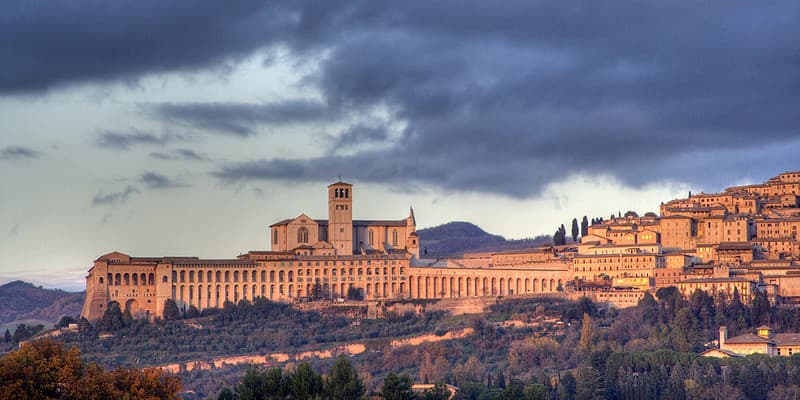
Perched on the sun-drenched slopes of Mount Subasio in the heart of Umbria, Assisi, the Basilica of San Francesco and Other Franciscan Sites is a masterclass in how a city can become a living sanctuary. It isn’t just a collection of old buildings; it is the spiritual and artistic epicenter of the Franciscan movement, where the legacy of Saint Francis and Saint Clare is woven into every pink-hued stone.
Assisi is a remarkably preserved medieval hill town that has maintained its layout since the 13th century. The World Heritage designation encompasses more than just the town center; it includes a network of sacred sites scattered across the valley and the mountain:
- The Basilica of San Francesco: A massive, two-tiered complex (Upper and Lower Basilicas) built into the hillside. It houses the tomb of Saint Francis.
- Basilica of Santa Chiara: Dedicated to Saint Clare, featuring her tomb and the Byzantine crucifix that reportedly spoke to Francis.
- The Cathedral of San Rufino: A Romanesque masterpiece where both saints were baptized.
- San Damiano: The humble church and convent where Francis heard the call to “repair my house” and where Clare lived and died.
- Eremo delle Carceri: A hermitage tucked into a dense forest on the mountain where the friars went for solitary prayer.
- Basilica of Santa Maria degli Angeli: A massive Renaissance church in the valley that encloses the Porziuncola, the tiny 9th-century chapel where the Franciscan Order began.
Attraction
Assisi draws millions annually, transcending simple tourism to become a site of deep pilgrimage and art history.
- The “Cradle” of Italian Art: The Basilica of San Francesco is essentially the “birthplace” of the Renaissance. Its walls are covered in frescoes by masters like Giotto, Cimabue, and Pietro Lorenzetti, marking a revolutionary shift toward realism in Western art.
- Universal Message: Even for non-believers, the site is an attraction due to Saint Francis’s universal message of peace, poverty, and respect for nature.
- The Landscape: The town offers some of the most iconic views in Italy, with cobblestone alleys opening onto the rolling green vistas of the Umbrian Valley.

Heritage
Assisi was inscribed as a UNESCO World Heritage Site in 2000 for several profound reasons:
- Criterion (i): The site represents a masterpiece of human creative genius. The Basilica of San Francesco is considered a supreme achievement of medieval architecture and a fundamental reference point for art history.
- Criterion (ii): It exhibits an important interchange of values. The spiritual and artistic messages of the Franciscan Order influenced the development of art and architecture across Europe and the world.
- Criterion (iii): It is a unique testimony to a cultural tradition. Assisi is an exceptional example of a “city-sanctuary” that has maintained a continuous relationship with its environmental setting from Roman times to the present.
- Criterion (iv): It is an outstanding architectural ensemble. The complex of Franciscan sites influenced building techniques and urban planning throughout the Middle Ages and the Renaissance.
- Criterion (vi): It is directly associated with living traditions. As the birthplace of the Franciscan movement, Assisi is tangibly linked to a universal message of peace and tolerance that continues to resonate today.
Gateway
The ideal gateway to Assisi is the city of Perugia, located just 12 km (7.5 miles) away.
- Airport: Perugia San Francesco d’Assisi – Umbria International Airport (IATA: PEG). It handles domestic and international flights (mostly via Ryanair).
- Lodging: Perugia is a major university city with extensive lodging ranging from luxury boutique hotels like Sina Brufani to cozy bed-and-breakfasts.
- Transit: From Perugia, you can reach Assisi in 20 minutes by train or bus.
When
- Spring (April–June): The weather is mild, and the Umbrian countryside is vibrant with wildflowers.
- Autumn (September–October): Excellent for cooler temperatures and the olive harvest season.
- The Feast of Saint Francis (October 3–4): A peak time for spiritual energy and events, though the town will be incredibly crowded.
- Winter: Quiet and atmospheric, but can be quite cold and foggy.

Consideration
- Steep Terrain: Assisi is built on a steep hill. Be prepared for a lot of walking on inclined, often slippery cobblestones. Sturdy shoes are non-negotiable.
- Dress Code: These are active religious sites. You must cover your shoulders and knees to enter any of the basilicas; security is strict.
- Quietude: In the basilicas—especially the Lower Church—silence is strictly enforced. It’s a place for prayer, not loud chatting.
- Photography: Most of the famous frescoes in the Basilica of San Francesco are strictly off-limits for photography to protect the pigments.

Resources
- UNESCO World Heritage: Assisi: The definitive technical and historical record of the site.
- Umbria Tourism – Assisi: The official regional travel guide for logistical and event information.
- San Francesco Assisi (Official Site): Managed by the friars; provides spiritual info, mass schedules, and restoration updates.
- ItalyGuides: Assisi: Excellent virtual tours and historical context for individual monuments.
- GetYourGuide – Assisi Tours: A reliable platform to book guided walking tours or day trips from nearby cities like Florence or Rome.
Featured Image
Assisi (Roberto Ferrari, Flickr/CC BY-SA 2.0).
In The News
Advertisement

Comment:
 All About World Heritage Sites (...and more)
Leave a comment