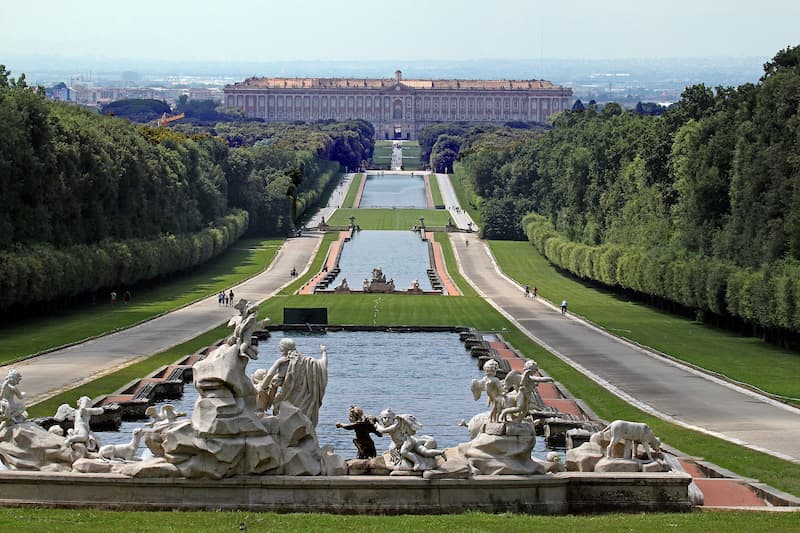
The 18th-Century Royal Palace at Caserta (Reggia di Caserta), along with its sprawling park, the Carolino Aqueduct, and the San Leucio industrial complex, represents one of the most ambitious architectural and social projects of the Enlightenment. Commissioned in 1752 by King Charles of Bourbon and designed by Luigi Vanvitelli, this site was intended to be the heart of a new administrative capital for the Kingdom of Naples, rivaling the grandeur of Versailles and the Royal Palace of Madrid.
The site is a harmonious trio of engineering and artistry:
- The Royal Palace: A massive five-story rectangular structure with 1,200 rooms and four internal courtyards. It is known for its Grand Staircase, the Palatine Chapel, and the Court Theatre.
- The Royal Park and English Garden: Stretching 3 km along a central axis, the park features a “telescope” effect of fountains, basins, and the Grand Cascade. The English Garden is a masterpiece of “organized wilderness,” featuring exotic plants and artificial ruins.
- The Aqueduct of Vanvitelli (Carolino Aqueduct): A 38 km engineering marvel that transports water from the base of Mount Taburno to power the palace fountains and the San Leucio colony.
- The San Leucio Complex: An 18th-century silk-weaving colony that functioned as a “utopian” community, providing workers with housing, education, and medical care—a revolutionary social experiment for its time.
Attraction
The Reggia is a magnet for travelers for several reasons:
- Cinematic Fame: Its opulent interiors have served as filming locations for major blockbusters, including Star Wars: Episode I & II (The Theed Royal Palace on Naboo) and Mission: Impossible III.
- Scale and Splendor: It is often cited as the largest royal residence in the world by volume (2 million m^3), offering a “more-is-more” aesthetic of Baroque and Neoclassical gold, marble, and frescoes.
- The “Water Way”: The sight of the fountains leading toward the waterfall at the foot of the Briano Hill is considered one of the most beautiful vistas in Europe.

Heritage
Inscribed as a UNESCO World Heritage Site in 1997, it met four criteria:
- Criterion (i): It is a unique creation of the Enlightenment, where high-quality architecture is perfectly integrated into a planned natural landscape.
- Criterion (ii): It demonstrates an outstanding interchange of human values through its ambitious urban planning, linking the palace to the surrounding territory via the aqueduct.
- Criterion (iii): It is an exceptional testimony to the Bourbon dynasty’s power and their application of Vitruvian principles of beauty and functionality.
- Criterion (iv): The San Leucio complex is an outstanding example of an industrial site born from idealistic social principles.
Gateway
- City: Naples is the primary gateway, located approximately 30 km south.
- Airport: Naples International Airport (NAP) serves as the main commercial hub with extensive international connections.
- Lodging: Naples offers a vast range of options, from 5-star hotels on the Lungomare to boutique B&Bs. Alternatively, the town of Caserta provides comfortable overnight options within walking distance of the palace entrance.
- Transit: The Reggia Express, a historic train service, often runs between Naples and Caserta, though regular regional trains take only 30–40 minutes.
When
- Spring (April to June): This is the optimal time to see the English Garden in bloom and enjoy the park before the intense Mediterranean summer heat.
- Early Autumn (September to October): The weather is mild, and the changing colors of the trees in the park provide a stunning backdrop for photography.
- Avoid: Summer (July/August) can be extremely hot for the 3 km walk, and the first Sunday of every month is “free entry day,” which often results in overwhelming crowds.

Consideration
- Online Reservations: In 2026, pre-booking tickets via the official reseller (TicketOne) is highly recommended, especially for the Royal Apartments, which have strict time-slot entries.
- Transportation within the Park: The park is enormous. Consider renting a bicycle (4/hour), hiring a horse-drawn carriage, or taking the shuttle bus (2.50 return) to reach the waterfall.
- Separate Tickets: While most tickets include the Palace and Park, the San Leucio Complex is a few kilometers away and often requires a separate booking or transit.
- Comfort: Wear walking shoes. Exploring the full complex (Apartments, Park, and English Garden) typically takes 5–6 hours.

Resources
- Reggia di Caserta – Official Website: The primary source for official news, opening hours, and 2026 event schedules.
- UNESCO – Caserta Site Profile: Technical details on the history and criteria of the heritage listing.
- Italia.it – Royal Palace of Caserta: The national tourism portal’s guide to the site and surrounding Campania region.
- TicketOne – Official Booking Portal: The only authorized reseller for online tickets to the palace and park.
- GetYourGuide – Caserta Day Trips: Excellent for booking guided tours from Naples that include transportation and skip-the-line access.
Featured Image
Royal Palace of Caserta (Carlo Pelagalli, Wikipedia/CC BY-SA 3.0).
In The News
Advertisement

Comment:
 All About World Heritage Sites (...and more)


Leave a comment