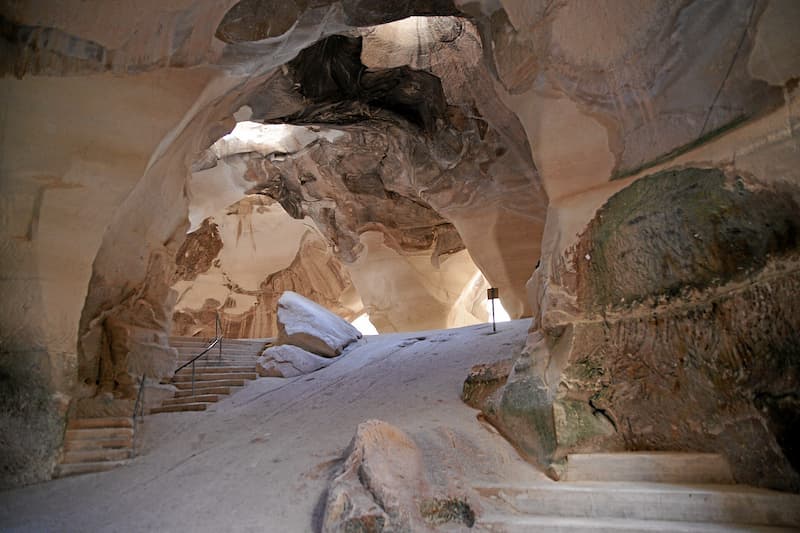
The Caves of Maresha and Bet-Guvrin in the Judean Lowlands are a spectacular “city under a city,” showcasing how humans have adapted to their environment over two millennia. This archaeological marvel in Israel provides a unique look into a “Land of Caves” where the soft chalk bedrock became the canvas for a subterranean civilization.
The site comprises the ancient twin cities of Maresha (Iron Age to Hellenistic period) and Bet-Guvrin (Roman to Crusader period). What makes this site extraordinary is not just what stands above ground, but the thousands of man-made caves carved into the thick, homogeneous layer of soft chalk.
Over 2,000 years, inhabitants excavated nearly 500 subterranean complexes containing thousands of chambers. These were not just random holes but sophisticated, functional spaces:
- Columbaria: Intricate dovecotes with thousands of small niches for raising pigeons.
- Olive Oil Presses: Large-scale industrial workshops found deep underground.
- Cisterns & Baths: Massive water storage systems that sustained the desert population.
- Hiding Complexes: Narrow, winding tunnels used by Jewish rebels during the Bar Kokhba revolt against Rome.
- The Bell Caves: Enormous, cathedral-like limestone quarries, some reaching 25 meters in height, shaped like bells to ensure structural stability.
Attraction
The site is a magnet for history buffs, photographers, and families for several reasons:
- The “Dig for a Day” Program: This is one of the few places on Earth where tourists can actually join an active archaeological dig, sifting through ancient “garbage” caves to find 2,000-year-old pottery, coins, and tools.
- Sidonian Burial Caves: These caves feature rare, vibrant frescoes of mythical creatures (like the three-headed Cerberus) and real animals (elephants, giraffes), reflecting a multicultural Hellenistic society.
- The Roman Amphitheater: Visitors can explore one of the best-preserved Roman arenas in Israel, complete with the subterranean galleries where gladiators and animals waited before combat.
- Visual Spectacle: The scale and acoustic quality of the Bell Caves are so impressive that they have been used as filming locations (e.g., Rambo III) and occasionally host underground concerts.

Heritage
Inscribed in 2014, the site is recognized under Criterion (v) of the UNESCO guidelines:
- Traditional Human Land Use: It is an eminent example of how humans utilized the unique geological properties of the Judean Lowlands. The “city under a city” represents a sustainable, adaptive way of life where the subterranean environment provided natural climate control (cool in summer, warm in winter) and protected the inhabitants’ industries.
- Continuity of History: The caves offer a chronological record of occupation from the Iron Age through the Persian, Hellenistic, Roman, Byzantine, and Early Islamic periods, up to the Crusades.
Gateway
The best gateway to the site is Tel Aviv, specifically via Ben Gurion International Airport (TLV).
- Logistics: The airport is located in Lod, on the outskirts of Tel Aviv. From here, you can reach the National Park in about 45 to 60 minutes by car or taxi.
- Lodging: Tel Aviv offers the widest range of international-standard hotels, boutique stays, and hostels in the country.
- Alternative: While the city of Kiryat Gat is closer (15 mins) and has a train station, it lacks a commercial airport and has significantly fewer lodging options for international tourists compared to the metropolitan hub of Tel Aviv.
When
- The Ideal Window: March to May (Spring). This is when the Judean Lowlands are covered in lush green grass and blooming wildflowers (like the red anemones). The weather is mild, typically 18°C to 25°C.
- Alternative: September to November (Autumn). The heat of summer has dissipated, making the outdoor portions of the park comfortable to explore.
- Note: Aim for late March to catch the peak of the spring bloom before the landscape turns golden-brown in the summer heat.

Consideration
- Physical Activity: You will be climbing many stairs and walking through uneven cave floors. Closed-toe shoes with good grip are essential.
- Cave Temperatures: Even on a scorching 35°C day, the caves remain a cool, damp 18°C–20°C. You may want a light layer if you plan to spend hours underground.
- Dig Reservations: If you wish to participate in the “Dig for a Day” program, you must book weeks in advance, as it is highly popular and slots are limited.
- The “Circuit” Road: The park is large; it is best navigated by car, driving between the major “parking clusters” (Maresha, Sidonian Caves, Bell Caves, and the Amphitheater).
- Security Context: As with all travel in this region, always check the current travel advisories and park opening status on the day of your visit.

Resources
- Israel Nature and Parks Authority (Official) – The primary source for opening hours, entry fees, and real-time alerts.
- UNESCO World Heritage Centre – Detailed maps and the official nomination dossier.
- Archaeological Seminars Institute – The official organizers of the “Dig for a Day” program.
- Tourist Israel – A comprehensive travel guide with practical logistics for international visitors.
- Viator – Used for booking organized day-tours from Tel Aviv or Jerusalem that combine the caves with other Judean sites.
Featured Image
The Bell Cave, Maresha (Mboesch, Wikimedia/CC BY-SA 4.0).
In The News
Advertisement



Comment:
 All About World Heritage Sites (...and more)
Leave a comment