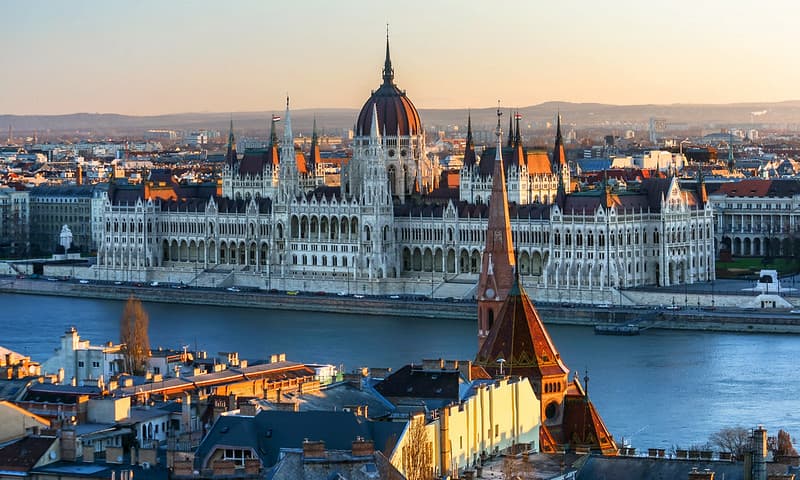
Budapest, including the Banks of the Danube, the Buda Castle Quarter and Andrássy Avenue, is a sprawling urban masterpiece in Hungary that showcases the evolution of European architecture and urban planning. It is a city of two halves—Buda and Pest—unified by history and the flowing Danube.
The World Heritage site encompasses several distinct zones:
- The Buda Castle Quarter: Perched on a hill, this medieval and baroque district features the Royal Palace, Matthias Church, and the Fisherman’s Bastion.
- The Banks of the Danube: This stretch includes the iconic Neo-Gothic Hungarian Parliament, the Gresham Palace, and four historic bridges, including the Szechenyi Chain Bridge.
- Andrássy Avenue: A 19th-century radial boulevard (often called the “Champs-Élysées of the East”) that connects the city center to Heroes’ Square. It is also home to the Millennium Underground Railway, the world’s second-oldest subway.
Attraction
Budapest is a magnet for travelers due to its “Grand Dame” elegance and vibrant energy:
- Thermal Bath Culture: Often called the “City of Spas,” visitors flock to the Art Nouveau Gellért Baths or the expansive Széchenyi Thermal Bath.
- Ruin Bars: Unique to Budapest, historic buildings in the Jewish Quarter have been converted into eclectic, artistic nightlife hubs like Szimpla Kert.
- The Danube Panorama: The riverfront is spectacular at night when the Parliament and Castle are illuminated, making river cruises a top activity.

Heritage
Inscribed in 1987 (and extended in 2002), the site meets Criteria (ii) and (iv):
- Criterion (ii): The architecture has had a profound influence on Eastern European urban development, particularly the unification of three cities (Buda, Pest, and Óbuda) into a single modern metropolis.
- Criterion (iv): It serves as an outstanding example of a city that reflects the diverse periods of Hungarian history, from Roman ruins (Aquincum) and Gothic fortifications to 19th-century Neo-Renaissance and Art Nouveau styles.
Gateway
The city itself is the primary gateway, offering world-class connectivity.
- Airport: Budapest Ferenc Liszt International Airport (BUD) is the main commercial hub, located about 16 km (10 miles) from the city center.
- Lodging: From the ultra-luxury Four Seasons Gresham Palace to trendy apartments in District VII, there is ample lodging. For first-timers, staying in Pest (District V) is recommended for proximity to major sights.
When
- Shoulder Seasons (April–May & September–October): The best overall value and weather. Temperatures range from 15°C to 22°C, and crowds are manageable.
- Winter (December): Despite the cold, the city is magical for its world-renowned Christmas Markets at Vörösmarty Square.
- Summer (August): Ideal for the Sziget Festival, though be prepared for high heat and peak prices.

Consideration
- Currency: Hungary uses the Forint (HUF). While cards are widely accepted, carry small amounts of cash for markets.
- Public Transport Validation: You must validate paper tickets before or at the start of your journey to avoid heavy fines from roving inspectors.
- Taxis: Never hail a cab on the street. Use apps like Bolt to ensure regulated pricing and safety.
- Thermal Bath Etiquette: Most baths require a swim cap for the lap pools and flip-flops for the walkways.

Resources
- UNESCO World Heritage – Budapest: The official technical dossier for the site.
- Budapest Info (Official): The city’s official tourism portal.
- BKK – Budapest Transport: Essential for planning metro, tram, and bus travel.
- Nomadic Matt – Budapest Guide: Excellent itineraries and budget tips.
- Big Bus Tours Budapest: A convenient way to see all the World Heritage zones in one loop with an audio guide.
Featured Image
Hungarian Parliament (Jorge Franganillo, Flickr/CC BY 2.0).
In The News
Advertisement

Comment:
5 responses to “Budapest, including the Banks of the Danube, the Buda Castle Quarter and Andrássy Avenue”
-
I would say the must-sees would be the Buda Castle district, Parliament (inside for the crown jewels and outside for the architecture, modeled after England’s Parliament building), Hero’s Square, Andrassy Boulevard, the Great Synagogue and Hungarian National Gallery. The must-do’s include a visit to a famous bath to pamper yourself, lunch at the Great Market Hall followed by dessert in a popular coffeehouse or cafe; and, of course, a day trip to the beautiful Danube Bend.
LikeLike
-
At the Millennium Monument you’ll meet the world’s most historic Hungarians. The granddaddy of all Magyars was Árpád. Atop the pillar, the Archangel Gabriel offers the crown to Saint Stephen, the king who Christianized the Magyars.
LikeLike
-
For sweeping panoramic views of Budapest, go up to the Fisherman’s Bastion on the Buda district. Right across the Chain Bridge, make your way past Buda castle. The hill isn’t particularly steep but can induce a sweat as it meanders towards the stairs of the Fisherman’s Bastion. The effort will be well worth it, as the views are fantastic. The multi-colored tiles on Matthias Church offer a welcome sight. Here you can see the famed Parliament Building, Chain Bridge, and the radiant district of Pest from up high.
LikeLike
-
The banks of the Danube is a joy to take a stroll along the Danube (especially at night when everything is lit up). This stretch of the Danube walkway goes from the Elizabeth Bridge to the Chain Bridge, and is perfect for those who want a short, but interesting walk. Promenading along the Danube is a great way to see many of Budapest’s best sights.
LikeLike
-
The Parliament is the most dramatic of all, I think, because of its sheer size. You don’t expect a utilitarian building to have such esthetic value. It is Hungary’s largest, and Budapest’s tallest, building. Yes, you will visit it and be struck by its size and beauty on the inside.But from the outside, it is equally majestic and awe-inspiring. It is the length of three football fields (imagine standing in the end zone of one and then looking two fields beyond). It is more than 300 feet high, filled with almost 700 rooms.
LikeLike

 All About World Heritage Sites (...and more)

Leave a comment