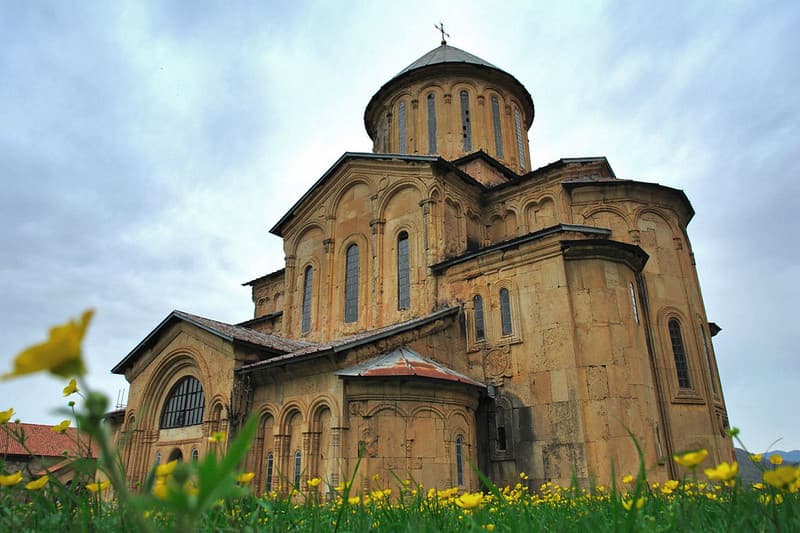
The Gelati Monastery, located in the Imereti region of western Georgia, is a profound architectural and spiritual landmark that serves as a testament to the nation’s medieval “Golden Age.” Founded in 1106 by King David IV (David the Builder), it was designed to be more than just a place of worship—it was an intellectual powerhouse intended to rival the greatest academies of the Byzantine world.
The Gelati Monastery complex sits on a verdant hillside approximately 8 km northeast of the city of Kutaisi. It is an ensemble of several significant structures, most notably the Cathedral of the Virgin, the smaller churches of St. George and St. Nicholas, and the ruins of the Gelati Academy.
Architecturally, the site represents the pinnacle of Georgian medieval design. The buildings are constructed from large, smoothly hewn blocks of pale stone, characterized by their balanced proportions and the use of blind arches for exterior ornamentation. Inside, the Cathedral is famous for its vibrant, multi-layered frescoes and one of the most remarkable mosaics in the Eastern Orthodox world: a 12th-century masterpiece in the apse depicting the Virgin and Child flanked by the Archangels Michael and Gabriel.
Attraction
Gelati is an essential stop for anyone exploring the cultural heart of the Caucasus for several reasons:
- The Tomb of David the Builder: One of Georgia’s most revered kings is buried in the south gate. At his own request, his tomb was placed in the floor so that all who entered would step on his grave—a gesture of extreme humility.
- Masterful Frescoes: The interior walls are covered in colorful murals dating from the 12th to the 18th centuries, offering a visual history of Georgian ecclesiastical art.
- Atmospheric Spiritualism: If you visit during a Sunday morning service, you may hear the haunting polyphonic Georgian chants, which are themselves recognized by UNESCO as intangible heritage.
- Natural Beauty: The monastery is surrounded by dense forests and offers peaceful views over the Tskaltsitela river valley, making it as much a nature retreat as a historical one.

Heritage
UNESCO inscribed Gelati Monastery in 1994 (with boundary modifications in 2017) based on its exceptional universal value:
- Criterion (iv): It is a masterpiece of the “Golden Age” of Georgian architecture. It illustrates the high point of the kingdom’s political and economic strength and reflects the sophisticated artistic idiom of the period.
- Preservation of Byzantine Art: The site preserves an almost unique ensemble of mosaics and paintings that are comparable in quality to the best Byzantine examples, making it a critical site for the study of Eastern Christian art.
- Intellectual Hub: The presence of the Academy, where philosophy, science, and theology were studied, marks it as a rare example of a medieval center of learning that bridged the gap between the Byzantine and Islamic worlds.
Gateway
The city of Kutaisi is the primary and most convenient gateway to Gelati Monastery.
- Commercial Airport: Kutaisi International Airport (KUT) is a major hub, particularly for low-cost carriers (like Wizz Air) connecting Georgia to Europe and the Middle East. It is located just 20 km from the city center.
- Lodging: As Georgia’s third-largest city, Kutaisi offers a wide range of accommodation, from upscale boutique options like the Newport Hotel to charming guesthouses in the historic center.
- Proximity: The monastery is a short 15 minute taxi or bus ride from the city, allowing for easy half-day trips.
When
- Spring (May to June): The surrounding hills are at their greenest, and the weather is mild and pleasant for exploring the grounds.
- Autumn (September to October): This is harvest season in the nearby wine regions. The temperatures are comfortable, and the autumn foliage provides a stunning backdrop to the stone structures.
- Time of Day: Early morning (around 9:00 AM) is best to avoid the large tour groups and to catch the morning light as it illuminates the gold in the mosaics.

Consideration
- Dress Code: As an active religious site, visitors must dress respectfully. Women should cover their heads (scarves are usually available at the entrance) and wear skirts that cover the knees. Men should wear long trousers and avoid tank tops.
- Restoration Work: Since 2020, the monastery has undergone significant conservation efforts due to roof leaks that threatened the frescoes. You may see scaffolding inside the main cathedral; check local updates if you want an unobstructed view of specific murals.
- Combine with Motsameta: Most visitors combine Gelati with a trip to the nearby Motsameta Monastery, which is perched dramatically on a cliff over a river loop. A taxi driver will usually offer a combined price for both.
- Stairs and Slopes: While the main courtyard is relatively flat, the walk between the different churches and the ruins of the Academy involves some uneven stone paths.

Resources
- UNESCO World Heritage Centre – The definitive source for official documentation and maps of the site.
- Georgia Travel (National Tourism Administration) – Provides practical visitor information and regional highlights.
- Lonely Planet: Gelati Monastery – Offers independent reviews and logistical tips for independent travelers.
- Agenda.ge Heritage News – Excellent for checking the current status of restoration works and conservation news.
- GetYourGuide – A high-utility site for booking guided day tours from Kutaisi or Tbilisi that include Gelati and Motsameta.
Featured Image
Cathedral of the Virgin (Roberto Strauss, FLickr/CC BY 2.0).
In The News
Advertisement

Comment:
 All About World Heritage Sites (...and more)

Leave a comment