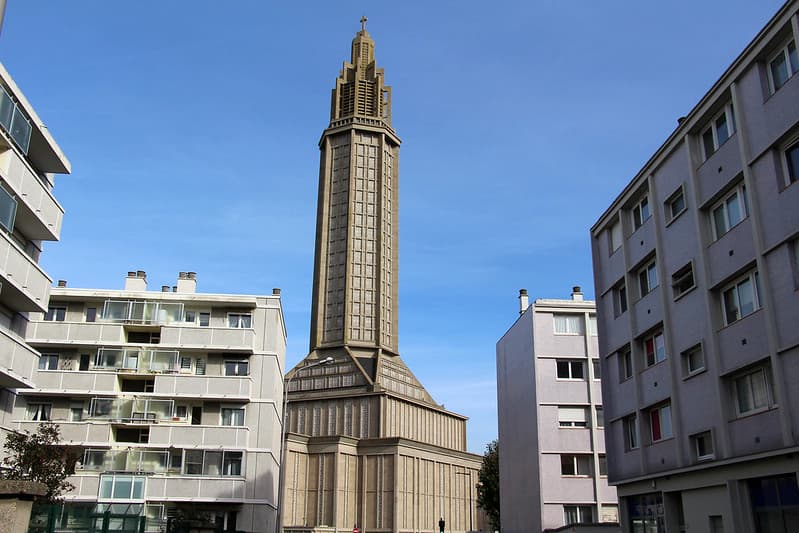
Known as the “Concrete Poet’s Masterpiece,” the city center of Le Havre in Normandy is a radical departure from the quaint, timber-framed image of northern France. After being nearly leveled during World War II, it was reimagined as a modernist utopia, proving that industrial materials like concrete could possess their own rhythmic, classical beauty.
The site encompasses the administrative, commercial, and cultural heart of Le Havre, rebuilt between 1945 and 1964. Following the “Great Bombardment” of 1944, which left 80,000 people homeless, architect Auguste Perret was tasked with creating a new city from the rubble.
Perret’s design is defined by a rigorous modular grid—specifically a 6.24m square—that dictates the proportions of every street, square, and building. This creates a sense of “musical harmony” and visual continuity. The architecture is characterized by exposed reinforced concrete, wide boulevards (like the Avenue Foch, which is wider than the Champs-Élysées), and innovative “prefabricated” structural elements. Key landmarks include the soaring St. Joseph’s Church and the monumental Hôtel de Ville (Town Hall).
Attraction
While many tourists initially perceive Le Havre as “grey,” they are quickly won over by its light and space. Its global appeal lies in:
- St. Joseph’s Church: A 107-meter-high concrete “lighthouse” that dominates the skyline. Inside, it features 12,768 pieces of multicolored hand-blown glass that bathe the raw concrete interior in a kaleidoscope of light.
- The “Show Flat” (Appartement Témoin): A meticulously preserved 1950s apartment that allows visitors to step back into the mid-century modern era, showcasing the “ideal” living standards of the time (central heating, built-in kitchens, and sunlight).
- Art and Culture: The MuMa (Museum of Modern Art André Malraux) holds one of France’s finest Impressionist collections, housed in a stunning glass-walled building that reflects the changing light of the estuary.
- Un Été au Havre: An annual summer contemporary art festival that places giant, colorful installations—like the famous “Catène de Containers”—throughout the city’s architectural landscape.

Heritage
Inscribed in 2005, Le Havre is one of the few 20th-century urban centers on the UNESCO list. It met two primary criteria:
- Criterion (ii): The city is an outstanding example of the integration of urban planning traditions with the pioneering implementation of modern technology and architecture. It managed to preserve the historical “spirit” of the old port while embracing a revolutionary new layout.
- Criterion (iv): It is a landmark of post-war urban planning based on a unity of methodology. Perret’s use of the modular grid and prefabrication was ahead of its time, providing a blueprint for how a destroyed city could be rebuilt with dignity, functionality, and aesthetic cohesion.
Gateway
While Le Havre has a small regional airport (LEH – Octeville), the definitive international gateway is Paris.
- Airport: Fly into Paris Charles de Gaulle (CDG).
- Lodging: Paris offers limitless options for every budget.
- Connection: You can take a direct train from Paris Gare Saint-Lazare to Le Havre in about 2 hours and 15 minutes. Alternatively, many travelers rent a car and drive through the scenic Seine Valley to reach the coast.
When
- The Best Time: May to September. This period offers the warmest temperatures (16°C to 22°C) and the most sunlight.
- Summer Highlights: July and August are the peak of the “A Summer in Le Havre” festival, when the city feels most vibrant and outdoor art is everywhere.
- Autumn (October): Great for sailors, as the city often hosts major regattas like the Transat Jacques Vabre.

Consideration
- Book the “Show Flat” Early: Access to the Appartement Témoin Perret is by guided tour only and spaces are limited. It is best to book weeks in advance during the summer.
- Monday Closures: Like many French cities, several museums (including the Natural History Museum) are closed on Mondays.
- Coastal Winds: Le Havre is a port city on the English Channel. Even on sunny days, it can be quite windy. Bring a windbreaker or a light jacket.
- Perception Check: Don’t expect “Old World” Europe. Le Havre is a tribute to the 20th century. To fully appreciate it, look at the textures of the concrete—Perret used crushed glass and colorful stones in the mix to give the walls a subtle shimmer.

(Patrick, Flickr/CC BY-SA 2.0).
Resources
- UNESCO World Heritage Centre – The official dossier on Perret’s urban plan.
- Le Havre Étretat Normandie Tourisme – The best local site for planning visits to the churches and museums.
- MuMa Le Havre (Official) – Essential for checking current art exhibitions.
- Everything Everywhere – A fantastic travel blog with a deep dive into the “why” of this specific site.
- Viator – Useful for booking guided architectural walking tours or day trips from Paris to the Normandy coast.
Featured Image
St Joseph’s Church (Fred Romero, Flickr/CC BY 2.0).
In The News
Advertisement


Comment:
 All About World Heritage Sites (...and more)
Leave a comment