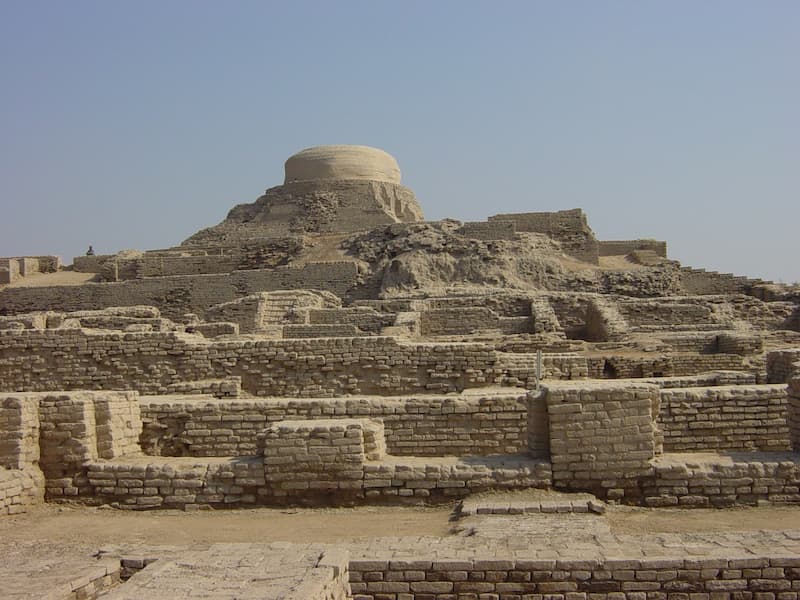
The Archaeological Ruins at Moenjodaro, located in the Sindh province of Pakistan, represent one of the world’s most significant urban settlements of the Bronze Age. Built around 2500 BCE, it was a major metropolis of the Indus Valley Civilization, contemporaneous with ancient Egypt and Mesopotamia.
Moenjodaro, which translates to “Mound of the Dead,” is a masterclass in ancient civil engineering. The city is divided into two distinct areas:
- The Citadel: An elevated mud-brick platform housing the city’s most important public buildings, including the Great Bath (the world’s first public water tank), a massive granary, and a “college” for priests.
- The Lower Town: A sprawling residential area laid out on a strict grid system. The houses were built with standardized baked bricks and featured private wells, bathrooms, and sophisticated covered drainage systems that far surpassed those of many later civilizations.
Attraction
Moenjodaro attracts scholars and travelers as a “Living Textbook of Urbanization.” Unlike other ancient ruins focused on royal tombs or palaces, Moenjodaro showcases an egalitarian society focused on civic convenience and hygiene. Visitors are drawn to the mystery of the undeciphered Indus Script and the poignant beauty of artifacts like the “Priest-King” and the “Dancing Girl” (though many originals are housed in museums in Karachi and Delhi).

Heritage
Inscribed in 1980, the site meets Criteria (ii) and (iii):
- Criterion (ii): It exerted a profound influence on subsequent urbanization in the Indian subcontinent.
- Criterion (iii): It bears exceptional testimony to the Indus Valley Civilization, representing a peak of human creative genius in town planning and water management.
Gateway
- The Direct Gateway: The town of Larkana is the closest urban center (28 km away).
- Airport: Moenjodaro Airport (IATA: MJD) receives domestic flights primarily from Karachi (IATA: KHI), which is the main international entry point for Pakistan.
- Lodging: While there is a basic archeological rest house at the site, most travelers stay in Larkana at hotels like the Sambara Inn or the Al Mansoor Hotel, which offer modern amenities for overnight stays.
When
- November to February: This is the ideal window. Daytime temperatures are a pleasant 20°C to 25°C, perfect for the extensive walking required.
- Avoid May to August: The region is one of the hottest on earth, with temperatures frequently exceeding 45°C (113°F), making outdoor exploration dangerous.

Consideration
- Safety & Security: While the site is generally safe, international travelers are often required to register with local police or may be assigned a security escort as a standard hospitality/safety protocol for foreigners in Sindh.
- Lack of Shade: The ruins are entirely exposed. Bring an umbrella for shade, high-SPF sunscreen, and at least 2 liters of water.
- The Museum: The on-site museum is excellent but small; visit it before walking the ruins to better understand the layout of the “Citadel” vs. the “Lower Town.”

Resources
- UNESCO World Heritage – Moenjodaro: The official archive for conservation maps and historical records.
- Mohenjodaro.net: A comprehensive scholarly resource with high-resolution photos and essays by leading archaeologists.
- Salam Pakistan – Mohenjo-daro: The official tourism portal of the Government of Pakistan for travel advisories and local festival dates.
- Harappa.com: An extensive digital archive covering the entire Indus Valley Civilization, including Moenjodaro.
- Expedia – Mohenjo Daro Packages: Use this for booking flights from Karachi to Moenjodaro and arranging car hires in Larkana.
Featured Image
Ruins of Moenjodaro (Junhi Han, Wikimedia/CC BY-SA 3.0 IGO).
In The News
Advertisement



Comment:
 All About World Heritage Sites (...and more)

Leave a comment