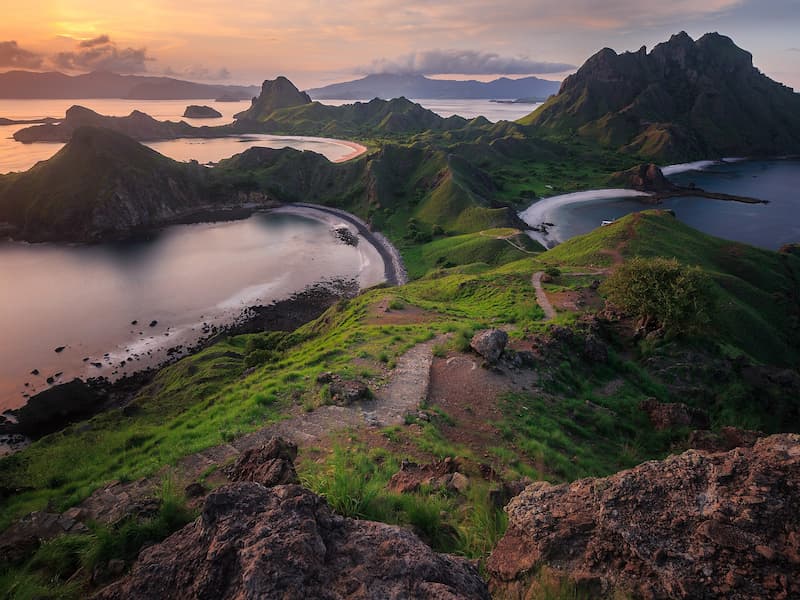
Komodo National Park is a rugged, volcanic archipelago located in the center of the Indonesian chain, between the islands of Sumbawa and Flores. It is a place where the “real-life dragons” still roam, and the landscape feels more like a prehistoric world than a modern tropical escape.
The park spans approximately 1,733 square kilometers and is composed of three large islands—Komodo, Rinca, and Padar—along with 26 smaller ones. Unlike the lush, emerald jungles seen elsewhere in Indonesia, much of Komodo is characterized by dry savanna, rugged hills of rusty-brown earth, and pockets of thorny green forest.
This environment is shaped by a starkly seasonal climate. The coastlines are equally dramatic, featuring jagged cliffs, hidden bays with white and pink sands, and turquoise waters that conceal one of the world’s most productive marine ecosystems.
Attraction
The primary draw is, without question, the Komodo Dragon (Varanus komodoensis). Reaching up to 3 meters in length and weighing over 70kg, these are the largest lizards on Earth. Watching a 150lb apex predator flick its forked tongue in the wild is a visceral, “National Geographic” style experience that few other places can offer.
Beyond the dragons, the park is a global hotspot for:
- World-Class Diving: The “shatter belt” between the Indian and Pacific Oceans creates strong currents that bring massive nutrient upwellings. Divers come to see manta rays, sharks, and vibrant coral gardens.
- Padar Island Viewpoint: A moderately steep hike leads to a summit offering a world-famous view of three bays—each with different colored sand (white, charcoal, and pink).
- Pink Beach: One of only a handful in the world, the sand gets its strawberry hue from crushed red organ-pipe coral mixed with white sand.

Heritage
Inscribed in 1991, the park earned its status under two primary natural criteria:
- Criterion (vii): The site contains superlative natural phenomena. The contrast between the stark, dry hills and the brilliant blue of the coral-rich seas creates one of the most aesthetically unique landscapes in Indonesia.
- Criterion (x): It is the most important habitat for the conservation of the Komodo dragon. These islands are the only place on Earth where this ancient species has evolved and survived in the wild. It also protects an incredible marine biodiversity within the Coral Triangle.
Gateway
The town of Labuan Bajo, located on the western tip of Flores Island, is the undisputed gateway to the park.
- Airport: Komodo International Airport (LBJ). It receives daily flights from Jakarta (2.5 hours) and Bali (1 hour).
- Lodging: Over the last decade, Labuan Bajo has transformed from a sleepy fishing village into a tourism hub. It offers everything from backpacker hostels to five-star luxury resorts like the AYANA Komodo or Ta’aktana.
- Access: All boat tours, whether day-trip speedboats or multi-day “liveaboard” phinisi schooners, depart from the Labuan Bajo harbor.
When
- Dry Season (April to October): This is the best time for hiking and general sightseeing. The weather is sunny, and the sea is calm.
- Shoulder Season (April–June): My personal recommendation. The islands are still green from the recent rains, but the skies are clear, and the crowds are thinner.
- Mating Season (July–August): The dragons are active but can be more elusive as they retreat into the bush to mate. This is also the peak tourist season.
- Manta Ray Season (December–March): While this is the rainy season, it is the best time for seeing large aggregations of manta rays, particularly in the southern parts of the park.

Consideration
- Safety First: You cannot explore the islands alone. You must be accompanied by a park ranger. Komodo dragons are venomous and unpredictable. If you are menstruating or have an open wound, inform your guide immediately, as dragons can smell blood from kilometers away.
- Physical Fitness: The hike up Padar Island and the treks to find dragons on Rinca involve steep inclines in intense heat (30°C+). Carry plenty of water and wear sturdy shoes.
- Fees and Permits: Entrance fees are tiered for foreigners and locals, and there are additional fees for rangers, trekking, and snorkeling. Expect to pay roughly IDR 500,000–700,000 ($32–$45) per person for a day’s permits.
- Cash is King: While many hotels take cards, you’ll need Indonesian Rupiah (IDR) for park fees and tipping your boat crew.

Resources
- UNESCO World Heritage Centre – The official scientific profile of the park.
- Indonesia.travel – The official tourism site for the Indonesian government.
- Global Conservation – Insight into the current conservation efforts and park protection.
- Southeast Asia Backpacker – A high-quality, independent guide for logistical planning.
- Viator – Useful for comparing and booking vetted day-trips and liveaboard boat tours from Labuan Bajo.
Featured Image
Sunset, Padar Island Viewpoint (Cems77, Wikimedia/CC BY-SA 4.0).
In The News
Advertisement


Comment:
5 responses to “Komodo National Park”
-
We have been lucky enough to snorkel and dive in some wonderful spots on this beautiful planet of ours but nothing compares to exploring what lives below the surface in Komodo National Park. The crystal clear waters and the vibrant coral reefs were enough to have us wanting to come back for more and that was before we lost count of the amount of turtles, manta rays and sharks that we encountered each and every time we put our head under the water. It was truly memorable in a way that is hard to explain and we were of course humbled by what we experienced, all we can say is that we cannot imagine any other under water adventures that we have in the future even coming close to our time in Komodo.
LikeLike
-
The diving is brilliant and the opportunities for underwater photography are endless. What makes Komodo such a special destination is the variety of dive sites and marine life.
There’s pinnacles and seamounts; healthy hard coral reefs; exhilarating drift dives; world-class manta ray dives; excellent muck dives; big fish, small fish; all found in warm water and cold water with good visibility and sometimes not so good visibility!
Just about every sought after critter can be seen in Komodo, including some very rare ones. Leopard anemone shrimps, dragon shrimps, paddle-flap and weedy Rhinopias to name a few. See the bright and colorful sea apples in the south of the park, alongside the tiny ladybugs whom cover the soft corals, feather stars and ascidians. In the north dive in the aquariums of Castle and Crystal Rock where the schooling fish zoom around the dive sites chased by giant trevallies, sharks and napoleon wrasses.
We both love diving in Komodo. Having spent the last 10 high seasons there we know it so well and going back each year is like seeing a good friend again.
LikeLike
-
Spotting dragons in Komodo National Park takes place on neighbouring Rinca Island – not Komodo – as this is the best place to spot these enormous reptiles. It’s here you can walk through the local village past rickety houses that are built high up on stilts above the island floor. You’ll be guided by a park ranger as you wander into the wilderness to come face-to-face with these endearing beasts. Pack your camera, and always stay close to your guide!
LikeLike
-
With such undeniable good looks it’s hard to believe that the island’s most infamous inhabitants, the Komodo dragons, are aggressive carnivores capable of hunting down wild boar, water buffalo and deer, all of which roam freely in the park.
Searching for these prehistoric-looking reptiles in their natural habitat, we are accompanied by park guides with two pronged sticks — understandably, tourists are only allowed on the island when part of an arranged tour. We are rewarded with sightings of six large males at a watering hole, who thankfully seemed more interested in napping than snacking.
LikeLike
-
The most exhilarating experience was at a dive site called Shotgun, in the narrow channel between Komodo Island and Gililawa Darat. When timed correctly, the water moves so quickly through the channel that you feel like you are flying through the water.
LikeLike

 All About World Heritage Sites (...and more)
Leave a reply to Jerry & Debbie Cancel reply