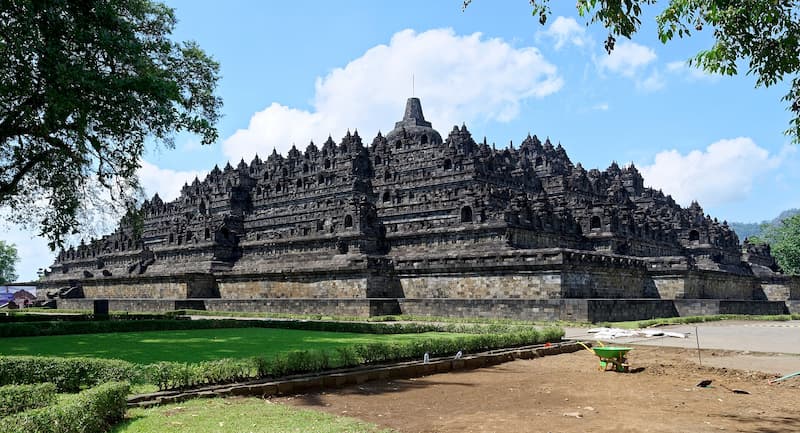
The Borobudur Temple Compounds, located in the Kedu Valley of Central Java, Indonesia, represent one of the world’s most magnificent Buddhist monuments. Built in the 8th and 9th centuries during the Syailendra Dynasty, this massive stone structure was abandoned for centuries before being rediscovered under layers of volcanic ash in the 1800s.
The site is a “triple-temple” complex consisting of Borobudur, Mendut, and Pawon, all situated along a straight geographic axis. The main temple is a colossal stepped pyramid made of nearly two million volcanic stones, featuring:
- The Structure: Five square terraces at the base, three circular platforms above, and a monumental central stupa at the peak.
- The Artistry: It holds the world’s largest collection of Buddhist reliefs (2,520 m^2) and 504 Buddha statues, many housed within 72 bell-shaped, openwork stupas.
- The Symbolism: The architecture reflects Buddhist cosmology, guiding pilgrims through the three realms of existence: Kamadhatu (desire), Rupadhatu (form), and Arupadhatu (formlessness).
Attraction
Tourists travel from across the globe to experience:
- Spiritual Grandeur: Standing atop the world’s largest Buddhist temple offers a profound sense of peace and historical weight.
- Sunrise Views: The “Borobudur Sunrise” is legendary, where the morning mist lifts to reveal the surrounding volcanoes, including the active Mount Merapi.
- Artistic Mastery: The intricate bas-reliefs are so detailed they serve as a virtual encyclopedia of 9th-century Javanese life and Buddhist lore.

Heritage
Inscribed in 1991, UNESCO recognizes Borobudur under Criteria (i), (ii), and (vi):
- Criterion (i): A masterpiece of Buddhist architecture and monumental arts.
- Criterion (ii): It exerted a significant influence on architectural revivals in the region between the 13th and 16th centuries.
- Criterion (vi): It represents a unique blending of indigenous ancestor worship with the Buddhist concept of attaining Nirvana.
Gateway
Yogyakarta (often called “Jogja”) is the essential gateway.
- Airport: Yogyakarta International Airport (YIA) handles major commercial domestic and international flights.
- Lodging: The city offers everything from ultra-luxury resorts to budget-friendly “homestays” near Malioboro Street. For those wanting to be steps away, the Manohara Hotel is located within the temple complex grounds.
- Access: The temple is about 40 km (1–1.5 hours) from the city center via taxi, private driver, or public shuttle.
When
- Best Time: April to October (the dry season).
- Why: You’ll have the best chance for clear skies and stunning sunrise/sunset views.
- Special Event: Visit during Vesak (Waisak Day) in May to witness a spectacular lantern-release ceremony and religious procession.

Consideration
- Limited Quotas: To preserve the stone, only 1,200 visitors are allowed to climb the temple structure daily. You must book a “Climb Up” ticket well in advance.
- Mandatory Footwear: All visitors climbing the structure are required to wear Upanat (special woven sandals) provided on-site to reduce erosion.
- Dress Code: Respectful attire is required; shoulders and knees must be covered. Sarongs are provided for those who need them.
- Passport Required: You must bring your original passport for entry verification if you are an international tourist.

Resources
- UNESCO – Borobudur Temple Compounds: Official history and heritage criteria.
- BorobudurPark – Official Tickets: The official government portal for booking entry slots.
- Indonesia Travel – Borobudur Guide: Detailed travel tips from the national tourism board.
- BorobudurSunrise.com: Specialized info on logistics for the early morning temple experience.
- GetYourGuide – Borobudur Tours: A reliable platform for booking guided day trips and guaranteed “Climb Up” tickets from Yogyakarta.


Comments:
4 responses to “Borobudur Temple Compounds”
-
As we make our way to the top in 36-degree heat and what feels like 100 per cent humidity, I am in awe of this incredible monument. It’s so calm and peaceful and the view of the distant mountains shrouded in clouds and the thick jungle below is simply breathtaking. The carvings on the walls are so intricate and every panel tells a story.
-
Borobudur has perhaps the finest examples of Buddhist reliefs in the world, with each of the 10 terraces symbolizing the path to Nirvana. The view from the top is extraordinary and will remain with you as one of the highlights of your visit to Southeast Asia.
-
The relatively modest nearby temples of Pawon and Mendutalso deserve a visit. Believed to be slightly older than Borobudur, these holy structures are geographically aligned with their more famous neighbour, although the exact relationship between them remains unknown. Next to Mendut stands a spectacular bodhi tree that provides a shaded spot in which to sit and ponder this mystery.
-
Borobudur always gives a majestic impression every time we visit it


Leave a Reply to BurmesterCancel reply