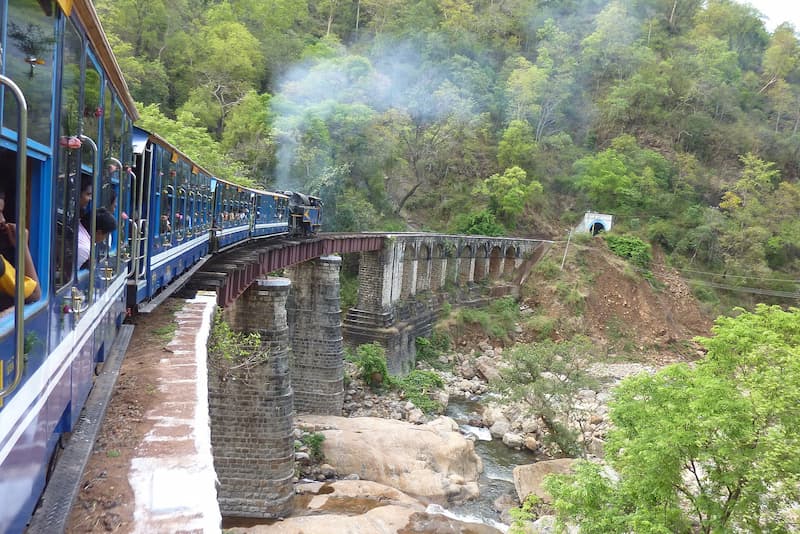
The Mountain Railways of India is a collective UNESCO World Heritage property comprising three extraordinary narrow-gauge railway lines that wind through the rugged, scenic foothills of the Himalayas and the Nilgiri Mountains. These railways—the Darjeeling Himalayan Railway, the Nilgiri Mountain Railway, and the Kalka-Shimla Railway—are celebrated as “living museums” of 19th-century engineering.
The site consists of three separate, fully operational lines:
- Darjeeling Himalayan Railway (DHR): Opened in 1881 in West Bengal, this 88 km “Toy Train” climbs from the plains to Darjeeling (2,258m), utilizing ingenious loops and zig-zags.
- Nilgiri Mountain Railway (NMR): Located in Tamil Nadu, this 46 km line (completed in 1908) is the only rack-and-pinion railway in India, scaling the steep Blue Mountains to Ooty.
- Kalka-Shimla Railway (KSR): Spanning 96 km in Himachal Pradesh, this 1903 engineering marvel features 102 tunnels and 864 bridges to reach the former summer capital of British India.
Attraction
Travelers are drawn to these railways for the nostalgic experience of vintage steam and diesel travel combined with breathtaking landscapes. The slow-paced journeys offer panoramic views of tea gardens (Darjeeling), dense pine forests (Shimla), and dramatic mountain gorges (Ooty). Key highlights include Ghum Station (India’s highest), the Batasia Loop, and the record-breaking Barog Tunnel.

Heritage
The Mountain Railways of India were inscribed as a UNESCO World Heritage Site (in stages: 1999, 2005, and 2008) under:
- Criterion (ii): They represent an important interchange of values on developments in technology, providing an effective rail link through difficult terrain.
- Criterion (iv): They are outstanding examples of innovative engineering solutions (loops, zig-zags, and rack systems) to overcome the extreme challenges of mountainous environments.
Gateways
Because the sites are geographically distant, there are three distinct gateways:
- For Darjeeling (DHR): Siliguri/New Jalpaiguri. The gateway airport is Bagdogra (IXB).
- For Shimla (KSR): Kalka/Chandigarh. The gateway airport is Chandigarh (IXC).
- For Ooty (NMR): Mettupalayam/Coimbatore.16 The gateway airport is Coimbatore (CJB).All these cities offer a wide range of lodging, from heritage hotels to modern commercial stays.
When
- Peak Season (March to June): Ideal weather for escaping the heat of the plains.
- Autumn (September to November): Offers the clearest views of the Himalayan peaks (Kanchenjunga) and Nilgiri valleys.
- Winter (December to February): Beautiful for snow in Shimla, though Darjeeling and Ooty can be quite cold at night.
- Avoid: July to August, as heavy monsoon rains can cause landslides and service disruptions.

Consideration
- Advance Booking: Tickets for these “Toy Trains” are in high demand and limited. Book via the IRCTC website months in advance.
- Travel Time: These are “slow” trains (approx. 10-15 km/h). A 96 km journey can take 5–6 hours; view them as an excursion, not just transport.
- Temperature: It can be 15°C cooler in the hills than at the base station; always carry layers.
- Altitude: While not extreme, some travelers may experience mild altitude discomfort at Darjeeling (2,200m).

Resources
- UNESCO World Heritage Centre – Mountain Railways: Official documentation and historical background.
- Indian Railways (Official): For technical history and heritage news.
- IRCTC Tourism: The official booking portal for special heritage rail packages.
- Darjeeling Himalayan Railway Society: A dedicated group preserving the history and operation of the DHR.
- MakeMyTrip – India Toy Trains Guide: A practical travel guide for booking flights and hotels near the rail gateways.
Featured Image
Nilgiri Mountain Railway (Stephan Niewolik, Wikimedia/CC BY 3.0).
In The News
Advertisement


Comment:
6 responses to “Mountain Railways of India”
-
Hope, the uniqueness and beauty of the train isn’t harmed. I traveled in that train in 1978 with my wife, 2 yr old son and 75 yr old mother. The first class compartment we were traveling in had big glass windows on both sides and through them we enjoyed the himalayan grace outside. There was a wall to wall carpet in the compartment and a tea-poy was elegantly placed in the middle. It was as if we were sitting comfortably in our house. New Jalpaiguri, from where the train starts, was full of flies, and even mosquitos. We had packed my two year old son from head to tow to prevent mosquito bites.
But the moment that 7500 feet climb started and the train started surmounting one mountain range after the other, we just forgot oour woes and enjoyed the train. The higher we went, the happier we were. It was as if traveling from hell to heaven in a single journey!
LONG LIVE THIS BEAUTIFUL TRAIN.
LikeLike
-
I really enjoyed the rhythmic chiming of ‘chuff-chuff-choo-choo’ of the engine. I really enjoyed the ride in the cool hills coated with Himalayan cedars.
LikeLike
-
It was my first toy train journey and the experience was good. The view is amazing and I will definitely recommend it to friends.
LikeLike
-
It was a wonderful experience witnessing the view of the beautiful hills. I would like to take this amazing train again to travel through the Himalayan region.
LikeLike
-
The entire trip all the way from Kalka, near Chandigarh, takes about 5 hours. However, many people prefer to travel only from Barog, as this is where the longest tunnel and most spectacular scenery occurs. It’s a steep climb with plenty of fascinating sightseeing along the way.
LikeLike
-
The train journey from Kalka to India’s erstwhile summer capital Shimla, early in the morning is one of the best things happen to me in the hills of India. One has to experience this journey while going to Shimla! It is simply amazing! The journey is around 5 – 6 hours. In between you get to see many breathtaking views which includes valleys, hills. If you take the train which starts at 5:30 AM or before sunrise you may get to see the sun rising behind the valley.
LikeLike

 All About World Heritage Sites (...and more)


Leave a reply to Mohhamad Cancel reply