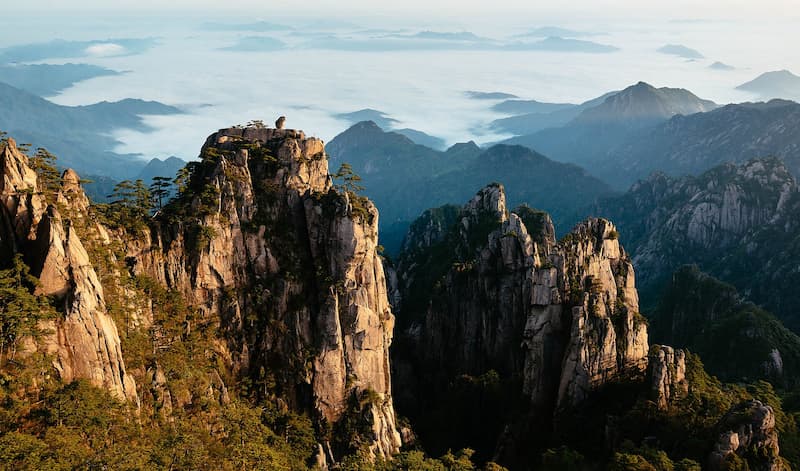
Mount Huangshan, or the “Yellow Mountain,” is one of China’s most iconic natural landmarks. Located in the southern Anhui Province, it is celebrated as the “loveliest mountain in China,” a sentiment immortalized in centuries of Shanshui (mountain-and-water) paintings and poetry.
Mount Huangshan is a majestic granite mountain range consisting of 72 distinct peaks, with the highest being Lianhua Peak (Lotus Peak) at 1,864 meters. The landscape is characterized by steep, jagged precipices, deep ravines, and dramatic rock formations. It is world-famous for its “Five Wonders”:
- Fantastic Pines: Ancient trees that grow directly out of granite crevices, some over 1,000 years old (most notably the Guest-Greeting Pine).
- Grotesque Rocks: Massive boulders that resemble animals or mythical figures.
- Sea of Clouds: Ethereal mist that settles in the valleys, making the peaks look like floating islands.
- Hot Springs: Natural mineral springs found at the foot of the mountain.
- Winter Snow: A seasonal transformation that turns the range into a silver-white wonderland.
Attraction
Huangshan is a “bucket list” destination for its spiritual and aesthetic significance. Tourists come to witness the sunrise and sunset over the sea of clouds, which is considered a pinnacle of Chinese natural beauty. The site also offers the West Sea Grand Canyon, a breathtaking hiking area with a monorail that plunges into deep, misty gorges. Beyond nature, the nearby UNESCO-listed ancient villages of Hongcun and Xidi offer a glimpse into the traditional Hui-style architecture of imperial China.

Heritage
Mount Huangshan is a rare UNESCO Mixed World Heritage Site, inscribed in 1990 for meeting both cultural and natural criteria:
- Natural (vii, x): It represents a unique geological history of granite geomorphology and serves as a major habitat for endemic and threatened plant and animal species.
- Cultural: It has played a central role in Chinese art and literature since the Tang Dynasty, serving as the birthplace of the influential “Huangshan School” of painting.
- Global Geopark: In 2004, it was also designated a UNESCO Global Geopark to recognize its scientific importance in understanding tectonic uplift and glacial history.
Gateway
- Commercial Airport: Huangshan Tunxi International Airport (TXN) is the primary gateway, located about 10 minutes from the city center and 1 hour from the mountain’s South Gate.
- Secondary Hub: Huangshan North Railway Station is a major high-speed rail hub connecting the city to Shanghai (2.5-3 hours) and Hangzhou (1.5 hours).
- Lodging: Visitors usually stay in Tunxi (city center) for its historic “Old Street” or in Tangkou Town at the base of the mountain for an early start. There are also several high-end hotels on the summit, such as the Beihai Hotel and Xihai Hotel, for those wishing to see the sunrise.
When
- Spring (March to May) & Autumn (September to November): These are the most pleasant seasons for hiking, featuring blooming azaleas in spring and vibrant red foliage in autumn.
- Winter (December to February): The best time for the “Sea of Clouds” and snow-capped peaks. It is also the least crowded and most affordable season.
- Avoid: Chinese national holidays (early May and early October) and summer school holidays (July/August), as the trails can become extremely congested.

Consideration
- Physical Stamina: Even with cable cars, exploring the summit involves thousands of stone steps. Good hiking boots are essential.
- Luggage: Do not carry heavy suitcases up the mountain. Store your main luggage at your hotel in Tunxi or Tangkou and take only a small overnight backpack to the summit.
- Weather: It is often 10°C cooler on the summit than in the city. Bring layers and rain gear, as the mountain is prone to sudden mist and rain.
- Crowd Management: To avoid 2-hour lines at the cable car, aim to arrive at the park gates by 7:00 AM.

Resources
- UNESCO World Heritage Centre – Huangshan: Official documentation on the site’s heritage values.
- Huangshan Municipal Government (English): The best source for official local news, weather updates, and park alerts.
- The China Guide – Huangshan Tips: A practical guide for planning hiking routes and understanding the cable car systems.
- Huangshan Tour Guide: Detailed breakdowns of logistics from Shanghai and Hangzhou.
- Trip.com – Huangshan Hotels & Tours: A reliable platform for booking high-speed train tickets, airport transfers, and summit hotels.
Featured Image
Sea of Clouds at Mount Huangshan (Nicolascornet, Wikimedia/CC BY-SA 4.0).
In The News
Advertisement



Comment:
One response to “Mount Huangshan”
-
The granite spires of Huang Shan, traversed by stone-stepped trails and graced by the uniquely shaped Huang Shan pines, are a visual delight in any weather. Fog that makes islands of dozens of peaks, spring blossoms on precipitous slopes, and autumn color only add to their glory. Huang Shan is a UNESCO World Heritage site, a national park, and a sister park to Yosemite in the U.S. Like Yosemite, it plays an important role in the history of painting and photography in its own country – it has been a source of inspiration to painters for over 1000 years!
LikeLike

 All About World Heritage Sites (...and more)
.jpeg)


Leave a comment