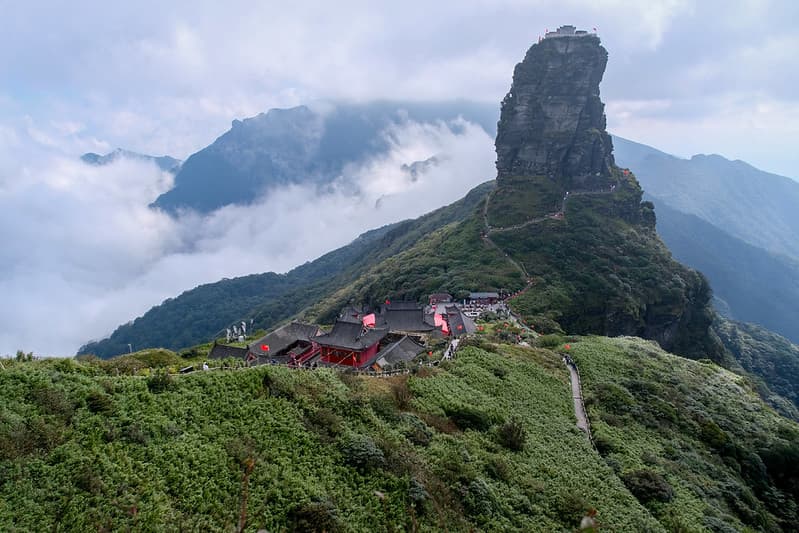
Towering above the clouds in the Wuling Mountains of Guizhou Province, Fanjingshan (Mount Fanjing) is a majestic “island” of metamorphic rock rising from a vast “sea” of karst. As a sacred Buddhist site and a sanctuary for rare wildlife, it offers one of China’s most dramatic and spiritual mountain experiences.
Fanjingshan is the highest peak of the Wuling range, reaching an altitude of 2,572 m. Unlike the limestone karst landscapes typical of southwest China, Fanjingshan is composed of ancient metamorphic rock dating back over 1 billion years. This unique geology has created a “terrestrial island” effect, where isolation has allowed ancient species to survive and evolve independently. The site is famous for its three distinct summits: Old Golden Summit, Fenghuang Summit, and the iconic Red Cloud Golden Summit, which features two temples perched atop a narrow stone pillar split by a deep gorge.
Attraction
Fanjingshan has gained worldwide fame for its surreal, “floating” appearance and spiritual atmosphere:
- The Red Cloud Golden Summit: Two Buddhist temples—the Buddha Temple and the Maitreya Temple—sit on twin peaks connected by a narrow stone bridge over a vertical drop. It looks like something out of a fantasy novel.
- Mushroom Rock: A 10-meter tall rock formation that resembles a giant mushroom, created by centuries of wind and water erosion.
- The Sea of Clouds: Due to high humidity, the mountain is frequently enveloped in mist, creating the illusion of peaks floating on a white ocean.
- The “Buddha’s Halo”: A rare optical phenomenon where a rainbow-like ring appears around the observer’s shadow on the clouds, historically interpreted as a sign of enlightenment.

(Francisco Anzola, Flickr/CC BY 2.0).
Heritage
Inscribed in 2018, Fanjingshan is recognized primarily under UNESCO Criterion (x) for its outstanding biodiversity:
- Endemic Sanctuary: It is the only home in the world for the Guizhou Snub-nosed Monkey (approximately 800 individuals remaining) and the Fanjingshan Fir.
- Ancient Flora: It hosts the largest and most contiguous primeval beech forest in the subtropical region and is a “living laboratory” of Tertiary period relics (species from 65 to 2 million years ago).
- Species Richness: The site contains over 3,700 plant species and 2,300 animal species, representing a significant portion of China’s total floral and faunal diversity within a relatively small area of approximately 403 km^2.
Gateway
The city of Tongren in Guizhou Province serves as the primary gateway.
- Airport: Tongren Fenghuang Airport (TEN). It connects to major hubs like Beijing, Shanghai, and Guangzhou.
- Lodging: Tongren offers ample accommodation, ranging from business hotels like the V-Continent Tongren Hotel to boutique options.
- Local Access: For the most convenient experience, many travelers stay in Jiangkou County or the Zhaisha Dong Village at the foot of the mountain, which is about a 1.5-hour drive from the airport.
When
- Spring (April – June): Best for blooming azaleas and rhododendrons. The weather is mild, though rain is possible.
- Autumn (September – November): The peak season. The foliage turns vibrant shades of gold and red, and the air is clear, offering the highest probability of seeing the “Sea of Clouds.”
- Winter (December – February): Only for those seeking snow-covered temples; however, trails frequently close due to ice.

Consideration
- Mandatory Reservations: You must book tickets and a timed entry slot in advance via the official “Fanjingshan” WeChat mini-program or website. Daily visitor numbers are strictly capped.
- Physical Demands: Climbing to the Red Cloud Golden Summit requires ascending nearly vertical steps using iron chains. It is not recommended for those with severe vertigo or limited mobility.
- Weather Variability: The summit is often 10°C to 15°C cooler than the base. Bring windproof layers and a raincoat, as weather changes within minutes.
- The “Fog Risk”: It is common for the peaks to be completely obscured by mist. Check the live weather cameras at the visitor center before heading up the cable car.

Resources
- UNESCO – Fanjingshan: The official technical dossier and biodiversity records.
- China Highlights – Fanjingshan Guide: Excellent logistical advice on transport and hiking routes.
- Asia Odyssey Travel – How to Plan: Detailed information on reaching the site from surrounding provinces.
- Guizhou Tourism Official: The provincial government’s portal for regional travel updates.
- Trip.com – Fanjingshan Booking: A reliable platform for securing entry tickets and booking hotels in Jiangkou or Tongren.
Featured Image
Red Cloud Golden Summit, Fanjingshan (Francisco Anzola, Flickr/CC BY 2.0).
In The News
Advertisement


Comment:
 All About World Heritage Sites (...and more)


Leave a comment