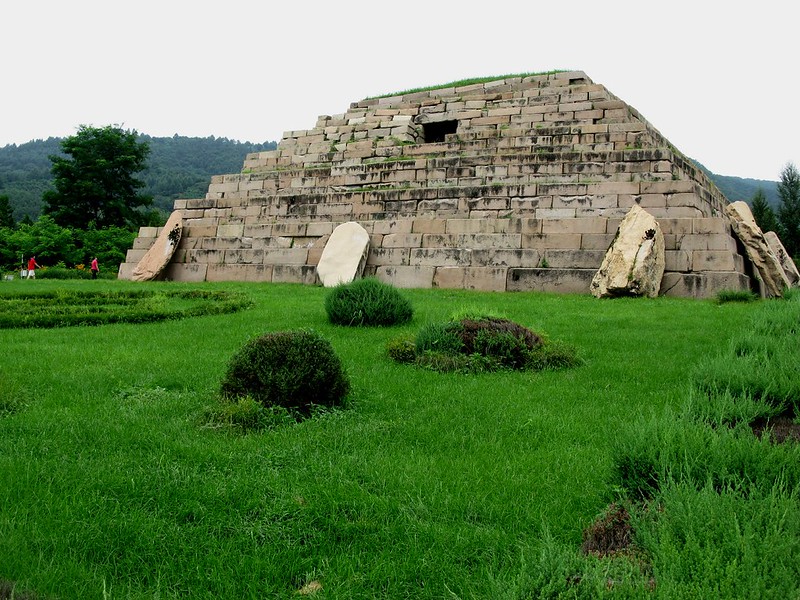
Inscribed in 2004, the Capital Cities and Tombs of the Ancient Koguryo Kingdom is a sprawling archaeological treasure located in Northeast China. This site preserves the remnants of a powerful ethnic group and regional power that ruled over parts of northern China and the northern half of the Korean Peninsula from 37 BCE to 668 CE.
The site is divided primarily between two locations: Ji’an in Jilin Province and Huanren in Liaoning Province. It encompasses the archaeological remains of three fortress-cities and 40 identified tombs.
- Wunü Mountain City: Located in Huanren, this was the first capital of the Koguryo. It is a classic “mountain city,” built atop a rugged plateau for defense.
- Guonei City & Wandu Mountain City: Located in Ji’an, these served as the capital for over 400 years. Guonei was a rare “plain city” built on flat land, while Wandu was its mountain counterpart, designed to house the palace and military during times of war.
- The Tombs: The site includes 14 imperial tombs and 26 noble tombs. The most famous is the “Tomb of the General” (Jiangjunfen), often called the “Pyramid of the East” due to its stepped stone structure.
Attraction
The site draws visitors interested in ancient military architecture and the roots of East Asian history.
- Architectural Ingenuity: The tombs feature elaborate “corbelled” ceilings designed to roof wide spaces without pillars, supporting massive earth or stone mounds above.
- Vibrant Mural Art: Several noble tombs contain well-preserved wall paintings. These murals depict scenes of daily life, hunting, wrestling, and mythology, providing a rare window into a vanished culture’s worldview.
- The Gwanggaeto Stele: A nearly seven-meter-tall granite monument with over 1,700 characters that tells the foundation story of the kingdom and the exploits of its greatest king.

Heritage
UNESCO inscribed the site under Criteria (i) through (v), noting its “Outstanding Universal Value”:
- Cultural Exchange: The tombs and inscriptions demonstrate the profound impact of Chinese culture on the Koguryo, who adapted Chinese burial traditions while maintaining distinct artistic styles.
- Vanished Civilization: It serves as the primary physical testimony to the Koguryo, whose sophisticated urban planning and fortress systems influenced later city construction across Asia.
- Harmony with Nature: The capital cities represent a perfect blending of human creation and the natural environment, utilizing cliffs and rivers as integral parts of their defensive walls.
Gateway
While Ji’an is the destination, the primary gateway city with a commercial airport is Tonghua.
- Airport: Tonghua Sanyuanpu Airport (TNH). It handles domestic flights from major hubs like Beijing, Shanghai, and Guangzhou.
- Lodging: Tonghua offers a wide range of modern hotels, such as the V-Continent Tonghua Hotel. From Tonghua, Ji’an is roughly a 1.5 to 2-hour drive or train ride away.
- Ji’an Infrastructure: For those wishing to stay closer, Ji’an itself has developed significantly and offers sufficient lodging, including the Hongxiang Hotel, though Tonghua remains the better logistical hub for air travelers.
When
- Autumn (September – October): This is the “golden season.” The weather is cool and dry, and the surrounding mountains turn vibrant shades of red and yellow, making the mountain fortresses particularly photogenic.
- Late Spring (May – June): A beautiful time when the regional flora is in bloom, though it can be slightly rainier than autumn.
- Winter (December – February): Only for the hardy. Temperatures in Northeast China can drop below -20°C, though the sites under a blanket of snow are hauntingly beautiful.

Consideration
- Regional Politics: Because Koguryo history is shared with modern-day North and South Korea, the historical narrative at the site is presented through a specific lens. It is helpful to read various historical perspectives beforehand.
- Physical Activity: Visiting the mountain cities (especially Wunü and Wandu) involves significant climbing. Wear high-grip hiking shoes.
- Photography Restrictions: Photography is strictly prohibited inside the tombs to protect the delicate murals from light damage.
- Border Proximity: Ji’an sits directly on the Yalu River, facing North Korea. You can take boat tours along the river to see the North Korean side, but be mindful of border security protocols and avoid taking photos of military personnel.

Resources
- UNESCO – Ancient Koguryo Kingdom: The official record detailing the heritage criteria and site maps.
- Visit China – Ji’an Guide: A helpful overview of the specific relics in the Ji’an cluster.
- Trip.com – Ji’an Travel: A reliable booking platform for hotels in Tonghua and Ji’an, often featuring recent traveler reviews of the ruins.
- China Discovery – Northeast China Tours: Provides logistical details for multi-city itineraries including Shenyang and Ji’an.
- Travel China Guide – Koguryo Relics: A practical guide for independent travelers, including ticket prices and opening hours.
Featured Image
Tomb of the General (Caitriana Nicholson, Flickr/CC BY-SA 2.0).
In The News
Advertisement



Comment:
 All About World Heritage Sites (...and more)

Leave a comment