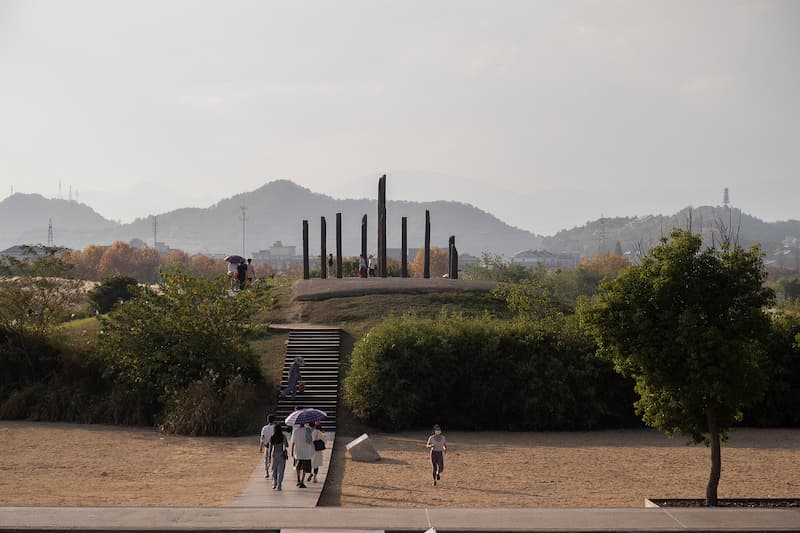
The Archaeological Ruins of Liangzhu City, located in the Yuhang District of Hangzhou, Zhejiang Province, China, represent the heart of a sophisticated, rice-cultivating urban civilization that existed roughly 5,000 years ago (3300–2300 BCE). This site is regarded as crucial evidence of 5,000 years of continuous Chinese civilization.
The site is remarkably preserved and composed of four main areas covering a vast expanse of land:
- The City Site: The core area, featuring a fortified city surrounded by massive earthen walls, a palatial area constructed on a vast artificial mound, and elite cemeteries.
- The Hydraulic System: An intricate network of dams, moats, and canals, which is the earliest known large-scale water conservation system in the world. It managed floods and facilitated boat transport.
- Archaeological Discoveries: Excavations have revealed advanced jade artifacts (specifically Cong and Bi disks), complex pottery, and large-scale architectural achievements.
Attraction
Liangzhu City attracts visitors worldwide for its intimate connection to the origins of civilization:
- “Museum of Jade”: The intricate jade carvings discovered here are unmatched in prehistoric China, showcasing a highly developed artistic and sociopolitical system.
- Immersive Ruins Park: Unlike many archaeological sites that only offer ruins, Liangzhu is a well-designed archaeological park where visitors can walk through reconstructed ancient buildings and see the scale of the earthen mounds.
- Educational Depth: The site provides profound insights into prehistoric rice agriculture, early urban planning, and the spiritual life of a Neolithic community.

(Siyuwj, Wikimedia/CC BY-SA 4.0).
Heritage
Inscribed in 2019, the site meets Criteria (iii) and (iv):
- Criterion (iii): It bears unique testimony to a prehistoric, rice-cultivating urban civilization in the Yangtze River Basin, which represents an early regional state with a unified belief system.
- Criterion (iv): The site provides an outstanding example of early urban civilization, demonstrated by large earthen monuments, urban planning, and advanced water management systems.
Gateway
- The City: Hangzhou, the capital of Zhejiang Province, is the direct gateway.
- Airport: Hangzhou Xiaoshan International Airport (IATA: HGH) is a major commercial hub with extensive international and domestic connections.
- Lodging: Hangzhou offers thousands of lodging options ranging from luxury hotels along the West Lake to business hotels closer to the ruins in the Yuhang District.
When
- Spring (March to May) and Autumn (September to November): These seasons offer mild temperatures, comfortable walking weather, and scenic beauty.
- Avoid Mid-Summer (July & August): The site is vast with little shade, and temperatures can exceed 35°C (95°F), making outdoor exploration very hot.
- Avoid Holidays: Chinese public holidays (especially National Day in early October) can lead to extreme crowding.

Consideration
- Size of the Site: The park is enormous. It is highly recommended to purchase the shuttle bus tickets to get between different areas.
- Reservation Needed: Tickets often need to be reserved in advance through the official website, especially during peak seasons.
- Liangzhu Museum: The museum, located nearby but outside the main park, houses the best artifacts and is essential for understanding the context of the site. Plan to visit both.
- Footwear: Comfortable walking shoes are essential as you will spend hours walking through the park.

Resources
- UNESCO World Heritage Centre – Liangzhu: The official archive for the site’s maps, history, and evaluation reports.
- Liangzhu Site Official Website: The local authority site for booking tickets, checking opening hours, and shuttle bus information.
- Travel China Guide – Liangzhu: A comprehensive guide on transportation, best visiting times, and practical tips.
- Hangzhou Official Tourism Board: Information on the Liangzhu Cultural Village and nearby attractions.
- Trip.com – Liangzhu Tours: Useful for booking guided day trips from Hangzhou city center or nearby attractions.
Featured Image
Liangzhu Ruins (Siyuwj, Wikimedia/CC BY-SA 4.0).
In The News
Advertisement


Advertisements
Advertisements
Advertisements
Advertisements
Comment:
Advertisements
 All About World Heritage Sites (...and more)


Leave a comment