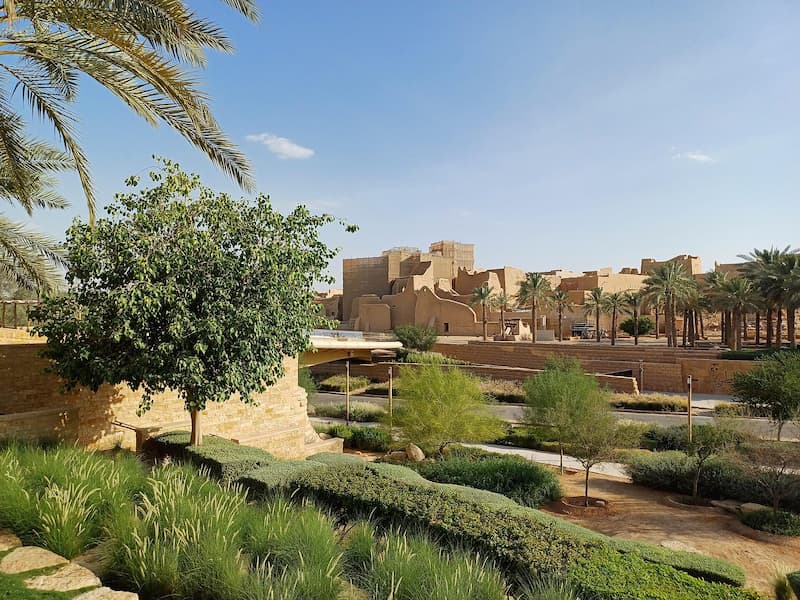
The At-Turaif District in ad-Dir’iyah is more than just a cluster of ancient ruins; it is the physical soul of Saudi Arabia. Located on the northwestern outskirts of the capital city, Riyadh, it serves as a monumental bridge between the Kingdom’s past and its ambitious future.
At-Turaif is a historic citadel built in the 15th century using sun-dried mud bricks, known as adobe. It sits atop a plateau overlooking the lush Wadi Hanifah, a natural oasis. This district was the original seat of power for the House of Saud and served as the capital of the First Saudi State from 1727 until 1818.
The architecture is the purest example of the Najdi style, characterized by thick walls for insulation, triangular decorative motifs, and narrow alleyways designed to provide shade and channel breezes. The site is a sprawling open-air museum featuring restored palaces, mosques, and a series of interconnected courtyards that reveal how a sophisticated urban society thrived in the heart of the Arabian desert.
Attraction
What draws visitors from across the globe is the juxtaposition of ancient history and modern luxury.
- Architectural Wonder: It is one of the largest mud-brick settlements in the world. Seeing the towering Salwa Palace—the largest structure in the district—illuminated at night is a bucket-list experience.
- The “Diriyah Season”: The site hosts high-profile international events, including the Diriyah E-Prix (Formula E), world-class boxing matches, and tennis tournaments.
- Bujairi Terrace: Directly across from At-Turaif is a premium dining destination featuring Michelin-starred restaurants, where guests can dine while overlooking the heritage site.
- Cultural Immersion: Interactive museums within the district use holograms and digital storytelling to bring 18th-century Arabian life to the present.

Heritage
At-Turaif was inscribed as a World Heritage Site in 2010 based on three specific cultural criteria:
- Criterion (iv): It is an outstanding example of a fortified urban ensemble within an oasis, showcasing the Najdi architectural style that is unique to the central Arabian Peninsula.
- Criterion (v): It represents a significant phase in human settlement in the desert, illustrating how early Saudis adapted to a harsh, arid environment through ingenious urban planning and water management.
- Criterion (vi): The site is directly associated with a major turning point in history: the birth of the First Saudi State and the spread of the Salafiyya reform movement, which had a profound impact on the Islamic world.
Gateway
The primary gateway to At-Turaif is Riyadh, the capital of Saudi Arabia.
- Airport: King Khalid International Airport (RUH) is a major global hub located approximately 30–40 minutes from the site. It handles hundreds of international and domestic flights daily.
- Lodging: Riyadh offers a vast array of accommodations. For luxury, the Ritz-Carlton Riyadh and Four Seasons Hotel are nearby. For those wanting to stay “on-site,” the newly opened Bab Samhan (a luxury heritage hotel in Diriyah) offers an authentic Najdi stay.
When
The optimal window to visit is from late October to March.
- The Weather: During these months, the desert heat subsides, with daytime temperatures ranging from 20°C to 25°C (68°F to 77°F). Evenings can be crisp and cool, making it perfect for walking through the open-air site.
- The Vibe: This period coincides with Diriyah Season, meaning the district is alive with festivals, concerts, and outdoor markets.
- Avoid Summer (May–September): Temperatures often soar above 45°C (113°F), making outdoor sightseeing during the day nearly impossible.

Consideration
- Tickets: Entry typically requires a “Diriyah Entry Pass,” which can be booked on the official website. This often includes a credit to spend at the Bujairi Terrace restaurants.
- Dress Code: While Saudi Arabia has modernized significantly, modest dress is still required. Men should avoid shorts, and women should cover their shoulders and knees. An abaya (traditional cloak) is not legally required for tourists but is widely worn and respected.
- Photography: Professional cameras may require a permit, but smartphone photography is generally encouraged.
- Walking: The site is almost entirely pedestrianized. Wear comfortable, closed-toe shoes as you will be walking on uneven stone and sand paths.

Resources
For more details and to plan your trip, refer to these websites:
- UNESCO World Heritage Centre – Official historical and technical data on the site’s inscription.
- Visit Saudi – The official tourism portal with up-to-date travel guides.
- Diriyah.sa – The official site for booking tickets and viewing the seasonal event calendar.
- Arab News – For news and features regarding the ongoing restoration and cultural significance.
- GetYourGuide – A reliable platform for booking guided tours of Diriyah and private transfers from Riyadh.


Comments:
Leave a Reply