Located primarily in the Western Cape and extending into the Eastern Cape province, the Cape Floral Region Protected Areas is a serial World Heritage site consisting of 13 protected area clusters. Covering over 1 million hectares, it is one of the world’s most significant centers of terrestrial biodiversity.
This site represents the Cape Floristic Kingdom, the smallest and richest of the world’s six floral kingdoms. It is characterized by its unique Fynbos vegetation—a fine-leaved, Mediterranean-style shrubland adapted to both mountainous terrain and periodic natural fires. The region encompasses a dramatic landscape of jagged sandstone mountains, coastal plains, and deep river gorges, ranging from the iconic Table Mountain in the west to the rugged Baviaanskloof in the east.
Attraction
The region is a “botanical safari” destination that offers more than just plants:
- The Proteas: It is the home of the King Protea, South Africa’s national flower, and thousands of other vibrant species like ericas and pincushions.
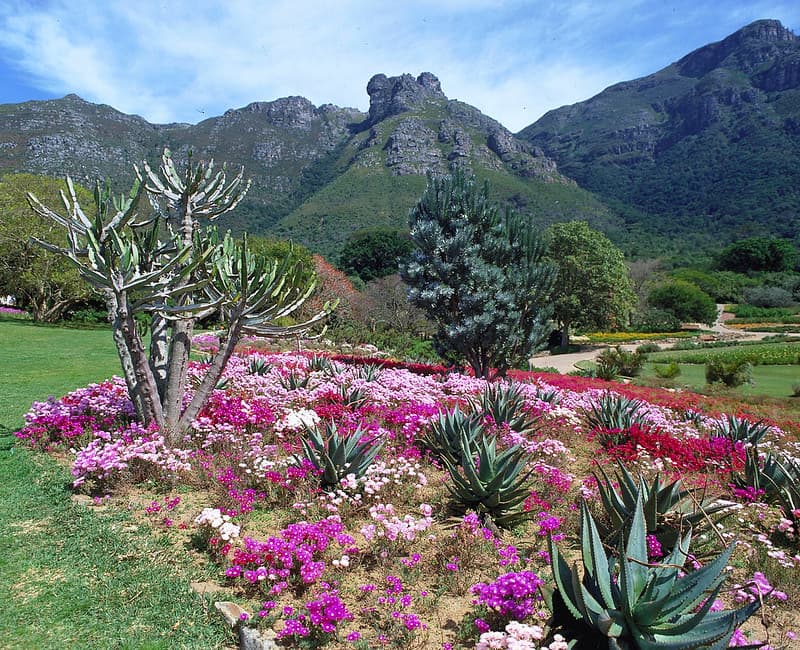
- Kirstenbosch National Botanical Garden: Often cited as one of the world’s most beautiful gardens, it sits on the slopes of Table Mountain and showcases the region’s flora in a curated setting.
- Adventure & Scenery: Beyond the flowers, the site offers world-class hiking, whale watching (along the coast), and the famous “Garden Route” drive.
- Endemic Wildlife: While famous for plants, you may spot rare species like the Table Mountain Ghost Frog or the Cape Sugarbird, which has co-evolved specifically with fynbos flowers.

Heritage
Inscribed in 2004 (and expanded in 2015), it meets UNESCO Criteria (ix) and (x):
- Exceptional Biodiversity: It contains roughly 9,000 plant species, about 69% of which are endemic (found nowhere else on Earth). Despite covering less than 0.5% of Africa, it hosts nearly 20% of the continent’s flora.
- Evolutionary Processes: The site is a living laboratory for studying plant reproductive strategies, adaptive radiation (how species diversify), and the role of fire in ecological succession.
Gateway
Cape Town is the undeniable gateway to the region.
- Airport: Cape Town International Airport (CPT) is a major hub with direct flights from London, Dubai, New York, and other global cities.
- Lodging: As a world-class city, it offers everything from the ultra-luxury Ellerman House and The Silo Hotel to comfortable guesthouses in the City Bowl and eco-friendly options near the airport like Hotel Verde.
When
- Peak Flowering (August to October): This is the best time to see the wild flowers in their full, vibrant glory as winter rains give way to spring.
- Active Adventure (November to March): The dry, warm summer months are best for hiking and exploring the coastal clusters, though the risk of wildfire is higher.
- Whale Season (June to November): If you wish to combine floral tours with southern right whale sightings along the coastal reserves.

Consideration
- Fire Risk: Many fynbos species rely on fire to germinate, but “uncontrolled” fires can be dangerous. Always follow local safety signage regarding fire hazards.
- Sun Protection: The sun in the Cape is exceptionally strong, even on cool days. Wear high-SPF sunscreen, a hat, and polarized sunglasses.
- Walking Gear: Trails in the protected areas—especially Table Mountain and the Cederberg—can be rocky and steep. High-quality hiking boots are essential.
- Permits: While Table Mountain is easily accessible, some remote clusters (like the Baviaanskloof) require specific permits or 4×4 vehicles for access.

7. Recommended Resources
- UNESCO – Cape Floral Region: The official technical dossier and maps of the 13 clusters.
- SANParks – Table Mountain: The official site for managing the most visited park in the region.
- CapeNature: The primary management body for the nature reserves within the Western Cape.
- SANBI – Kirstenbosch: Detailed information on the botanical garden and seasonal flowering guides.
- Expedia – Cape Town: A reliable platform to book lodging in Cape Town with verified reviews for your visit.
Featured Image
Kirstenbosch National Botanical Garden (South African Tourism, Flickr/CC BY 2.0).
In The News
Advertisement


Comment:
One response to “Cape Floral Region Protected Areas”
-
A mere drive-by to see this incredible floral region is criminal. You need to go hiking in the Cape Floral Region to truly experience the true fynbos feel, scent and sound. One of our favourite, relatively easy hikes to experience the Cape Floral Kingdom is the stroll up Chapman’s Peak. The hike starts at the green SANParks signpost on Chapman’s Peak Drive, and takes about 2 hours to the beacon – an easy stroll with lots of stops to enjoy the spectacular views overlooking the Indian Ocean to one side, and the Atlantic Ocean to the other. It is advised you hike with an experienced guide, or at least let friends and family know of your hiking plans and ETA.
LikeLike

 All About World Heritage Sites (...and more)

Leave a comment