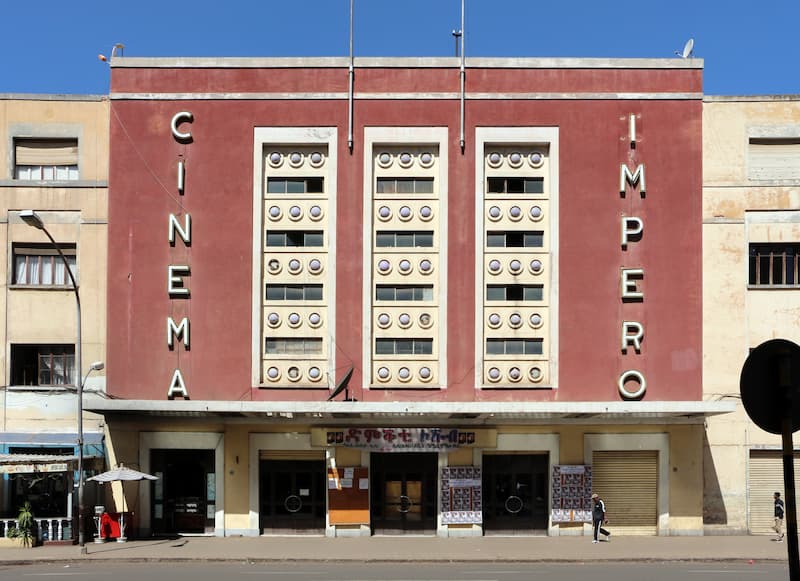
Asmara, the capital of Eritrea, is often referred to as “Piccola Roma” (Little Rome) and stands as one of the most unique urban environments in the world. It is a time capsule of early 20th-century European modernism transplanted into a high-altitude African landscape.
Located on a highland plateau at an elevation of approximately 2,325m, Asmara is an exceptionally well-preserved colonial planned city. Developed primarily between 1893 and 1941 during the Italian colonial occupation, the city underwent a massive construction boom in the late 1930s. Architects were given a “blank canvas” to experiment with radical new styles including Art Deco, Futurism, Rationalism, and Novecento.
The city features an orthogonal grid layout integrated with radial elements, wide boulevards, and a dense collection of modernist buildings. Unlike many colonial cities, Asmara’s architecture remains largely intact, having survived decades of conflict due to a lack of large-scale urban redevelopment.
Attractions
Asmara is a magnet for architects, historians, and “slow travel” enthusiasts for several reasons:
- Architectural Masterpieces: The Fiat Tagliero Building, designed to look like a soaring airplane with 15-meter cantilevered wings, is a Futurist icon. Other highlights include the Cinema Impero, with its classic Art Deco facade, and the Opera House.
- “La Passeggiata”: Every evening, the main thoroughfare, Harnet Avenue, fills with locals for a traditional stroll. The city’s vibrant café culture, complete with vintage Italian espresso machines, offers a unique blend of African and Mediterranean atmospheres.
- The Tank Graveyard: A haunting yet fascinating site on the outskirts where hundreds of rusted military vehicles from the war for independence are stacked, serving as a powerful memorial.

Heritage
Asmara was inscribed on the UNESCO World Heritage List in 2017 based on two specific criteria:
- Criterion (ii): It represents an outstanding example of the transposition of European modernist planning and architectural ideas into an African context. It shows how colonial planning was adapted to local geographical and cultural conditions.
- Criterion (iv): It is an exceptional architectural ensemble that illustrates a significant stage in human history—the application of early modernist urbanism at the beginning of the 20th century.
Gateway
The gateway to the site is the city of Asmara itself.
- Airport: Asmara International Airport (ASM) serves as the primary entry point for international flights, typically connecting through hubs like Istanbul, Dubai, or Addis Ababa.
- Lodging: The city has sufficient lodging, ranging from the historic Albergo Italia (built in 1899) and the Crystal Hotel to the more modern Hotel Asmara Palace.
When
The best time to visit is from September to April. During these months, the weather is dry and pleasant.
- Avoid June to August: This is the main rainy season, which can make travel in the highlands difficult.
- Cultural Note: Visiting in May allows you to witness Independence Day (May 24) celebrations, though it starts to get quite warm.

Consideration
- Visas and Permits: Almost all visitors require a visa obtained in advance. Additionally, you need a travel permit from the Ministry of Tourism to travel more than 25km outside of Asmara.
- Cash Economy: Eritrea is strictly a cash-based society. ATMs are non-existent for international cards, and credit cards are rarely accepted. You must bring enough USD or Euro to exchange for the local currency, the Nakfa.
- Connectivity: Internet access is limited and often very slow. It is best to treat a trip here as a “digital detox.”
- Photography: It is strictly forbidden to photograph government buildings, military installations, or any strategic infrastructure.

Resources
- UNESCO World Heritage Centre – Asmara: The official technical documentation and maps for the site.
- Explore Eritrea: A detailed local resource for travel tips, historical context, and tour options.
- Trip.com – Asmara: Useful for crowdsourced reviews of hotels and hiring local guides.
- Asmara Architecture: A dedicated project site focusing on the preservation and photography of the city’s modernist buildings.
- Britannica – Asmara: A reliable source for the colonial and post-colonial history of the capital.


Comments:
One response to “Asmara: A Modernist African City”
-
It feels like Italy did in the ‘50s and ‘60s. There are cafes on every little street, and Italian food everywhere.


Leave a Reply to SalCancel reply