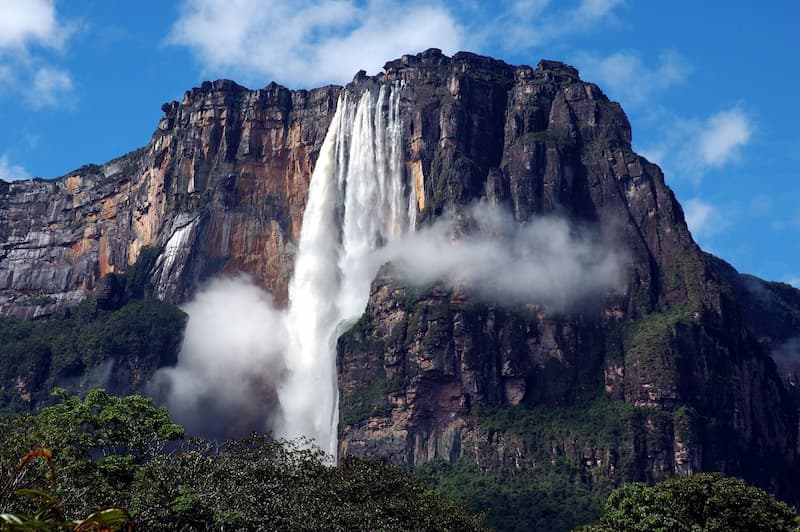
Inscribed as a sanctuary of ancient geology and record-breaking natural wonders, Canaima National Park is a majestic wilderness located in southeastern Venezuela along the borders of Brazil and Guyana. Covering 30,000 square kilometers, it is the sixth-largest national park in the world and serves as a primary gateway to the prehistoric Guiana Highlands.
Canaima is defined by its dramatic tepuis—colossal, flat-topped sandstone table mountains with vertical cliffs that rise abruptly from the surrounding savannas and tropical forests. These geological formations are among the oldest on Earth, dating back nearly two billion years. The park is home to a vast network of rivers, including the Caroní and Churún, which feed thousands of waterfalls. The interior is largely roadless, accessible primarily by small planes or traditional motorized dugout canoes (curiaras) operated by the indigenous Pemón people, who have inhabited the region for centuries.
Attraction
Canaima draws travelers worldwide primarily to see Angel Falls (Salto Ángel), the highest uninterrupted waterfall on the planet. Cascading from the summit of the Auyán-tepui, the water plunges a staggering 979 meters (3,212 feet). Beyond the falls, the park offers:
- Mount Roraima: A famous trekking destination known for its “alien” landscape of black rocks and endemic plants.
- Canaima Lagoon: A stunning basin featuring red-tinted water and the spectacular Hacha and Sapo Falls.
- Unique Biodiversity: Sightings of rare species like the giant anteater, jaguar, and the endemic “pebble toad.”

Heritage
Inscribed in 1994, Canaima meets UNESCO Criteria (vii), (viii), (ix), and (x):
- Geological History: The tepuis represent the remains of the ancient supercontinent of Gondwana, providing a unique record of Earth’s evolutionary history.
- Endemism: Because the tepui summits are isolated from the forest floor, they have become “islands in the sky” where roughly 33% of the plant species are found nowhere else on Earth.
- Superlative Beauty: The park protects unique and rare natural formations of exceptional beauty, most notably the world’s highest waterfall.
Gateway
The primary commercial gateway to the park within Venezuela is Puerto Ordaz (part of the larger Ciudad Guayana).
- Airport: Manuel Carlos Piar International Airport (PZO) handles frequent commercial flights from Caracas.
- Logging: The city offers sufficient overnight lodging, such as the Eurobuilding Hotel & Suites Guayana or Hotel Rosa Bela, for travelers to rest before catching a smaller charter flight into the Canaima Village Airstrip (CAJ).
- Alternative: Ciudad Bolívar (CBL) is a historic alternative, though Puerto Ordaz is currently the more reliable hub for air connections.
When
- Rainy Season (May – November): This is the best time to see Angel Falls. The water volume is at its peak, and the rivers are high enough for the necessary canoe trips to reach the base of the falls.
- Shoulder Months (October – November): Often considered the “sweet spot” as the rains begin to subside, but the falls remain thunderous and the vegetation is vibrant.
- Dry Season (December – April): Recommended only for trekking Mount Roraima or visiting the lagoon. Angel Falls often dries up to a mere mist during this time, and boat access may be impossible.

Consideration
- Logistics & Permits: You cannot drive to the heart of the park. You must book a tour package that includes the flight into Canaima Village.
- Cash (US Dollars): Venezuela’s economy is heavily dollarized for tourism. Small park entry fees and airport taxes (approx. $20–$40) are often required in cash only.
- Physical Demands: Reaching the base of Angel Falls involves a 4–5 hour river journey followed by a steep, slippery 1-hour jungle hike. Pack light and wear sturdy, waterproof hiking shoes.
- Connectivity: Expect very limited to no Wi-Fi or cell service outside of the main lodges in Canaima Village.
- Health: Yellow Fever vaccination is highly recommended for travel to this region of Venezuela.

Resources
- UNESCO – Canaima National Park: The official record of the site’s World Heritage status and biodiversity.
- Britannica – Canaima: A scholarly overview of the park’s geography and indigenous Pemon culture.
- Venezuela Tuya – Canaima Guide: A long-standing local resource for logistics and regional history.
- National Parks GANP – Canaima: Excellent maps and descriptions of the park’s primary tepui formations.
- Responsible Travel – Venezuela Tours: A platform to compare tour operators and packages for Angel Falls expeditions.
Featured Image
Angel Falls (Mr Angelfish, Wikimedia/CC BY-SA 4.0).
In The News
Advertisement


 All About World Heritage Sites (...and more)