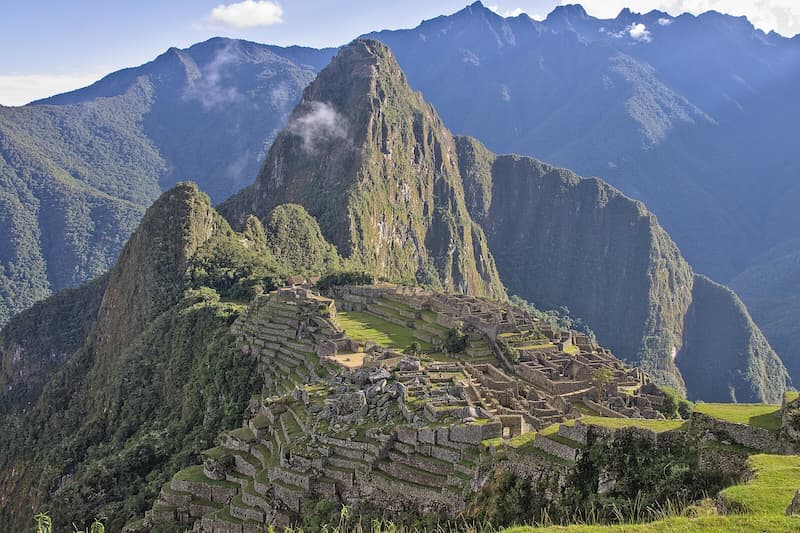
The Historic Sanctuary of Machu Picchu is perhaps the most iconic symbol of the Inca Empire and one of the world’s most breathtaking archaeological wonders. Perched at 2,430 m (7,970 ft) above sea level in the heart of a tropical mountain forest, it remains a testament to the ingenuity of a civilization that mastered the art of building in harmony with nature.
Built in the 15th century and abandoned during the Spanish Conquest, Machu Picchu is a sprawling citadel of polished stone. The site is divided into two main sectors: the Agricultural Sector, featuring a vast network of man-made terraces designed for cultivation and soil erosion control, and the Urban Sector, which houses over 200 structures including temples, palaces, and residences.
Its architectural hallmark is ashlar masonry, where massive granite blocks were cut so precisely that they fit together without mortar. Key landmarks within the site include the Intihuatana (a ritual stone associated with the astronomical clock), the Temple of the Sun, and the Room of the Three Windows.
Attraction
Machu Picchu draws millions of visitors annually due to its “Lost City” mystique. For centuries, it was hidden from the outside world until it was brought to international attention by Hiram Bingham in 1911.
- Dramatic Scenery: The sight of the ruins framed by the towering Huayna Picchu peak and the swirling cloud forests of the Andes is incomparable.
- Engineering Marvel: Tourists are fascinated by how the Incas transported multi-ton stones up steep mountain ridges without the wheel or draft animals.
- Spiritual Magnetism: Many travelers visit to experience what they describe as a unique “energy” or spiritual connection to the ancient Andean world.

Heritage
Inscribed as a UNESCO World Heritage Site in 1983, Machu Picchu is one of the few “mixed” sites, recognized for both cultural and natural significance:
- Cultural Criteria (i, iii): It is an absolute masterpiece of architecture and a unique testimony to the social, administrative, and religious organization of the Inca Civilization.
- Natural Criteria (vii, ix): The sanctuary sits in a transition zone between the High Andes and the Amazon Basin. It protects a remarkably diverse range of microclimates and habitats, sheltering endangered species like the spectacled bear and a vast array of endemic flora.
Gateway
The historic city of Cusco serves as the primary gateway to Machu Picchu.
- Commercial Airport: Alejandro Velasco Astete International Airport (CUZ) handles frequent daily flights from Lima and other South American hubs.
- Lodging: As a major global tourism hub, Cusco offers a massive range of lodging, from five-star luxury hotels housed in colonial convents to vibrant backpacker hostels and boutique guesthouses.
- Transit: From Cusco, travelers typically take a train (operated by PeruRail or Inca Rail) to the town of Aguas Calientes (Machu Picchu Pueblo), followed by a short shuttle bus up to the citadel.
When
The best time to visit is during the dry season (May to October).
- Peak Months: June, July, and August offer the clearest blue skies, making for the best photography and trekking conditions.
- Shoulder Season: April and October provide a good balance of fewer crowds and manageable weather.
- Note: February is the wettest month; the Inca Trail is closed for maintenance during this time, though the citadel itself remains open.

Consideration
- Altitude Sickness: Cusco is significantly higher than Machu Picchu (3,399 m vs 2,430 m). It is vital to spend at least two days in Cusco or the Sacred Valley to acclimatize before attempting any strenuous activity.
- New Circuit Rules (2026): Access is strictly controlled through a circuit system (Circuits 1, 2, and 3). You must choose your route at the time of booking, and once inside, you cannot backtrack or change paths.
- Mandatory Advance Booking: In 2026, tickets sell out months in advance for the peak season. No tickets are sold at the gate.
- Environmental Impact: To protect the site, single-use plastics are strictly prohibited. Travelers should bring reusable water bottles.

Resources
- UNESCO World Heritage Centre – Machu Picchu: The definitive source for historical and conservation data.
- Official Government Ticket Portal (Tu Boleto): The only official platform to purchase entry tickets for the various circuits.
- Peru.travel: The official tourism board of Peru, offering logistical guides and safety tips.
- Machupicchu.org: A highly detailed independent resource for planning treks, train schedules, and packing lists.
- GetYourGuide: A reliable platform for booking guided tours, train transfers, and all-inclusive day trips from Cusco.
Featured Image
Machu Picchu (Draceane, Wikimedia/CC BY-SA 4.0).
In The News
Advertisement

Comment:
12 responses to “Historic Sanctuary of Machu Picchu”
-
I’ve visited MP twice with family. 1970 and 1978 when we spent the night at the “little” Tourist Hotel.. We woke up and we had the whole place to our selves. I cherish the photos with no tourist in the back ground. We look forward to visiting next year with grandchildren. We loved living in Peru.
LikeLike
-
There were tough times along the way but it was amazing reaching Machu Picchu.
I have to admit I was quite emotional. The Inca capital was even more spectacular than the photographs I had seen.
LikeLike
-
The official list of Machu Picchu do’s and don’ts:
Visitors to Machu Picchu are not allowed to:Carry backpacks, bags or handbags larger than 16 x 14 x 8 inches (40 x 35 x 20 cm). Items that exceed these dimensions must be deposited in the cloakroom storage outside the entrance.
Enter with food and/or utensils.
Enter with any illegal substances or under the influence of any illegal drugs.
Enter with any type of alcoholic beverage or in a state of inebriation.
Carry umbrellas or parasols. (Caps, hats and raincoats are allowed.)
Carry tripods, monopods or extensions for cameras, cell phones or any other stabilizing equipment or extension for filming and/or photography, unless authorized by the Department of Culture of Cusco (DDC Cusco).
Enter with animals, except for guide dogs when strictly necessary.
Enter with any type of aerosols.
Enter with any type of musical instrument, megaphone or speakers.
Use virtual applications with cell phones or mobile devices along any narrow arteries, trails and points of congestion (the use of such technology is allowed only in large open spaces and designated explanation areas).
Enter with heels or hard-sole shoes (entrance is allowed only with shoes or sneakers that have soft or rubber sole).
Enter with baby carriages or strollers (only baby backpack carriers with non-metal frames are allowed).
Enter with sharp instruments and/or weapons of any kind.
Enter with banners, posters and/or placards, among other objects of this type. (The use of pennant are allowed exclusively for tour guides leading groups of at least 5 visitors and are limited to the model and dimensions determined by competent authorities in coordination with the respective guides).
Cause disturbances, hop, jump or generate disorder along the entry path to the Machu Picchu Sanctuary and/or at any point within the complex.
Enter with clothing intended for advertising purposes.
Climbing or leaning on walls and/or structures.
Touch, move or extract lithic elements.
Perform any type of graffiti.
Disturb, collect or extract native flora or fauna and/or cultural elements.
Carry out activities that distort the sacred character of the Machu Picchu Sanctuary, such as fashion shows, dances and social engagements, ceremonies of any kind.
Enter with portable stools or seats, among others.
Enter with trekking poles with metallic or hard tips (Canes and poles are allowed for use by elderly people or people with obvious physical handicaps, and in general as long as they have rubber tips).
Carry out any type of activity that implies the impairment or deterioration of the Machu Picchu Sanctuary, its natural environment and/or facilities.
Obscene acts contrary to morality and good manners.
Undress, wear costumes, lie down, run and/or jump.
Smoking or vaping.
Make loud or annoying noises such as clapping, screaming, whistling, singing, among other actions, because it disturbs the tranquility and the sacred character of the Machu Picchu Sanctuary.
Make any kind of fire.
Dispose of waste of any kind.
Disrespect the established circuits and routes.
The commercial sales in the interior of the Sanctuary of Machu Picchu and spaces the Puente Ruinas bridge.
Feed the domestic and wild animals of Machu Picchu Sanctuary.LikeLike
-
It was such an amazing trip. It was a wonderful experience. I was just thinking and trying to understand how they created this amazing space without the technology we have today. They were able to build this amazing, beautiful little sanctuary on a mountaintop. It’s at about 8,000 feet of elevation, and the river is about 4,000 feet below that, so it’s gorgeous and terrifying at the same time.
LikeLike
-
10 things I wish I knew before visiting Machu Picchu:
1. There are three ways to get to Machu Picchu, but a car isn’t one of them.
2. It’s worth getting there early — just be prepared to wait.
3. There are no bathrooms once you get past the gates.
4. And there are no places to purchase food or water either.
5. Thinking of hiking Huayna Picchu or Mount Machu Picchu? You’ll need a separate ticket.
6. You’re photographing it right? Just DON’T bring a tripod.
7. But DO bring bug spray.
8. History buff or not, you must enter with a guide.
9. Once you’re inside the park, you can only exit twice.
10. But before you leave, make sure to stamp your passport.LikeLike
-
Rise by 4 a.m. to get in line for the first buses up the mountain. That got us there in time for the citadel’s 6 a.m. opening. More important, it gave us a couple of quieter hours on site before the bigger crowds started arriving by train.
You’d have to be staunchly agnostic to not feel something a little spiritual or cosmic walking around the Machu Picchu grounds, especially in the morning as the mist surrounding it continually, gracefully moves like a slide show revealing new scenery every 20 seconds or so.
For a whole other reason, we said a few Hail Marys as we took an extra 90-minute (and $85) hike up to Huayna Picchu, the ultra-steep peak seen behind the ruins in most photographs. Those photos don’t show you the ropes and dropoff-lined steps to get up there.
LikeLike
-
Machu Picchu really is surreal. But don’t stop there. The whole sacred valley in Peru is filled with these amazing ruins, Machu Picchu is just the most complete and relatively easy to access. I’ll also add that it’s worth getting a tour guide when you get up there. Knowing how the city functions is what makes it so fascinating.
LikeLike
-
Machu Picchu is an awe-inspiring place but for me, the Inca Trail was the memory that will last the longest.
LikeLike
-
During two amazing days here, highlights were viewing the Temple of the Condor and climbing to the Guardhouse for a majestic view of Machu Picchu and the surrounding mountains.
LikeLike
-
This place is one of the ultimate examples of the journey being more important than the destination. Maybe that journey will be on the “Inca Trail”, or maybe one of the numerous alternative hikes that are now being opened up. The important thing here is to take your time.
Walking to Machu Picchu makes you properly appreciate it. It makes you consider where you’re going, and the historic importance of the way you’re getting there. It makes you ponder the feat of the Incans in creating this place. It makes you gape in wonder at the rugged beauty of the area in which they chose to build their citadel.
This is something of a pilgrims’ trail. Just being there at the finish line doesn’t capture the experience. Getting there does.
LikeLike
-
Here are a few things I wish I’d known before booking the trip and travelling to Peru:
– You can’t buy a ticket to visit Machu Picchu without being in Peru. The way the system works is you book a reservation online through the Peruvian government, and then you must visit a local bank (in Peru) to purchase the ticket within a short window of time (3 days). It’s an expensive ticket, but you can pay with a credit card at the local bank.
– There are several ways to walk to Machu Picchu along The Inca Trail. Unless you are pretty serious about hiking, you should not do this. There are options for public transport all the way up to the entrance of Machu Picchu itself. Again, I’m in reasonably good shape, and was in no way prepared for this hike. Thankfully I was able to buy bus tickets on site.
– You should spend at least two days in Cusco before visiting Machu Picchu. Even if you plan to stay in Aguas Calientes before the hike, you’re going to need time to physically acclimatise to the altitude. Since Cusco is at about 11,000 feet above sea level, you’ll likely feel the affects of altitude sickness – I certainly did. That means shortness of breath, headaches, and an overall sense of exhaustion. The locals are used to it, and you’ll get passed – quickly – by elderly folk while you’re huffing and puffing. You’ll want to drop any sense of ego; these are folk who not only live in the clouds, but they come from generations of people who’ve lived there.
– Do not eat a heavy meal or drink a lot when you first arrive in Cusco. It will compound the effect of altitude sickness, and may cause anything from an upset stomach to vomiting. In other words, chill out! Be sure to give yourself ample time to chill out. It’ll make your time at Machu Picchu all the more memorable.LikeLike
-
Machu Picchu was beyond impressive. It was easy to see why this magnificent Incan complex has become such a popular tourist attraction. Its history and architecture was very interesting and made us appreciate the Incas’ skill levels even more. This was one of the best trips we’ve ever taken and definitely one of the most memorable. Make that trip to Machu Picchu happen soon.
LikeLike

 All About World Heritage Sites (...and more)

.jpg)
.jpg)
Leave a comment