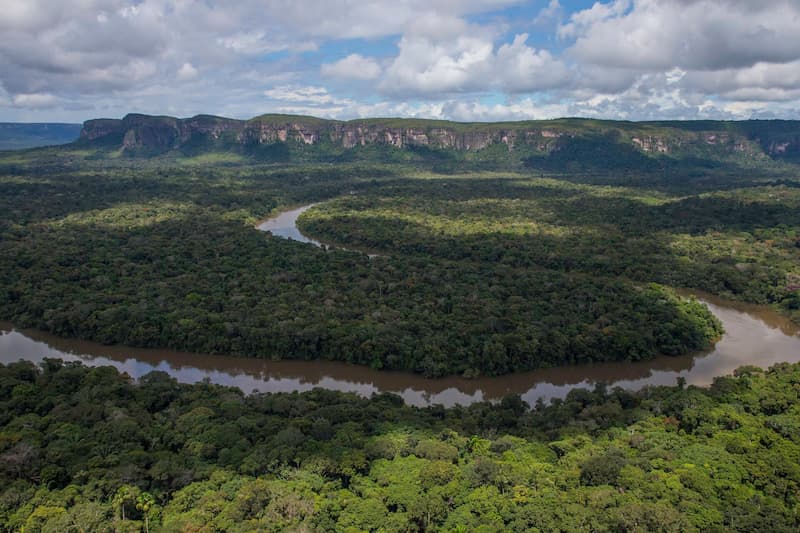
Deep within the heart of the Colombian Amazon lies a landscape so ancient and isolated it is often described as “the lost world.” Chiribiquete National Park – “The Maloca of the Jaguar” is not just Colombia’s largest protected area; it is a sacred bridge between the past and the present, where nature and ancient human spirituality remain remarkably untouched.
Covering over 4.3 million hectares, Chiribiquete is the largest tropical rainforest national park in the world. Its most defining geological features are the tepuis—towering, isolated table-top mountains that rise abruptly from the dense jungle floor. These formations are part of the Guiana Shield and are estimated to be over 2 billion years old.
The name “Maloca of the Jaguar” refers to the park’s status as a spiritual “longhouse” (maloca) for the jaguar, which is a central figure in local indigenous cosmology. The park serves as a critical junction where four distinct biogeographical provinces meet: the Amazon, the Orinoco, the Andes, and the Guiana Shield.
Attraction
Chiribiquete attracts the world’s attention not as a traditional tourist resort, but as one of the last great wildernesses:
- Prehistoric Rock Art: The park contains the world’s largest collection of prehistoric rock art. More than 75,000 pictographs adorn the walls of 60 rock shelters at the base of the tepuis. These “Sistine Chapels of the Amazon” date back over 20,000 years.
- The Myth of the Jaguar: The paintings predominantly feature the jaguar, symbolizing power and fertility. For many, the site represents the very origin of Amazonian culture.
- Exclusivity and Mystery: Because the park is largely inaccessible by land and ground entry is strictly restricted to protect the environment and uncontacted tribes, it possesses an aura of mystery that few places on Earth can match.
- Apex Biodiversity: It is a sanctuary for iconic species like the Jaguar, the Amazon River Dolphin (Pink Dolphin), the Giant Otter, and the Chiribiquete Emerald Hummingbird.

Heritage
UNESCO inscribed Chiribiquete as a Mixed World Heritage Site in 2018, acknowledging both its natural and cultural “Outstanding Universal Value”:
- Cultural (Criterion iii): The rock art provides an exceptional testimony to the lives of the earliest inhabitants of the Amazon. These paintings are not just historical artifacts; they represent a continuous spiritual tradition that persists today among isolated groups.
- Natural (Criteria ix & x): The park is a “center of plant diversity” and a vital corridor for evolutionary processes. Its isolation has allowed for high levels of endemism (species found nowhere else) and the preservation of pristine ecosystems that are critical for global climate regulation.
Gateway
The primary gateway to Chiribiquete is the town of San José del Guaviare.
- Commercial Airport: Jorge Enrique González Torres Airport (SJE) serves the town with regular commercial flights from Bogotá (via airlines like Satena).
- Lodging: While it is a frontier town, San José del Guaviare has developed a range of “eco-lodges” and hotels catering to adventurous travelers. Options like Hotel Quinto Nivel or various boutique jungle lodges provide sufficient comfort for overnight stays before or after expeditions.
When
- Dry Season (December to March): This is the best time for flyovers. The skies are clearer, providing the best visibility of the tepuis and the winding rivers below.
- Shoulder Season (July to August): There is often a short “veranillo” (little summer) during these months which can also offer good flying conditions.
- Avoid the Heavy Rains (April to June): The intense Amazonian rainfall can lead to flight cancellations and heavy cloud cover that obscures the landmarks.

(Carlos Castano Uribe, Wikimedia/CC BY-SA 3.0).
Consideration
- Aerial-Only Tourism: Currently, the most common (and often only legal) way for tourists to see the park is via overflights. Landing inside the park is strictly prohibited to protect the “Voluntary Isolation” of indigenous tribes and the fragile ecosystem.
- Vaccinations: You must have a valid Yellow Fever vaccination certificate to travel to this region of Colombia. It is also recommended to take malaria precautions.
- Ethical Tourism: Be aware that the park is home to uncontacted indigenous groups. Any attempt to enter unauthorized zones is a serious legal and ethical violation.
- The “Frontier” Experience: San José del Guaviare is safe but remote. Expect basic infrastructure and carry sufficient cash (Pesos), as ATMs can be unreliable.
- Sun and Humidity: Even on a flight, the equatorial sun is powerful. Use high-SPF sunscreen and stay hydrated.

(Carlos Castano Uribe, Wikimedia/CC BY-SA 3.0).
Resources
- UNESCO World Heritage Centre – The official site for detailed maps and the archaeological significance of the “Maloca of the Jaguar.”
- Parques Nacionales Naturales de Colombia – The official government body managing the park; essential for checking current access regulations.
- Colombia Travel – The official tourism portal for Colombia, providing guides on the gateway town of San José del Guaviare.
- Mongabay: Chiribiquete – A leading environmental news site for updates on conservation efforts and new species discoveries in the park.
- Viator – This platform lists specialized agencies that organize authorized flyovers and eco-tours departing from San José del Guaviare or Bogotá.
Featured Image
Chiribiquete National Park (Angie5jb, Wikimedia/CC BY-SA 4.0).
In The News
Advertisement



Comment:
 All About World Heritage Sites (...and more)
Leave a comment