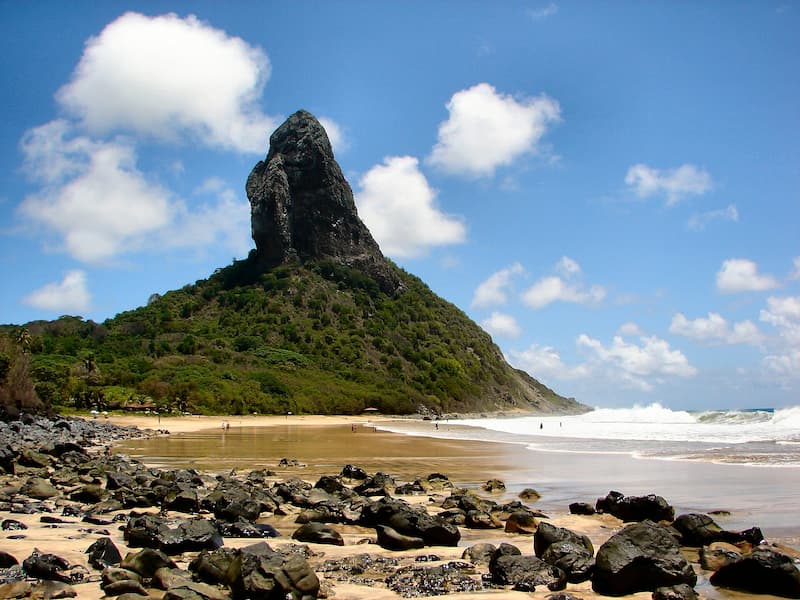
The Brazilian Atlantic Islands, consisting of the Fernando de Noronha Archipelago and Atol das Rocas, are isolated volcanic summits of the Mid-Atlantic Ridge. This remote sanctuary is widely regarded as the “Galápagos of Brazil,” offering a pristine look at evolution and marine life in the open ocean.
- Fernando de Noronha: An archipelago of 21 islands and islets located 340 km off the coast. Only the main island is inhabited. It features jagged volcanic peaks, such as the Morro do Pico, and the only remaining sample of Insular Atlantic Forest.
- Atol das Rocas: Located 150 km west of Noronha, this is the only atoll in the South Atlantic. It is a biological reserve primarily made of coralline algae and vermetid snails, creating a spectacular seascape of shallow lagoons and tidal pools.
Attraction
Travelers are drawn to these islands for their “unplugged” beauty and world-class aquatic experiences:
- Legendary Beaches: Praia do Sancho is consistently ranked by TripAdvisor as one of the best beaches in the world.
- Dolphin Watching: Baía dos Golfinhos (Dolphin Bay) is home to the world’s largest resident population of spinner dolphins.
- Scuba Diving: With visibility often exceeding 50 meters, the archipelago is a premier diving destination where visitors swim alongside sea turtles, rays, and reef sharks.
- Atol das Rocas Experience: While humans cannot land on the Atoll (it is for research only), boat tours allow visitors to witness the unique marine ecosystem from a distance.

Heritage
Inscribed in 2001, the site meets several UNESCO criteria:
- Biodiversity Hotspot: It serves as a vital breeding and feeding ground for tuna, sharks, and marine mammals, playing a key role in the restocking of fish in the South Atlantic.
- Endemism: It is a Global Centre of Bird Endemism, hosting the largest concentration of tropical seabirds in the Western Atlantic.
- Geological Rarity: Atol das Rocas is the only oceanic atoll in the South Atlantic, providing a unique landscape of natural aquariums at low tide.
Gateway
To reach the islands, you must travel through one of two major gateway cities on mainland Brazil:
- Recife (Pernambuco): The most common hub. Recife/Guararapes International Airport (REC) offers multiple daily commercial flights to the island. Recife is a major city with luxury hotels (e.g., Hotel Rosewood or Hotel Atlante Plaza) and extensive culture.
- Natal (Rio Grande do Norte): The closest city to the islands. Natal International Airport (NAT) also provides commercial flights. It offers excellent lodging like the Serhs Natal Grand Hotel.
- The Island Destination: Once you land at Fernando de Noronha Airport (FEN), you will find high-quality boutique “pousadas” (inns) like Pousada Maravilha or Nannai Noronha.
When
- Dry Season (August to January): This is the peak time. The sea is calm, visibility for diving is at its absolute best, and sunshine is guaranteed.
- Surfing Season (December to March): For those seeking big waves, the “Noronha Hawaii” season brings massive swells to beaches like Cacimba do Padre.
- Rainy Season (March to July): While more humid, this is the “low season” where prices are slightly lower, and the island becomes incredibly lush and green.

Consideration
- Environmental Taxes: All visitors must pay a daily Environmental Preservation Tax (TPA) and an additional fee to enter the National Marine Park. It is best to pay these online in advance to avoid long airport queues.
- Strict Visitor Limits: Only about 400–500 tourists are allowed on the island at any given time. Book your flights and lodging months in advance.
- Limited Infrastructure: Internet is slow, and freshwater is precious. There are no large resorts; the charm lies in small, high-end eco-inns.
- Conservation Rules: Sunscreen is often restricted on certain beaches to protect coral, and picking up shells or disturbing wildlife carries heavy fines.

Resources
- UNESCO – Brazilian Atlantic Islands: Official heritage documentation and conservation maps.
- Visit Brasil – Fernando de Noronha: The official government guide for international travelers.
- Noronha.pe.gov.br: The official state website for paying the mandatory Environmental Preservation Tax (TPA).
- TAMAR Project: Information on the legendary sea turtle conservation project based on the island.
- Expedia – Fernando de Noronha Packages: A reliable platform for booking combined flight and “pousada” packages.
Featured Image
Morro do Pico and Conceicao Beach (Bjorn Christian Torrissen, Wikimedia/CC BY-SA 3.0).
In The News
Advertisement


Advertisements
Advertisements
Advertisements

Advertisements
Comment:
Advertisements
 All About World Heritage Sites (...and more)


Leave a comment