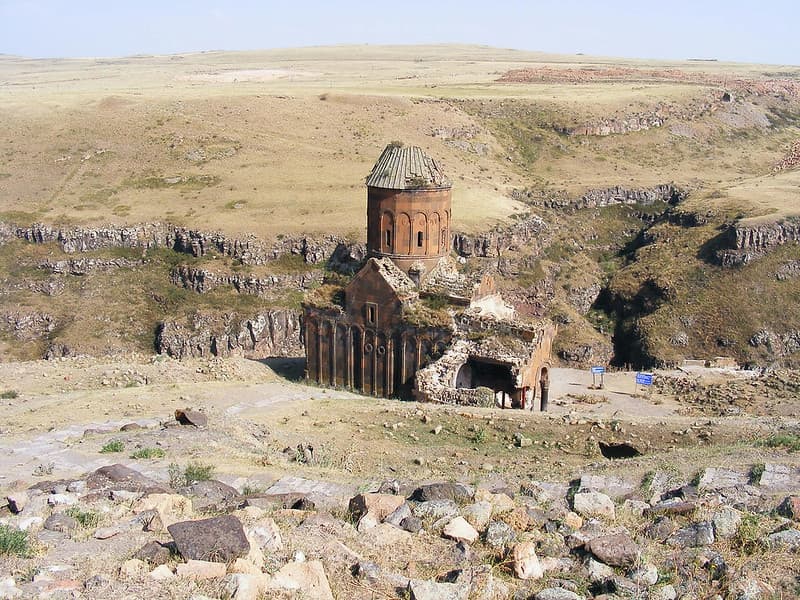
The Archaeological Site of Ani, located in northeastern Turkey near the Armenian border, is a profound “city of ghosts.” Once a prosperous capital of the Bagratid Armenian kingdom and a crucial Silk Road trade hub, it was abandoned centuries ago. Today, it stands as a vast, windswept plateau filled with the haunting ruins of medieval Armenian churches, Seljuk mosques, and fortified walls, offering a dramatic visual testimony to a multicultural past.
Ani is not a compact site; it is a sprawling complex encompassing roughly 78 hectares surrounded by defensive walls. The architecture is a syncretism of Armenian, Georgian, and Islamic styles, utilizing local volcanic tuff stone in shades of rose, yellow, and black.
- The Cathedral of Ani: Designed by Trdat the Architect, this monumental structure is renowned for its early Gothic-style pointed arches and clustered piers.
- Church of St. Gregory of Tigran Honents: The best-preserved monument, famous for its intricate exterior stone carvings and nearly complete interior frescoes depicting the life of Saint Gregory the Illuminator.
- Mosque of Manuchihr: Believed to be the first Turkish mosque in Anatolia, featuring a striking octagonal minaret.
- Church of the Holy Redeemer: Famous for being split cleanly in half by a lightning strike in the 1950s, leaving one side standing intact.
- The Walls and Citadel: Impressive fortifications that once protected a population of over 100,000 people.
Attraction
Travelers are drawn to Ani for its atmosphere of poignant isolation. It offers a rare opportunity to explore a major medieval metropolis without the crowds typical of other UNESCO sites. The dramatic landscape—situated on the edge of the Akhurian River gorge—combined with the desolate beauty of the crumbling architecture makes it a paradise for photographers and history enthusiasts. It is a profound place of reflection on the endurance and fragility of civilization.

Heritage
Inscribed in 2016, the site meets three distinct criteria (ii), (iii), and (iv):
- Criterion (ii): Ani demonstrates a significant interchange of architectural and urban planning values between Christian Armenian and Islamic cultures over centuries.
- Criterion (iii): It bears exceptional testimony to Armenian cultural, artistic, architectural, and urban design development as a whole, representing a peak in the Armenian architectural school.
- Criterion (iv): It is an outstanding example of a medieval urban center that comprehensively illustrates the evolution of architectural styles in the region between the 7th and 13th centuries, including military, religious, and civil structures.
Gateway
- The City: Kars is the mandatory gateway city, located 42 km west of Ani.
- Airport: Kars Harakani Airport (IATA: KSY) has daily flights from Istanbul and Ankara.
- Lodging: Kars has sufficient lodging, ranging from budget hotels to high-end boutique options like the Kars Park Hotel or historic Russian-era buildings turned into guesthouses.
When
- Best Overall: Late Spring (May–June) and Early Autumn (September–October) offer the most pleasant temperatures for walking. In late spring, the surrounding steppes are carpeted in green and wildflowers.
- Winter (January–March): While bitterly cold, visiting in winter provides a stunning, eerie experience of the ruins covered in snow. Many travelers arrive via the Dogu Ekspresi (Eastern Express) train to Kars specifically for this experience.
- Avoid July/August: It can be very hot with almost no shade.

Consideration
- Border Sensitivity: The site is directly on the border with Armenia, which is closed. Stay within marked paths. Visitors may see border guards, and straying too close to the gorge can be dangerous.
- No Facilities: There are no food or water vendors inside the site. Bring sufficient water, snacks, and sun protection (hat, sunscreen).
- Transport: The easiest way to get there is to hire a taxi for the day in Kars (approx. 45 min drive) or take the daily tourist shuttle bus departing from the city center in the morning.
- Walking: The site is large, uneven, and requires extensive walking. Wear sturdy, comfortable shoes.

(Panegyrics of Granovetter, Flickr/CC BY-SA 2.0).
Resources
- UNESCO – Archaeological Site of Ani: The official archive for maps, conservation reports, and history.
- Turkish Museums – Kars Ani Ruins: The official website for entrance fees, opening hours, and practical information.
- Virtual Ani: A comprehensive, independent digital archive offering detailed photos, history, and interactive maps of every building.
- Kars Tourism Board: Local government portal with information on accommodation and transport to Ani.
- Viator – Ani Tours: For booking guided day trips from Kars, including transportation and an English-speaking guide.
Would you like me to find the current 2026 train schedules for the Eastern Express to Kars, or should I look up a list of top-rated hotels in Kars city center?
Featured Image
Church of St. Gregory of Tigran Honents (Marko Anastasov, Flickr/CC BY 2.0).
In The News
Advertisement



Comment:
 All About World Heritage Sites (...and more)
Leave a comment