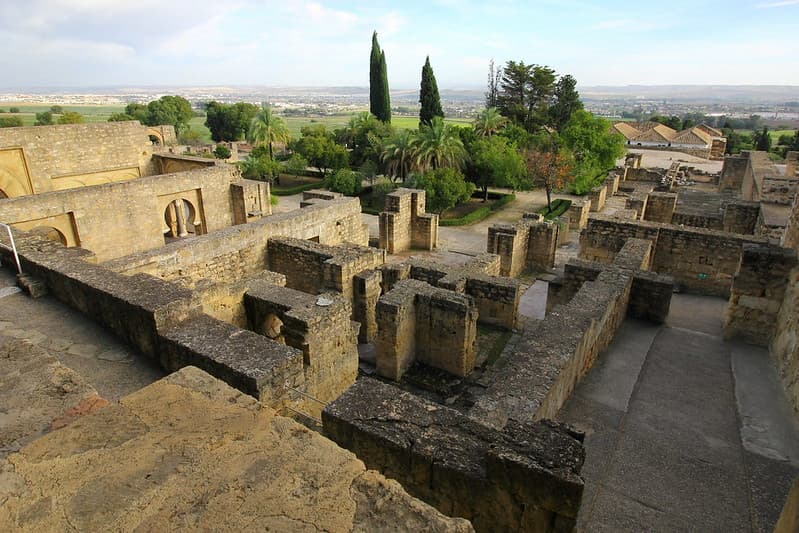
Inscribed as a UNESCO World Heritage site in 2018, the Caliphate City of Medina Azahara (Madinat al-Zahra) is one of the most significant archaeological treasures in Europe. Built in the mid-10th century by Abd-al-Rahman III, the first Umayyad Caliph of Córdoba, this “Shining City” was designed as a dazzling palace-city to project the power and sophistication of Al-Andalus.
Medina Azahara is a vast, fortified urban complex situated at the foot of the Sierra Morena mountains. The city was built on three distinct terraces to adapt to the sloping terrain:
- The Upper Terrace: Contained the Caliph’s private residence (Qasr) and administrative offices.
- The Middle Terrace: Housed the diplomatic reception halls, including the magnificent Salón Rico, and lush geometric gardens.
- The Lower Terrace: Featured the congregational mosque, workshops, military quarters, and residential areas for the city’s population.The city flourished for only 70 years before being sacked and destroyed during the civil wars that ended the Caliphate in 1010. It lay hidden for nearly 1,000 years until its rediscovery in 1911.
Attraction
Medina Azahara is a magnet for travelers interested in medieval Islamic art and architecture. It offers a rare, “frozen-in-time” glimpse into a vanished civilization. Key attractions include:
- Salón Rico: The crown jewel of the site, a reception hall adorned with intricate marble carvings of “trees of life” and horseshoe arches.
- The Museum & Visitor Center: An award-winning modern building that houses exquisite artifacts, from lustre ceramics to astronomical instruments, and features a 3D movie that reconstructs the city’s original splendor.
- Night Visits: During summer months, the site is dramatically illuminated, offering a magical, cooler experience under the stars.

Heritage
UNESCO recognizes Medina Azahara under Criteria (iii) and (iv):
- Unique Testimony: It is the only surviving example of a planned Umayyad city of this scale in the Western Islamic world, providing deep insight into the material culture and urban life of Al-Andalus.
- Technological Marvel: The city showcased advanced urban infrastructure, including complex aqueducts, decorative stone carving, and sophisticated landscape adaptation that influenced Mediterranean architecture for centuries.
Gateway
Córdoba is the direct and essential gateway to the site.
- Airport: While Córdoba has a local airport (ODB), most international visitors use Seville Airport (SVQ) or Málaga Airport (AGP) and take the high-speed AVE train to Córdoba (approx. 45–60 minutes).
- Lodging: Córdoba offers exceptional lodging, from the luxury Hospes Palacio del Bailío (built over Roman ruins) to charming boutique hotels in the Jewish Quarter like Las Casas de la Judería.
- Access: The site is located 8 km (5 miles) from the city center. A dedicated tourist bus departs from the city, or you can take a 15-minute taxi ride.
When
- Spring (March to May): The ideal time. The gardens are in bloom, and temperatures are pleasant (around 20°C to 25°C).
- Autumn (September to November): Another excellent window with mild weather and fewer crowds.
- Avoid Summer: In July and August, Córdoba is often the hottest city in Europe, with temperatures frequently exceeding 40°C. If you must visit then, choose the morning session (opens at 9:00 AM) or a night tour.

Consideration
- The Shuttle Bus: To protect the ruins, private vehicles must park at the Museum/Visitor Center. You then pay a small fee (approx. €3) for the official shuttle bus that takes you the final 2 km up to the archaeological site.
- Footwear: The terrain consists of ancient stone, gravel, and steep slopes. Sturdy walking shoes are a must.
- Interpretive Signage: While the site has been well-researched, only about 10% has been excavated. Hiring a guide is highly recommended to help you visualize the structures that are currently off-limits or still buried.
- Closing Days: Like most state museums in Spain, the site is closed on Mondays.

Resources
- UNESCO – Medina Azahara: The official record of its universal value and historical background.
- Conjunto Arqueológico Madinat al-Zahra: The official museum website for hours, tickets, and seasonal night-tour schedules.
- Turismo de Córdoba: Practical information on how to get there and booking the official shuttle from the city.
- Spain.info – Medina Azahara: A broad overview of the site’s history and architectural highlights.
- GetYourGuide – Medina Azahara Tours: A convenient platform to book guided tours with transportation included from Córdoba.
Featured Image
Medina Azahara (Jorge Cancela, Flickr/CC BY 2.0).
In The News
Advertisement

Comment:
 All About World Heritage Sites (...and more)
Leave a comment