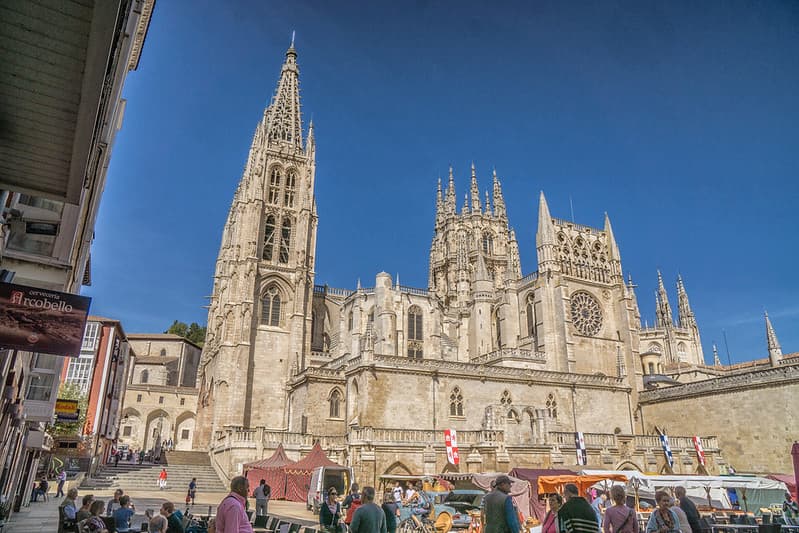
Located in the heart of Castile and León, the Burgos Cathedral (Catedral de Santa María de Burgos) is a towering masterpiece of Spanish Gothic architecture. It is an intricate forest of stone spires and pointed arches, representing over four centuries of artistic evolution and spiritual ambition.
Construction began in 1221 and continued until 1567, resulting in a structure that harmonizes the French “High Gothic” style with unique Spanish elements.
- The Exterior: Defined by two openwork spires that dominate the city’s skyline and the Puerta del Sarmental, a portal featuring a magnificent sculptural ensemble of the Majesty of Christ.
- The Interior: A massive Latin-cross layout housing treasures such as the Golden Staircase (an Italian Renaissance gem by Diego de Siloé), the Capilla del Condestable, and the legendary Papamoscas, an automaton clock that opens its mouth as it strikes the hours.
Attraction
The cathedral is a bucket-list destination for several distinct reasons:
- El Cid’s Resting Place: It holds the tomb of the legendary medieval knight Rodrigo Díaz de Vivar (El Cid) and his wife Doña Jimena.
- Camino de Santiago: It is a major milestone for thousands of pilgrims on the “French Way” toward Santiago de Compostela.
- Architecture Pilgrimage: For design enthusiasts, it is considered one of the three great Gothic cathedrals of Spain, alongside Toledo and León.

Heritage
Inscribed in 1984, Burgos holds a unique distinction: it is the only Spanish cathedral to be listed individually by UNESCO without being tied to a larger historic city center.
- Criterion (ii): It exerted a profound influence on Spanish art and architecture by introducing French Gothic forms to the Iberian Peninsula.
- Criterion (iv): It is an “integral Gothic cathedral,” showcasing the complete history of the style from the early 13th century through its transition into the Renaissance.
- Criterion (vi): It is intimately linked to the history of the Reconquista and the unification of the Spanish monarchy.
Gateway
While Burgos has a regional airport (Burgos Airport – RGS), its commercial flights are limited. For international travelers, the most effective gateways are:
- Madrid (Adolfo Suárez Madrid-Barajas Airport – MAD): Roughly 2.5 hours away. It offers the best international connectivity and frequent bus (ALSA) or high-speed train services to Burgos.
- Bilbao (BIO): Approximately 1.5 to 2 hours away, offering great regional European flights and plenty of lodging.
- Lodging in Burgos: The city itself has excellent options, such as the AC Hotel Burgos by Marriott (modern) or Hotel Vía Gótica (classic views).
When
- Late Spring (May–June) & Early Autumn (September–October): These are the optimal windows. The weather is crisp and pleasant (15°C to 25°C), avoiding the biting cold of the Castilian winter and the intense summer heat.
- April: If you enjoy cultural pageantry, visiting during Holy Week (Semana Santa) offers a chance to see dramatic religious processions through the medieval streets.

(Juan Ramon Rodriguez Sosa, Wikimedia/CC BY-SA 2.0).
Consideration
- Climate: Burgos is at a high elevation (over 800m). Even in summer, nights can be quite chilly. Always pack a light jacket.
- The “Papamoscas” Clock: Make sure to be inside the cathedral on the hour to see the famous “Flycatcher” figure strike the bell.
- Museum of Human Evolution: While in town, don’t miss this world-class museum, which is linked to the nearby Atapuerca archaeological site.
- Entrance Fees: There is a charge for tourists (around €10 as of 2026), which includes an audio guide. Mass is held in separate areas and is free, but sight-seeing is restricted during these times.

Resources
- UNESCO – Burgos Cathedral: The official record of the site’s heritage status and history.
- Catedral de Burgos (Official): The main site for booking tickets and checking liturgical schedules.
- Spain.info – Burgos: The national tourism portal’s guide to the city and region.
- Spanish Nomad Guide: A detailed visitor’s guide with photography tips for the cathedral interior.
- Viator – Burgos Day Tours: A great resource for booking guided architectural walks or day trips from Madrid.
Featured Image
Burgos Cathedral (Graeme Churchard, Flickr/CC BY 2.0).
In The News
Advertisement


Comment:
 All About World Heritage Sites (...and more)

.jpg)
Leave a comment