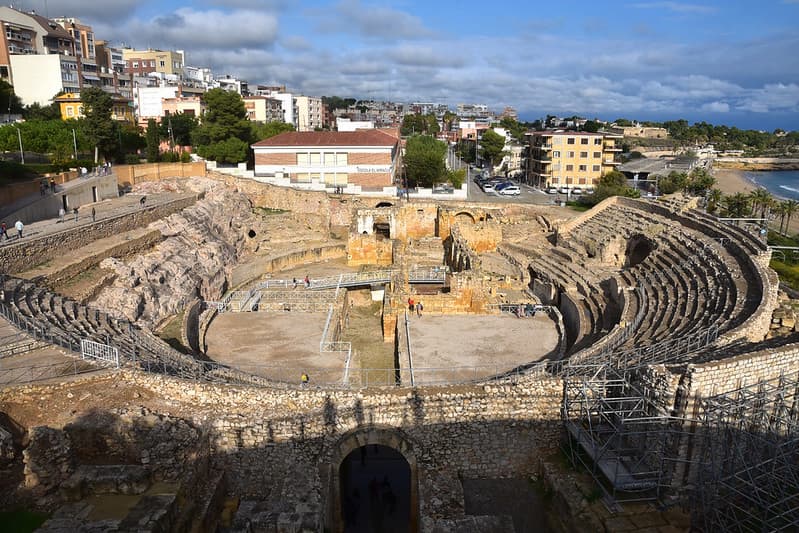
The Archaeological Ensemble of Tarraco, located in the sun-drenched coastal city of Tarragona, Spain, is one of the most significant Roman sites in Europe. Founded in 218 BC during the Second Punic War, it was the first and oldest Roman settlement on the Iberian Peninsula. Over centuries, it evolved into the capital of the vast province of Hispania Citerior, serving as a center of imperial power where emperors like Augustus and Hadrian once walked.
Tarraco is a “living” archaeological site where 2,000-year-old structures are seamlessly woven into the fabric of a modern city. The ensemble includes 14 distinct locations:
- The Amphitheatre: A stunning 2nd-century arena built right on the shoreline. It once held 15,000 spectators and still contains the ruins of a later Visigothic basilica.
- The Roman Circus: One of the best-preserved chariot-racing tracks in the world. Visitors can explore the long, vaulted underground tunnels where horses and spectators once moved.
- The Provincial Forum: Once the administrative heart of the province, its massive ruins are now part of the city’s lively public squares.
- The Roman Walls: The oldest Roman military architecture outside of Italy, stretching nearly 1,100 meters around the old quarter.
- Les Ferreres Aqueduct (Devil’s Bridge): Located 4km outside the city, this towering two-tier stone bridge remains a marvel of ancient hydraulic engineering.
Attraction
Tarraco draws travelers for its unique “Mediterranean-meets-History” vibe. It offers the rare ability to explore world-class ruins in the morning and lounge on golden beaches by the afternoon. The city is famous for Tarraco Viva, an annual Roman history festival where gladiators, legionaries, and ancient artisans take over the streets, making history feel tangible rather than academic.

Heritage
Inscribed in 2000, the site meets Criteria (ii) and (iii):
- Criterion (ii): Tarraco was a model for provincial capitals throughout the Roman Empire, demonstrating an exceptional interchange of values in urban planning and architectural design.
- Criterion (iii): It provides “eloquent and unparalleled testimony” to a specific stage in the history of the Mediterranean lands in antiquity, illustrating the expansion of Roman civilization.
Gateway
- The Primary Gateway: Barcelona (IATA: BCN) is the main international gateway. It is located 80 km away, with direct buses (Plana) or trains (Renfe) taking about 1 hour and 15 minutes.
- The Closer Alternative: Reus Airport (IATA: REU) is just 15 km away and handles many seasonal and budget flights.
- Lodging: Tarragona has extensive options. H10 Imperial Tarraco offers views over the ruins, while the Part Alta (Old Town) is filled with boutique apartments tucked into historic stone buildings.
When
- Best Overall: May and September. The weather is perfect for walking (20–25°C), and the crowds are thinner than in summer.
- For History Buffs: Visit in May for the Tarraco Viva festival.
- For Tradition: Late September features the Santa Tecla Festival, where you can see the famous “Castellers” (human towers) reaching up to 10 stories high in the cathedral square.

Consideration
- The Tarragona Tourist Pass: Consider a combined ticket (approx. 15€) to save money if you plan to visit the Amphitheatre, Circus, and Walls.
- Sun Protection: Most of the archaeological sites are completely exposed. Bring a hat and plenty of water, especially at the Aqueduct.
- MHT Hours: The Tarragona History Museum (MHT) manages the sites; they often have shorter hours on Sundays and Mondays.
- Walking: The historic center is steep and paved with old stones. Sturdy footwear is essential.

Resources
- UNESCO – Archaeological Ensemble of Tarraco: The official archive for maps and the original dossier for inscription.
- Tarragona Turisme: The official city portal for events, festival dates, and site opening hours.
- National Archaeological Museum of Tarragona (MNAT): The best resource for viewing the intricate mosaics and sculptures removed from the sites for preservation.
- Tarraco Viva: The official site for the annual Roman reenactment festival.
- Viator – Tarragona Tours: Use this to book guided day trips from Barcelona or private archaeological walking tours in Tarragona.
Featured Image
Amphitheatre of Tarraco (Carole Raddato, Flickr/CC BY-SA 2.0).
In The News
Advertisement


Comment:
 All About World Heritage Sites (...and more)

Leave a comment