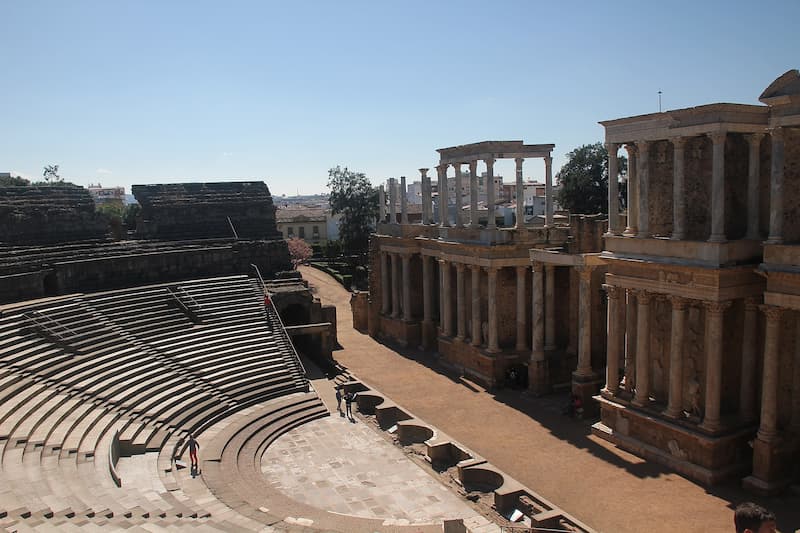
The Archaeological Ensemble of Mérida, located in the Extremadura region of western Spain, is the most extensive and well-preserved collection of Roman ruins on the Iberian Peninsula. Founded in 25 BC as Augusta Emerita by Emperor Augustus, it served as the capital of the Roman province of Lusitania. Today, the modern city of Mérida is literally built atop its imperial predecessor, with 22 distinct protected sites—including a theater, amphitheater, circus, and temples—integrated into the contemporary urban fabric.
Attraction
Mérida draws visitors worldwide primarily because its ruins are not just “museum pieces” but living structures:
- Active Roman Theatre: The theater, built by Agrippa, is still used today for the world-renowned International Classical Theatre Festival.
- The World’s Longest Roman Bridge: The Puente Romano stretches 792 meters over the Guadiana River and remained a primary transit route for nearly 2,000 years.
- Engineering Marvels: The Acueducto de los Milagros (Aqueduct of Miracles) stands with massive 25-meter-high arches that earned their name because it seemed a “miracle” they never collapsed.
- Domestic Life: Sites like the Casa del Mitreo offer a rare look at luxury Roman life, featuring the famous “Cosmos Mosaic.”

Heritage
Inscribed in 1993, Mérida is a World Heritage site under Criteria (iii) and (iv):
- Criterion (iii): It is a remarkable example of a Roman city built according to strict urban design rules, serving as an idealized “Rome away from Rome.”
- Criterion (iv): The ensemble provides an outstanding record of the public architecture of a provincial capital, representing the pinnacle of Roman engineering, administration, and entertainment.
Gateway
- The City: Badajoz is the closest major city with an airport, located approximately 50 km (30 minutes) west of Mérida.
- Airport: Badajoz Airport (IATA: BJZ) handles domestic flights, primarily from Madrid and Barcelona.
- Alternative: Many travelers use Seville (IATA: SVQ) or Madrid (IATA: MAD) as gateways and reach Mérida via a 2-to-4-hour bus or train ride.
- Lodging: Mérida has excellent overnight options, including the Parador de Mérida, housed in a former 18th-century convent built over a Roman temple.
When
- Spring (April–June): The landscape is lush, and the weather is mild (20–25°C). The Emerita Lvdica festival in June features Roman reenactments.
- Summer (July–August): Very hot (often over 35°C), but essential if you want to attend a play at the Classical Theatre Festival at night.
- Autumn (September–October): Pleasant temperatures and fewer crowds.

Consideration
- Combined Ticket: Purchase the “Entrada Conjunta” (approx. 17€). It covers all major sites and is valid for several days.
- Footwear: You will be walking on original Roman stones and dirt paths. Wear sturdy, comfortable shoes.
- Walking City: Most ruins are within a 15-minute walk of each other, making the city very pedestrian-friendly.
- Siesta Hours: Note that the National Museum of Roman Art and some smaller ruins may close for several hours in the afternoon.

Resources
- UNESCO – Archaeological Ensemble of Mérida: The official archive for maps and historical dossiers.
- Consorcio Ciudad Monumental de Mérida: The local authority site for tickets, maps, and real-time site updates.
- National Museum of Roman Art (MNAR): Information on the Rafael Moneo-designed museum housing the city’s finest mosaics.
- Spain.info – Mérida Guide: The national tourism portal for local gastronomy and festival dates.
- GetYourGuide – Mérida Tours: For booking skip-the-line guided walking tours and Roman-themed experiences.
Featured Image
Roman Theatre of Merida (Von Ralph, Wikimedia/CC BY-SA 3.0).
In The News
Advertisement


Comment:
 All About World Heritage Sites (...and more)

Leave a comment