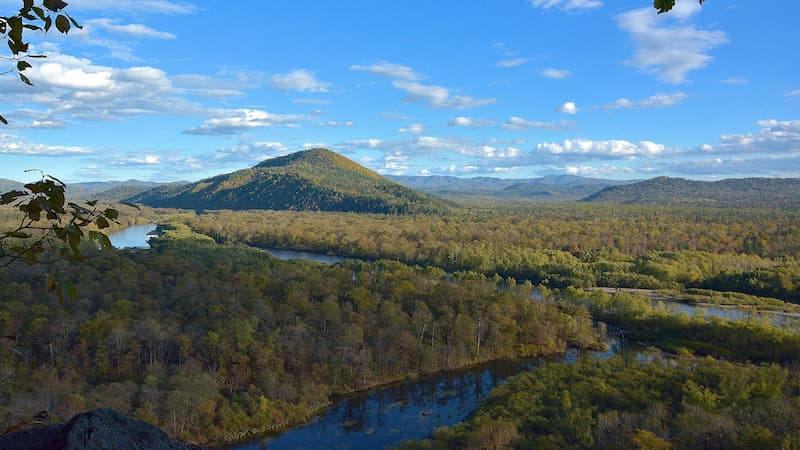
The Central Sikhote-Alin is a wild, mist-shrouded mountain range in the Russian Far East that serves as the last great stronghold for some of the world’s most elusive creatures. Extending from the peaks of the Sikhote-Alin mountains to the shores of the Sea of Japan, it is a place where the frozen north meets the sub-tropical south.
The Central Sikhote-Alin is a vast wilderness area located in the Primorsky Krai region. It is characterized by one of the most unusual and diverse temperate forests on the planet. This region is a “biogeographic melting pot”: here, northern species typical of the Siberian taiga (like the brown bear, reindeer, and lynx) cohabit with southern, sub-tropical species (like the Amur tiger, Himalayan black bear, and the Amur leopard).
The property includes the Sikhote-Alin Zapovednik (Strict Nature Reserve) and was extended in 2018 to include the Bikin River Valley. The landscape ranges from rugged coastal cliffs and lagoon lakes to dense, ancient forests of Korean pine and Mongolian oak, rising up to alpine tundra at nearly 2,000 meters.
Attraction
The site is a magnet for eco-tourists and wildlife photographers for several reasons:
- The Amur (Siberian) Tiger: This is the primary draw. As the largest cat in the world, the Amur tiger is the “king” of these forests. While seeing one in the wild is rare and requires immense patience, the chance to track them and see their footprints in the snow or mud is a profound experience.
- The “Stone Dragons”: In areas like the “Dragon Park” (near the edges of the range), erosion has carved the mountain peaks into bizarre, towering pillars that look like mythical stone guardians.
- Pristine Coastal Beauty: Sites like Cape North and Lake Blagodatnoye offer spectacular views of the Sea of Japan, where you can watch huge rookeries of spotted seals (larga seals) sunning themselves on the reefs.
- Extreme Biodiversity: For botanists, the area is a “Center of Plant Diversity,” featuring relics from the pre-glacial era, such as wild ginseng and the rare Rhododendron fauriei.

(Romanver, Wikimedia/CC BY-SA 4.0).
Heritage
Central Sikhote-Alin was inscribed by UNESCO under Criterion (x) for its biodiversity:
- Unique Ecosystem Assemblage: It contains a mixture of boreal and subtropical flora and fauna that is found nowhere else on Earth. It is a critical “biocorridor” where species from different climate zones overlap.
- Survival of Endangered Species: It is essential for the survival of globally threatened species. It provides the largest and most stable habitat for the Amur tiger and is a nesting ground for rare birds like the Blakiston’s Fish-Owl (the world’s largest owl) and the Scaly-sided Merganser.
Gateway
The primary gateway city to the region is Vladivostok, but the immediate “town” gateway is Plastun.
- Vladivostok (VVO): This major city has Vladivostok International Airport, which connects to Moscow and various Asian hubs. It offers world-class lodging and serves as the logistics base for most expeditions.
- Plastun (Local Gateway): To reach the heart of the reserve, travelers usually fly from Vladivostok to Plastun Airport (TLY) on small regional aircraft (operated by Aurora Airlines). Plastun is a remote settlement that serves as the headquarters for the Sikhote-Alin Reserve and has several comfortable guest houses and local hotels specifically catering to eco-tourists.
When
- Late May to June: Best for seeing blooming wildflowers, including the legendary rhododendrons, and observing bears as they emerge.
- September to October (Recommended): This is the “Golden Autumn.” The humidity drops, the mosquitoes vanish, and the forests turn a brilliant palette of red and gold. This is also the best time for hiking and coastal photography.
- Winter (December to February): Only for the hardy. This is the best time for tiger tracking, as paw prints are easily visible in the deep snow. Temperatures can drop to -20°C or lower.

Consideration
- Guided Access Only: You cannot simply wander into the reserve. A visit to the Sikhote-Alin Zapovednik requires a permit and must be accompanied by an official guide. Applications should be submitted at least 3 days in advance.
- Ticks and Encephalitis: Primorye is a high-risk area for tick-borne encephalitis, especially in spring and early summer. Vaccination or specialized insurance and repellent clothing are mandatory.
- Physical Fitness: Many of the eco-trails, such as the climb to Bald Mountain, are long (13km+) and involve significant elevation gain.
- Connectivity & Cash: Mobile signal is non-existent once you enter the forest. Furthermore, Plastun is a cash-heavy economy; do not rely on credit cards for local purchases or guest houses.

Resources
- UNESCO World Heritage Centre – The official source for maps, history, and scientific criteria.
- Sikhote-Alin Nature Reserve (Official) – The best place to check trail availability and permit requirements.
- Wild Russia – A non-profit resource providing deep ecological context for the region’s biodiversity.
- Visit Primorye – The regional tourism board’s guide for logistical travel tips.
- Viator – Used for booking organized wildlife tours and multi-day expeditions from Vladivostok that handle all permits and regional flights.
Would you like me to check the 2026 flight schedule between Vladivostok and Terney to help you time your arrival?
Featured Image
Bikin River valley (Olga Ukhvatkina, Wikimedia/CC BY-SA 4.0).
In The News
Advertisement



Comment:
 All About World Heritage Sites (...and more)


Leave a comment