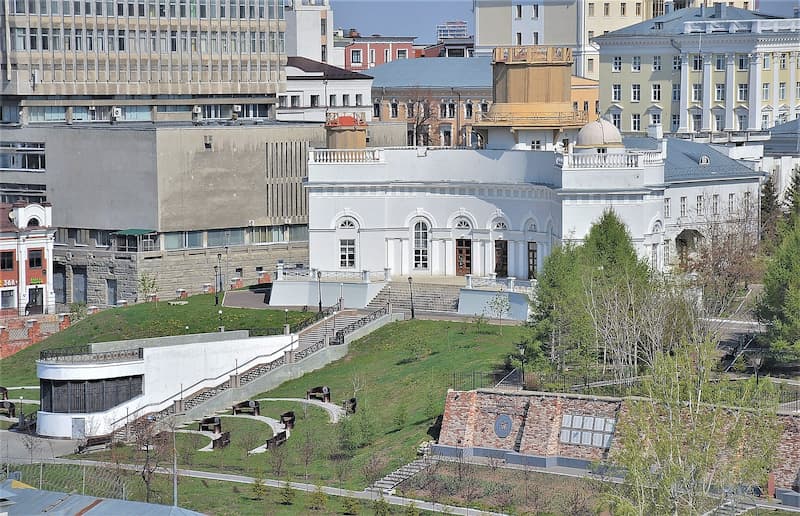
The Astronomical Observatories of Kazan Federal University (KFU), inscribed as a UNESCO World Heritage Site in 2023, represent a fascinating bridge between the Enlightenment’s scientific rigor and the architectural elegance of the 19th and early 20th centuries. This isn’t just a place for star-gazers; it’s a monument to the era when humanity began standardized, global mapping of the heavens.
The site is comprised of two distinct but historically linked components located in and near Kazan, Tatarstan:
- The City Astronomical Observatory (founded 1837): Located within the university campus in the heart of Kazan. It is a masterpiece of late Classicism, designed to house high-precision instruments while serving as a functional academic hub. Its distinctive hemispherical dome remains a landmark of the university’s historic core.
- The V.P. Engelhardt Astronomical Observatory (founded 1901): Situated in a wooded suburban area about 20 km west of the city. This site includes not only the observatory buildings and towers but also the tomb of Vasily Engelhardt himself. It was designed to move sensitive observations away from the “light pollution” and vibrations of the growing city.
Attraction
For the modern traveler, the observatories offer a “steampunk” aesthetic meets high-science vibe:
- Historical Instruments: You can see rare, functioning heliometers and telescopes from the 19th century that look like they belong in a Jules Verne novel.
- The Modern Planetarium: Adjacent to the Engelhardt site is one of Russia’s most modern planetariums, offering immersive digital shows that contrast sharply with the vintage brass instruments nearby.
- Scientific Romanticism: The suburban site is exceptionally peaceful, surrounded by a park-like setting that makes it a perfect escape from the urban bustle. It’s where history, nature, and the cosmos collide.

(Winer, Wikimedia/CC BY-SA 3.0).
Heritage
Kazan’s observatories were recognized by UNESCO based on two specific cultural criteria:
- Criterion (ii): The site demonstrates a significant interchange of human values regarding the development of architecture and technology. The Kazan school of astronomy acted as a bridge between Eastern and Western scientific traditions, influencing global astronomical constants used for decades.
- Criterion (iv): It is an outstanding example of a specialized architectural ensemble. The transition from the “integrated” city observatory to the “isolated” suburban observatory marks a pivotal shift in how scientific research was organized globally during the industrial revolution.
Gateway
The capital of the Republic of Tatarstan, Kazan, is your essential gateway.
- Commercial Airport: Kazan International Airport (KZN) is a major hub with modern facilities and connections across Russia and international hubs (notably Istanbul and Dubai).
- Lodging: As a major “Third Capital” of Russia, Kazan offers everything from international 5-star chains (like the Tasigo or Mirage Hotel) to quirky, budget-friendly hostels in the Bauman Street pedestrian area.
When
- May to September: The weather is mild to warm, making the stroll through the university campus and the wooded Engelhardt grounds very pleasant.
- August: This is often the best month for clear-sky night observations, and the city holds various cultural festivals during the late summer.
- Winter (December–February): Only for the brave. Kazan gets very cold, but the sight of the snow-covered domes under a crisp, dark winter sky is undeniably magical if you’re dressed for -15°C.

Consideration
- Visa Requirements: Most international travelers require an E-visa or a standard tourist visa to enter the Russian Federation. Be sure to check the current diplomatic status of your home country.
- Permits: While the city observatory is easy to see from the outside, entering the working laboratories or the Engelhardt site often requires a pre-booked guided tour. You can’t always just “show up” and expect to look through a telescope.
- Language: While younger people in Kazan often speak English, signs and older staff at the scientific sites will primarily use Russian or Tatar. A translation app is a lifesaver here.
- Currency: Due to ongoing international financial shifts, international credit cards (Visa/Mastercard) issued outside Russia generally do not work. You will likely need to bring cash (USD or Euro) to exchange for Rubles upon arrival.

(Stanislav Alexandrovich Korotkiy, Wikimedia/CC BY 3.0).
Resources
- UNESCO World Heritage – Kazan Observatories: The primary source for the official history and maps of the protected zones.
- Kazan Federal University (KFU) Official Site: Information on the university’s history and how to contact the departments for tours.
- Visit Tatarstan: The official tourism portal for the region, offering logistical advice and cultural highlights.
- TripAdvisor – Kazan: Useful for booking hotels and reading recent traveler reviews on the best local guides.
- The Planetarium of KFU: (Note: Site is in Russian) Essential for checking showtimes and special observation nights at the Engelhardt site.
Featured Image
City Astronomical Observatory (MarSaf, Wikimedia/CC BY-SA 4.0).
In The News
Advertisement

Comment:
 All About World Heritage Sites (...and more)


Leave a comment