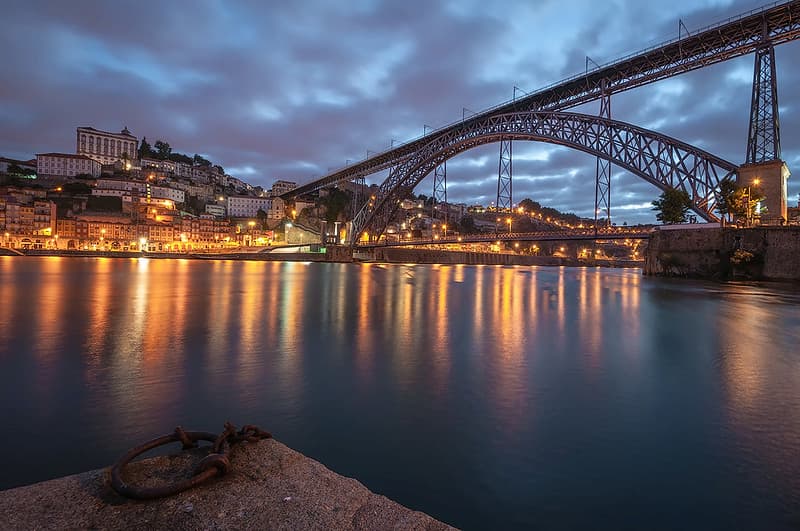
The Historic Centre of Oporto, Luiz I Bridge and Monastery of Serra do Pilar is a world-renowned ensemble in northern Portugal that encapsulates over two millennia of urban history. Spilling down the steep granite hills toward the mouth of the Douro River, the site is a breathtaking “staircase” of red-tiled roofs, narrow medieval alleys, and monumental baroque churches.
The site is composed of three interconnected elements that form a singular cultural landscape:
- The Historic Centre (Porto): This is the heart of the city, centered around the Ribeira district. It features a medieval urban fabric of winding streets that evolved from Roman origins (Portus Cale). Key landmarks include the Sé (Cathedral), the 14th-century Fernandine Walls, and the opulent Palácio da Bolsa (Stock Exchange Palace).
- Luiz I Bridge: An architectural marvel and a symbol of the city. Completed in 1886 by Théophile Seyrig (a student of Gustave Eiffel), this double-deck iron arch bridge connects Porto with Vila Nova de Gaia. Its upper deck serves the Metro and pedestrians, while the lower deck is for vehicles and walkers.
- Monastery of Serra do Pilar: Perched on a high outcrop in Vila Nova de Gaia, this 16th-century former monastery is unique for its circular church and cloister, a design rarity in Europe. It offers the most iconic panoramic view of the entire UNESCO site.
Attraction
Porto attracts millions annually because it feels “authentic” and “lived-in” compared to more sterile European capitals.
- Port Wine Culture: The city is the namesake of Port wine. While the grapes grow in the Douro Valley, the wine is aged in the massive caves (cellars) of Vila Nova de Gaia, where tourists flock for tastings.
- Visual Drama: The sheer verticality of the city—colorful houses stacked on top of each other along the riverfront—creates a stunning backdrop for photography and “slow travel.”
- Gastronomy: From the legendary Francesinha sandwich to fresh Atlantic seafood and the local tradition of tripas (tripe), Porto is a top-tier destination for foodies.
- Literary & Art Scenes: The Livraria Lello, often cited as one of the world’s most beautiful bookstores, and the vibrant azulejos (blue ceramic tiles) found at São Bento Station, provide a unique aesthetic charm.

Heritage
The site was inscribed on the UNESCO World Heritage List in 1996.
- Criterion (iv): It is an outstanding example of a European urban ensemble that has grown continuously over 1,000 years, looking outward toward the sea for its commercial and cultural links.
- The designation acknowledges how the city successfully integrated medieval, Renaissance, Baroque, and Neoclassical styles into a cohesive, functional landscape that remains an active social and institutional center today.
Gateway
- City: Porto serves as the primary gateway.
- Airport: Francisco Sá Carneiro Airport (OPO) is located just 11 km from the city center. It is a major international hub with direct flights from North America, Europe, and the Middle East.
- Lodging: Porto offers a vast array of accommodations, from high-end heritage hotels in the Aliados district to charming riverside guesthouses in Ribeira and luxury wine-themed resorts in Vila Nova de Gaia.
When
- Late Spring (May to June): The weather is mild, and the city is vibrant. June 23–24 is the Festa de São João, Porto’s biggest festival, featuring street parties, fireworks, and the tradition of hitting people on the head with plastic hammers.
- Autumn (September to October): This is the harvest season in the nearby Douro Valley. The weather remains warm, the summer crowds have thinned, and it is the best time for wine enthusiasts.
- Winter (November to February): While rainy, it is the quietest and most affordable time to visit, though the Atlantic winds can be quite brisk.

Consideration
- The Terrain: Porto is extremely hilly. Exploring the Historic Centre requires significant walking on steep, uneven cobblestones. Proper footwear is essential.
- Transportation: The Andante Card is the best way to navigate the Metro, buses, and the funicular. Note that driving inside the Historic Centre is highly discouraged due to narrow streets and limited parking.
- Microclimates: Even on a sunny day, the breeze off the Atlantic can be cold. Carry a light jacket even in summer.
- The Bridge Walk: Crossing the upper deck of the Luiz I Bridge is free and provides the best views, but it can be windy and is shared with the Metro trains—stay behind the designated lines.

Resources
- UNESCO World Heritage – Porto: The official repository for the site’s history, maps, and conservation status.
- Visit Porto & North: The official regional tourism portal with updated 2026 event calendars.
- Visit Portugal – Porto: The national tourism office’s comprehensive guide.
- Lonely Planet – Porto: Expert travel advice and neighborhood breakdowns.
- GetYourGuide – Porto Activities: A reliable platform to book Port wine cellar tours, Douro River cruises, and guided walking tours.
Featured Image
In The News
Advertisement

Comment:
11 responses to “Historic Centre of Oporto, Luiz I Bridge and Monastery of Serra do Pilar”
-
It’s the people that makes Porto special. There’s all that history, but above all it’s the people here, they are so welcoming.
LikeLike
-
I love the bridges, especially Ponte Dom Luís I, which has two levels, one down below, the other way up above. I really like it here. Porto is small and compact, you can walk or bike everywhere. The food is good, people are friendly. I’m here to stay.
LikeLike
-
Ribeira has those old taverns, a culture of tradition, that’s characteristic of an old people. It’s got good restaurants and then there’s the river, the most beautiful part of our River Douro.
LikeLike
-
There is a miradouro, at the end of the rua São Bento da Vitoria in the center of what was once the old Jewish quarter. It’s a very old street and when you get to the end, there’s a lookout with the most gorgeous, gorgeous, special view of the old townhouses of Porto tumbling down to the riverside. From that one vantage point you can see the river, the wine houses, the barcos rabelos, and if you look to the left, you can see the cathedral and the upper town of Porto.
It’s a view that takes everybody’s breath away. And the thing that is amazing about it, and that only could exist in Porto, is that nobody has fixed it up, it’s a mess. The building next to is completely falling apart. It’s not paved, there’s garbage in certain place. That sounds awful, but it’s very Porto. You still find these secret places that are absolutely extraordinarily beautiful that no one has bothered prettying up.
LikeLike
-
The first hours of my stay in Porto left me a great impression of the city. I could admire the beauty of the city and its amazing bridges from the train or from the nice terrace where I ended up first before catching another bus to Lisbon.
LikeLike
-
I strongly recommend Porto as a fabulous city for a short break. I lived there for 5 years in the 80’s and went back a few years ago to find it had hardly changed (apart from a ghastly MacDonald’s in the city centre). Traditional Portuguese food is filling, tasty and all natural, and Porto has excellent restaurants with a strong emphasis on fish. There are the port wine caves to visit and the beautiful “Solar do Vinho do Porto” port wine lounge overlooking the Douro where you can watch the sun go down in style. Wine buffs get to try outstanding local wines that never make it out of Portugal, and at very reasonable prices, and the many varieties of cheese and sausages are well worth sampling – especially the “Queijo fresco”- fresh white cheese, and the many types of goat and sheep’s cheeses. Portugal has a sizeable Brit population and has even adopted some of our traditional habits, such as tea at 4pm (toast and butter -“torrada”, cups of tea, and has added an interesting snack of cheese eaten with a slice of quince jam -“mermelada”-). Most young people speak good English and the Portuguese are helpful and friendly. Porto is a safe city with a great nightlife- many bars and restaurants, and people walking the streets at all hours. The hilly terrain means you can walk off all the bread, potatoes, cheese and sausage! It’s easy to hire a car and explore the surrounding countryside, or take a boat trip up the Rio Douro into the picturesque interior. Best months- May, June, September and October (July and August are very hot, winter and early spring are cold and wet and hotels and houses often have little or no heating and cold tile floors). June sees the festival of Sao Joao – where people go around hitting each other with bulbs of young garlic, and there are fresh sardine BBQs in the streets. Go for it!
LikeLike
-
The impressive Dom Luís I Bridge is a Porto landmark, connecting Porto’s city centre in the North to Vila Nova de Gaia in the South. With construction starting in 1879, this double-deck metal bridge is of historical significance. Ways of crossing Dom Luís I Bridge include by car, foot and tram. We recommend taking a stroll upon its upper deck where there are some awesome 360-degree views to be had.
LikeLike
-
Walking around the streets of the Ribeira district made me feel like being inside a painting. Filled with colourful houses, bars, restaurants, and shops, Ribeira represents the riverside area of Porto. Don’t forget to walk around its backstreets and maybe find some time to indulge yourself with a short river cruise.
LikeLike
-
Many of the city’s architectural treasures are free to enjoy. Sao Bento Railway Station, Igreja do Carmo, and Church of Saint Ildefonso (among others) are notable for their stunning blue-and-white tile murals. Narrow streets are lined with colorful apartment buildings stacked up like Legos. Decorative Art Nouveau facades add an air of whimsy beside stolid Gothic church spires. Even derelict structures add charm, particularly those covered in street art. Porto’s many attractions are spread across steep hills, but easy to access thanks to efficient tram service. Take a ride in one of the vintage cars and feel yourself transported back to the turn of the 19th century.
LikeLike
-
There was something quite special about this city. When I climbed to the top of the hill where the Cathedral is located and overlooked the red roofs of the old crumbling buildings, I instantly felt there are few sides to Porto; The Porto of the top-level, with the old churches and the bell towers and the one of the low-level, with the residential colorful buildings.
Although it is not an island, walking along the Riberia of Porto, which is one of the oldest parts of the city, might give you the feeling you are on one. The river front and the dotted ships on the Douro river are really close. Porto DOES have all the right ingredients for a perfect long weekend or a short vacation in Europe; Its gastronomy is a mirror of its cultural diversity and there are a lot of great chefs’ oriented restaurants in the city.
LikeLike
-
Whether gazing towards the heavens on a riverfront stroll, taking late-afternoon photos from the water and across the river on Vila Nova de Gaia’s promenade, or winding your way up a medieval alleyways with their shops, bars and residential doorways, you’ll be enchanted by the colours of Porto’s Old Town.
The palette of vibrant hues stretches from traders’ riverside homes and the barcos rabelos moored beside the Praca de Ribeira to the grand buildings of the sloping Avenida dos Aliados and the “Shopping Central” pedestrian mall on Rua Santa Catarina to the breadth of colourful blooms in the Crystal Palace Gardens.
Streets such as Galeria de Paris and its parallel Candido Reis (also known for their nightlife) offer up intriguing vintage clothing and old records, handmade souvenirs and other curiosities. A trip up Torre dos Clerigos – the bell tower adjoining the 18th century Clerigos Church – in the Carmo neighborhood and visit to the gothic twin-towered Se Cathedral are both highly recommended.
A walk around the Crystal Palace gardens offers a welcome break from the tourist mecca below and the late afternoon photo opportunities are spectacular. While the Crystal Palace is long gone ( torn down in 1956), the domed sport, entertainment and events centre remains a drawcard.
It was gearing up for a pop concert on the day we visited so the sound check provided a musical backdrop to our stroll. The flowers in summer bloom, regal peacock inhabitants and expansive views of the Douro was worth an hour-long sidetrack before heading down through the spider’s web of suburban Porto alleyways back to the riverfront for a short stroll back to our accommodation.
LikeLike

 All About World Heritage Sites (...and more)
.jpg)
Leave a comment