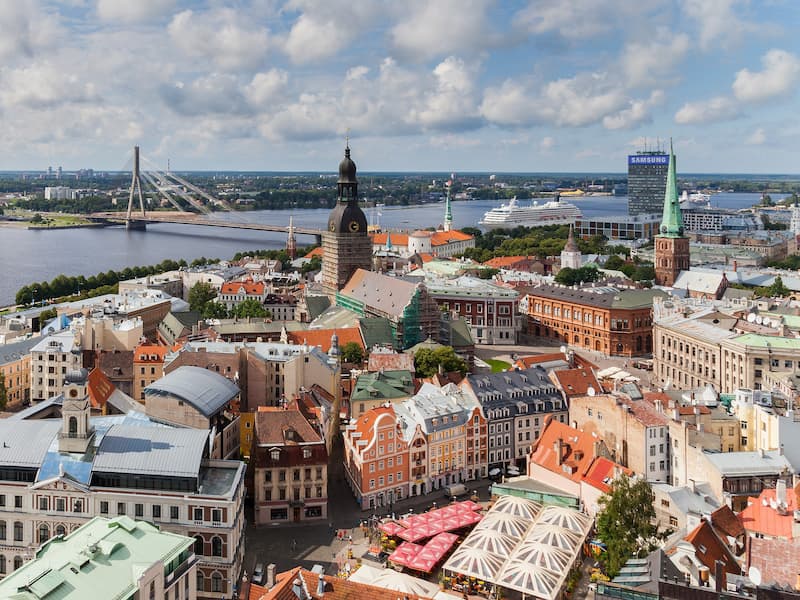
The Historic Centre of Riga, the capital of Latvia, is a mesmerizing architectural tapestry that narrates the evolution of a Baltic powerhouse. It is a city where narrow medieval lanes open up into grand boulevards lined with some of the world’s most elaborate Art Nouveau facades.
The site is essentially composed of three distinct yet harmoniously integrated urban landscapes:
- Vee-Rīga (Old Riga): The medieval heart, characterized by its labyrinthine cobblestone streets, towering Gothic church spires, and 15th-century dwellings like the “Three Brothers.” It reflects the city’s history as a wealthy Hanseatic trading port.
- The Boulevard Circle: A semi-circle of 19th-century parks and grand public buildings that replaced the city’s ancient fortification walls.
- The Art Nouveau District: Known as the “Quiet Centre,” this area contains one of the highest concentrations of Jugendstil (Art Nouveau) architecture in the world. Over 800 buildings feature intricate stone carvings of mythical beasts, ornate flowers, and stoic human faces.
- Wooden Architecture: Scattered throughout the buffer zone are unique 19th-century wooden structures, a rare surviving heritage that adds a rustic, historical layer to the city’s stone-dominated skyline.
Attraction
Riga attracts travelers globally for its unique “bridge” status—it feels like a meeting point between Northern, Western, and Eastern Europe.
- Architectural Diversity: Tourists visit specifically to walk Alberta iela and Elizabetes iela, streets that serve as a virtual gallery of Art Nouveau masterpieces.
- Panoramic Views: The spire of St. Peter’s Church offers the definitive 360-degree view of the city’s red-tiled roofs and the Daugava River.
- The Central Market: Housed in five massive Zeppelin hangars from the 1920s, it is one of Europe’s largest and most vibrant food markets, offering a sensory immersion into Latvian culinary life.
- Cultural Hub: Riga is the cultural heart of the Baltics, hosting world-class opera, ballet, and choral festivals that draw enthusiasts from every continent.

Heritage
The Historic Centre of Riga was inscribed on the UNESCO World Heritage List in 1997.
- Criterion (i): UNESCO recognizes the city as a “unique artistic achievement,” specifically noting that its collection of Art Nouveau architecture is “unparalleled anywhere in the world.”
- Criterion (ii): Riga has played a significant role in the Baltic region, influencing the development of architecture, sculpture, and garden design over several centuries.
- Other Accolades: Beyond being a World Heritage Site, Riga was the European Capital of Culture in 2014. Additionally, the “Baltic Way” documents (the 1989 human chain across the Baltics) are included in the UNESCO Memory of the World Register, with Riga as a primary location for that historic event.
Gateway
- Gateway City: Riga itself serves as the gateway to the historic centre.
- Commercial Airport: Riga International Airport (RIX) is the largest airport in the Baltic States, serving as a major hub for AirBaltic with direct connections to most European capitals and several Middle Eastern cities.
- Lodging: The city offers thousands of options, from boutique hotels housed in medieval merchant homes in the Old Town to modern 5-star luxury brands along the park boulevards.
When
- Summer (June to August): This is the peak season. The “White Nights” bring nearly 20 hours of daylight, and the sidewalk cafés are in full swing. Temperatures are pleasant, ranging from 18°C to 25°C.
- The Christmas Season (December): Riga claims to be the home of the world’s first decorated Christmas tree (1510). The Old Town Christmas markets are magical, featuring mulled wine, roasted almonds, and snow-dusted Gothic spires.
- Autumn (September to October): A beautiful time to visit as the “green belt” parks turn vibrant shades of gold and amber, though the weather becomes increasingly damp.

Consideration
- Safety & Scams: While generally safe, travelers should be cautious in the “Quiet Centre” bars at night. There have been reports of “drink scams” where tourists are overcharged significantly. Always check the price before ordering.
- Footwear: The Old Town is almost entirely cobblestone. High heels or thin-soled shoes are not recommended for a full day of walking.
- Language: Latvian is the official language, but English is very widely spoken by the younger generation and those in the tourism industry. Russian is also common among older residents.
- Currency: Latvia uses the Euro (€). It is a highly digitized society; contactless card payments are accepted almost everywhere, including at small market stalls.
- Climate: Even in summer, the weather can be “Baltic”—unpredictable and windy. Always carry a light, waterproof layer.

Resources
- UNESCO World Heritage Centre – Riga: The official source for the historical criteria and conservation maps of the site.
- LiveRiga: The official tourism portal for the city, featuring event calendars and local guides.
- Latvia Travel – Riga: The national tourism office’s deep-dive into the capital’s attractions.
- Art Nouveau Center of Riga: A specialized site focused on the Art Nouveau museum and the city’s architectural gems.
- The Roaming Renegades – Guide to Riga: A detailed travel blog that provides practical itineraries and links to accommodation and tour bookings.
Featured Image
The Old Town of Riga (Diego Delso, Wikipedia/CC BY-SA 3.0).
In The News
Advertisement

Comment:
3 responses to “Historic Centre of Riga”
-
Riga’s medieval core on the right bank of the Daugava river is where you’d love to get lost in. With a skyline dominated by church and cathedral towers, head to the top of St. Peter’s Church for a bird-eye view of the capital. It’s also a lesson in architectural styles — while it followed the style of Gothic architecture during the Middle Ages, it has since been remodeled twice to reflect Romanesque and Baroque features. Maza Pils street is home to the oldest medieval houses in Riga, affectionately known as The Three Brothers, standing since 1490. Photo opportunities are abound at the Swedish Gate, the only remaining entrance to Old Riga, as well as the Bremen Town Musicians, where you can rub the structures of the Brothers Grimm fairytale characters for good luck.
LikeLike
-
Riga a damn cool city. It has an old town with winding, cobbled streets, and outside that the newer-but-still-old town is reminiscent of the Pest side of Budapest. It has a good mix of old world charm and Euro city grit.
LikeLike
-
Riga’s most gorgeous ’hood is its art nouveau district in and around Alberta iela (Albert Street). This spectacular concentration of some 800 elaborately decorated buildings was built from 1896 to 1913, when Riga was booming. The local tourist office offers a great self-guided walking tour of the area, but the best place to start is at the Riga Art Nouveau Museum, which is housed in an apartment where one of Latvia’s best architects of the period, Konstantīns Peksens, once lived. Peksenss designed over 250 art nouveau buildings in Riga, including this spectacularly beautiful building. Another stunner is the Peitav Shul, which is the city’s last surviving synagogue after the city’s Jewish community was decimated by the Nazis.
LikeLike

 All About World Heritage Sites (...and more)


.JPG)
Leave a reply to James Cancel reply